
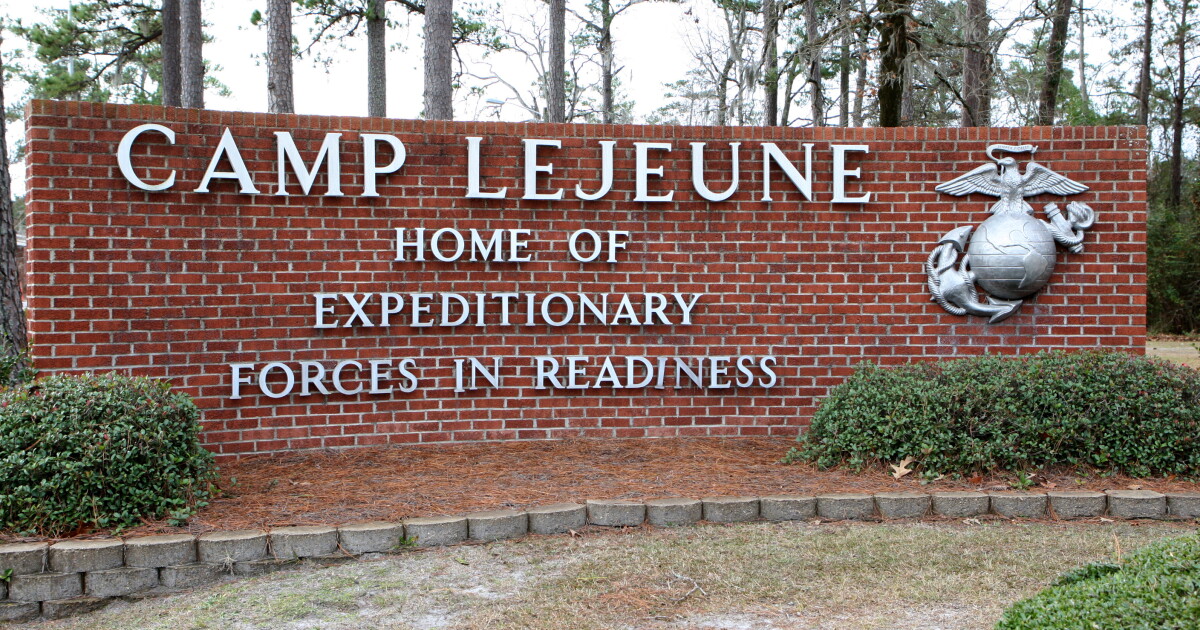
More than 408,000 Americans — Marines, their families, and civilian workers — filed claims seeking justice for toxic water exposure at Camp Lejeune, one of the largest public health disasters in U.S. military history. But years after Congress opened a legal path to compensation, procedural barriers and a mounting documentation backlog are leaving many victims without answers.
The federal court overseeing the Camp Lejeune Justice Act litigation has dismissed a legal challenge by six claimants who argued the U.S. Department of Justice was miscalculating their settlement offers. At the same time, a newly released joint status report reveals that more than three-quarters of the claims reviewed so far do not have enough documentation to qualify for the government’s fast-track settlement program.
What Happened at Camp Lejeune — and Why It Matters Now
From the 1950s through the 1980s, the drinking water at Marine Corps Base Camp Lejeune in North Carolina was contaminated with dangerous industrial solvents, including trichloroethylene and tetrachloroethylene. The CDC found that more than one million people may have been exposed. Sick veterans, grieving families, and civilian employees spent decades fighting for recognition before Congress passed the Camp Lejeune Justice Act in 2022, finally giving victims a legal avenue to seek damages. Today, more than 408,500 administrative claims have been filed, with thousands now moving into federal court.
The Settlement Dispute: What Claimants Are Arguing
To speed up compensation, the government created what it calls an Elective Option (EO) settlement program — a streamlined process designed to resolve qualifying claims faster than a full trial. But attorney James Foster of Fob & Foster, who represents more than 700 claimants, says the process isn’t working fairly for some of his clients.
Foster filed motions on behalf of six clients who argued the government either denied them an EO settlement or offered less than they deserved based on federal time-in-service and exposure records. He brought the challenge to federal court — and the court rejected it, not on the merits of whether the math was wrong, but on procedural grounds.
Chief Judge Richard Myers denied one of Foster’s motions on October 1, ruling that the plaintiff had not shown “good cause” to pursue the challenge in an individual case. Under the litigation’s case-management rules, issues affecting large numbers of plaintiffs must go through the Master Docket via the Plaintiff’s Leadership Group — a designated set of attorneys with special access and authority in the case.
Foster described the outcome this way:
“He did not deny it on the merits, he just denied it basically on procedural grounds, saying the Plaintiff’s Leadership Group would need to approve it in order for it to be considered. The other two judges, Judge Boyle and Judge Dever, both denied it as well. Just very vague orders, neither one of them really got into the merits. Judge Dever said that the government can basically administrate its settlement program however it wants.”
With the court’s refusals in hand and a September 27 deadline now passed, those specific settlement opportunities have permanently expired. Three of Foster’s clients would have accepted corrected offers, he says, but the DOJ declined to acknowledge or fix what he characterized as clear accounting errors.
“None of the clients wanted to take the offers that were incorrect,” Foster explained. “Ultimately, three of the four would have agreed to have taken the actual correct numbers that they were entitled to, but the Department of Justice would not agree to acknowledge the error that was made or correct the numbers. So those are gone.”
A Two-Tiered System: Who Gets Access to the Evidence?
At the center of the dispute is a troubling access gap: the evidence needed to verify claimants’ eligibility for settlements is largely unavailable to attorneys outside the inner circle of the Plaintiff’s Leadership Group.
Foster says the Department of Justice can pull federal agency records — including VA files — at will, while private attorneys like him face significant hurdles getting the same information:
“The Department of Justice has unfettered access to that database, and the VA person I spoke with told me that when the DOJ calls, they just give them whatever records that they ask for because they’re a federal agency. But we cannot get them without actually representing them in a VA claim. So, I would have to, on top of my 700 Camp Lejeune Justice Act claims, I would have to be representing these people in their VA claims, which they may already have a VA attorney assisting them or they may not want me to assist them, right?”
Private attorneys are also blocked from accessing “muster rolls” — historical Marine Corps personnel logs that establish where and when a service member was stationed at Camp Lejeune. These records are critical to proving eligibility for settlement. Foster says they are available to the Plaintiff’s Leadership Group but not to outside lawyers like himself, even for their own clients.
“The Plaintiff’s Leadership Group has access to that, but the non-Plaintiff’s Leadership Group lawyers like myself do not, even for my own clients. So, I can’t use those records to evaluate these cases for EO eligibility, global settlement, or anything else.”
The Documentation Backlog
The latest joint status report paints a sobering picture of where the overall process stands. The Navy’s Camp Lejeune Claims Unit is processing approximately 408,500 administrative claims. Of those reviewed so far, the government says 75% lack sufficient documentation to qualify for an EO settlement — though officials clarify this does not mean those claims are automatically denied. Families can still submit missing documentation, such as medical diagnoses and housing records, after receiving government-issued deficiency notices.
The Plaintiff’s Leadership Group holds a database of nearly 100 million pages of digitized Marine Corps records that could help verify claims. However, the DOJ argues that the federal court does not have jurisdiction over the Navy’s administrative process or the EO program, which limits how broadly those records can be used — primarily restricting them to active lawsuits rather than the administrative claims process where most victims currently stand.
For Foster, the procedural machinery threatens to bury the human reality of what happened at Camp Lejeune:
“If I were to have asked the judge to do anything, it would be to force these attorneys to actually sit down with some of these families and the people that have been hurt and actually listen to what they have to say, because it’s some of the saddest stories that you’ll ever hear. And that’s all being lost in this… The Beirut bombing killed 220 Marines. And that’s probably one of the most famous catastrophic incidents involving Marines in this country. Well, my small law firm represents almost twice as many Marines that were killed from the toxic water than were killed in the Beirut bombing.”
Trials on the Horizon
After years of delays, some Camp Lejeune cases are finally heading into the courtroom. Following a federal court ruling that struck down requests for jury trials, these cases will proceed as bench trials — meaning judges, not juries, will evaluate the evidence and decide outcomes. These initial bellwether trials are designed to show both sides how judges weigh the strength of representative claims, and the results are expected to shape how future cases are valued and settled.
The first kidney cancer trials are scheduled to begin soon. The Frank Mousser case is set for October 26, followed by the David Fancher case on November 9. Kidney cancer cases involving Jacqueline Tukes and David Downs — who is represented by Foster — are also designated as key bellwether trials.
“We represent one of the first ones going to trial, David Downs. He’s in his 90s now,” Foster said. “He’s been waiting for this for quite a while. I think he’s excited for it to be over with, hopefully, but it’s a long time to wait. Many people have been waiting for a very long time for this.”
Foster believes the trials could push crucial facts about the contaminated water into broader public view: “Once these cases go to trial, the facts come out. All the facts about the water, the statistics, the expert testimony, it actually becomes public; more so than it has been so far at least.”
Notably, the most recent status report does not include the comprehensive settlement framework the court had requested by October — something victims and their advocates had hoped to see. For the hundreds of thousands of claimants still waiting, the fundamental question remains unanswered: will the federal government resolve these cases through a fair administrative process, or will victims be forced to wait even longer for a court to determine what their suffering is worth? Coverage of this litigation is part of an ongoing Camp Lejeune Justice Act reporting series by journalist Annette Weston. Share this story on Bluesky or LinkedIn.










Comments are closed.