Student Research Highlights Poverty Challenges in Tucson
In an effort to spotlight the pressing issues of poverty in Southern Arizona, the Poverty in Tucson Field Workshop conducted by University of Arizona students has completed its 10th annual research initiative. The findings, presented at a community gathering at Habitat for Humanity Tucson, drew attention from over 100 locals, nonprofit organizations, and civic leaders, addressing critical matters such as food insecurity, rising living costs, and transportation difficulties.
Since its inception in 2015 by the School of Sociology at the College of Social and Behavioral Sciences, this workshop has offered invaluable insights into the root causes and impacts of poverty on the regional community. The collaborative efforts in 2025, involving the School of Sociology, Habitat for Humanity Tucson, and others, contributed to a grant from the U.S. Department of Housing and Urban Development’s Choice Neighborhoods program, targeting the 29th Street Thrive Zone in Tucson.
This year, 37 students participated in gathering data through over 280 interviews with economically disadvantaged residents across Tucson and Pima County. Among these, 117 individuals were identified as living below the poverty line, with 49 experiencing extreme poverty, defined as earning less than half of the poverty threshold for their household size.
Impact of Government Shutdown on Food Security
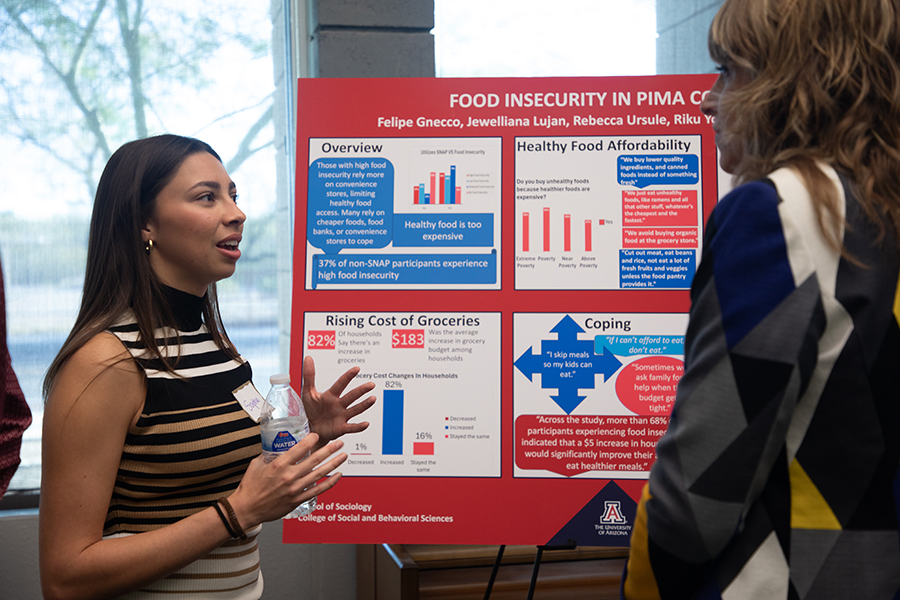
The analysis revealed that the recent government shutdown significantly exacerbated financial pressures, with 55% of the respondents relying on SNAP (Supplemental Nutrition Assistance Program), and 72% fearing loss of health insurance. Meanwhile, 82% faced escalating grocery prices.
Food insecurity remains a significant concern, intensified by disruptions in SNAP benefits. “The 2025 workshop was only two weeks into our data collection when the federal government shutdown led to the disruption of essential social services, including SNAP,” noted Brian Mayer, a sociology professor and director of the Tucson Poverty Project. “For the households we interviewed, this was both a major source of stress and anxiety as well as a direct impact on their ability to put food on the table. Rising food prices added to that pressure, with 82% reporting higher grocery costs over the past year.”
Political science major Rebecca Ursule and her classmate Sophia Hartel discovered that transportation barriers hinder access to food resources for many residents. “One recommendation I think could help is using mobile markets,” suggested Ursule. “We have to bring resources to those who need them most.”
Housing Costs and Health Coverage Worries
Affordable housing persists as a major challenge for Tucson’s low-income population, with 76% of those surveyed experiencing a severe housing cost burden, spending over half their income on rent. “We focused on housing instability and found that people living in poverty in Tucson, about 76%, were severely housing cost burdened,” reported Helene Roquebert, a student majoring in philosophy, politics, economics, and law.
Contributing factors include rent hikes, evictions, and unsafe housing conditions. Emergency rental assistance and home repair grants were recommended as interim solutions, while closing wage gaps was emphasized for lasting stability. “About 40% reported living in homes that were too hot during Tucson summers, leading some to turn off air conditioning to save money,” Roquebert said. “Higher wages would definitely help families better afford housing, groceries, and health care.”
Transportation Challenges Enhance Vulnerability
Transportation issues significantly affect access to essential services, with students Alyssa Esquero and Ava Laphen identifying safety concerns, poor road conditions, and limited transit accessibility as key obstacles. “People who live in poverty, 78% of them, ride the bus regularly, and they are vulnerable,” Esquero explained. “Our data show that 60% of those people also do not prefer to walk because of safety issues like crime,” Laphen added. “This is a statistic we should be focusing on.”
Informing Policy Through Community Voices
The research conducted by the students provides a foundation for policy development, rooted in the experiences of those directly impacted by poverty. The workshop showcases the value of experiential learning, offering both educational growth for students and practical benefits for the community.
“Meeting people where they are at is key,” said Ursule, reflecting on her experience. Tucson Mayor Regina Romero acknowledged the impact of the workshop on local policy, stating, “Based on previous research and input from Dr. Mayer and his students, we passed the Prosperity Initiative in the city of Tucson under mayoral and council leadership.” Romero praised the initiative for its practical approach, emphasizing that it goes beyond research to propose actionable, evidence-based solutions.
Read More Here