Understanding how life begins anew after major natural events is a fascinating domain of study. While much is known about nature’s ability to recover from disasters, the mechanisms through which life first occupies new areas remain elusive. A groundbreaking study led by scientists from the University of Arizona is shedding light on these initial colonization processes.
The research team focused on Iceland’s Fagradalsfjall volcano, which erupted three times between 2021 and 2023. These eruptions provided a unique opportunity to study how life begins in entirely new environments, as each eruption laid down fresh lava, sometimes even covering previous flows.
On March 23, 2021, glowing lava is seen oozing from Iceland’s Fagradalsfjall volcano during one of its repeated eruptions over the course of the 3-year study period.
“The lava coming out of the ground is over 2,000 degrees Fahrenheit, so obviously it is completely sterile,” noted Nathan Hadland, a doctoral student at the University of Arizona’s Lunar and Planetary Laboratory and lead author of a paper published in Nature Communications Biology. “It’s a clean slate that essentially provides a natural laboratory to understand how microbes are colonizing it.”
To explore this phenomenon, Hadland and his colleagues collected samples from various sources including newly cooled lava, rainwater, and airborne particles. They also gathered soil and rock samples from nearby areas for comparison.
The team extracted DNA from these samples to identify which organisms were present and how they managed to establish themselves in such a harsh environment. Despite Iceland’s precipitation, the freshly cooled lava offers minimal water and nutrients, presenting significant challenges for life.
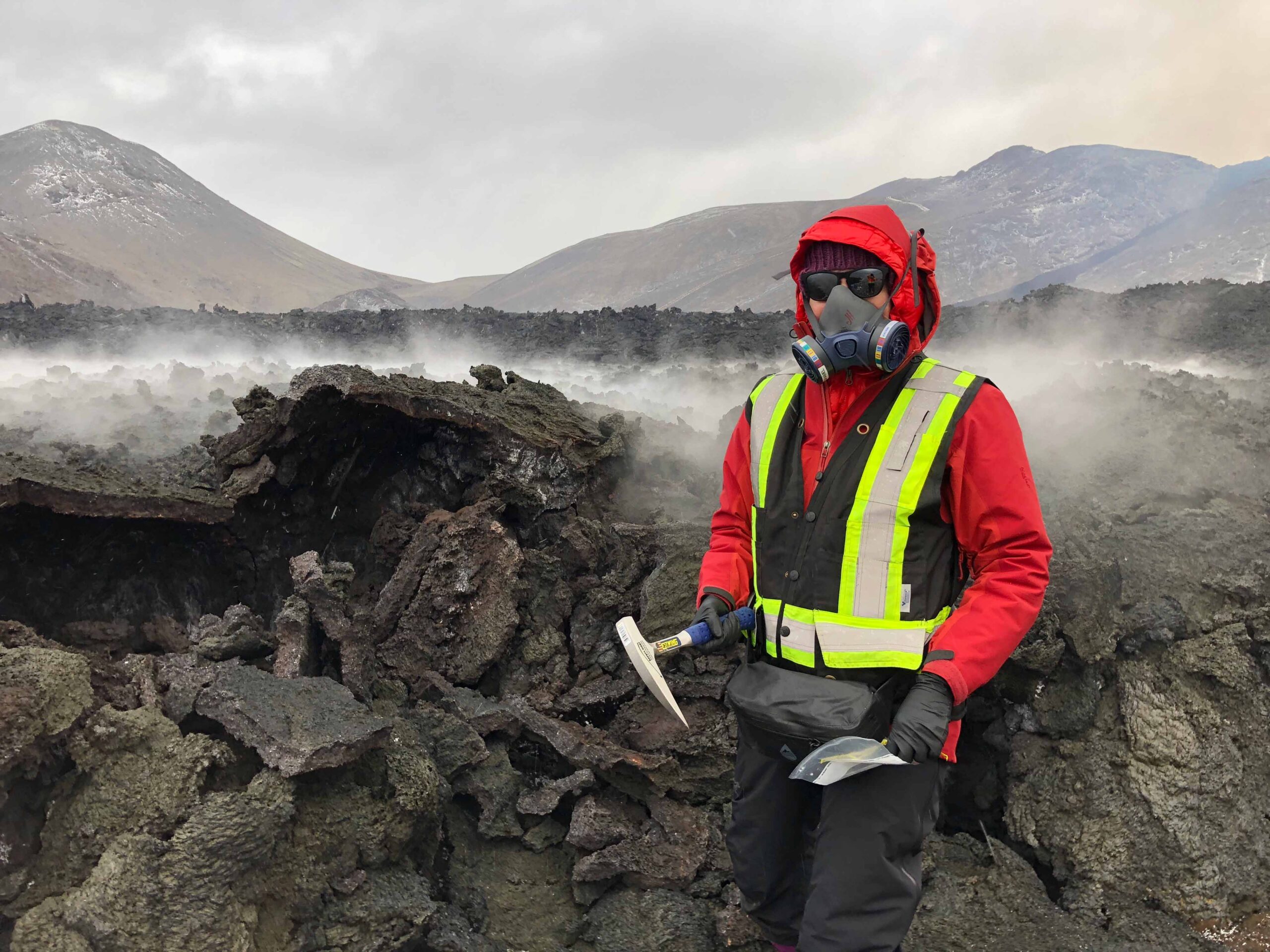
Solange Duhamel climbs onto a freshly cooled lava flow to collect samples.
“These lava flows are among the lowest biomass environments on Earth,” said co-author Solange Duhamel, associate professor at the University of Arizona’s Department of Molecular and Cellular Biology. “They are comparable to Antarctica or the Atacama Desert in Chile, which is not that surprising considering they start out as a blank slate. But our samples revealed that single-celled organisms are colonizing them pretty quickly.”
Initially, biodiversity increased during the first year after an eruption but decreased following the first winter, likely due to environmental changes selecting for resilient species. Over time, the microbial community stabilized as it adapted to the challenging conditions.
Tough Microbial Pioneers
“It appears that the first colonizers are these ‘badass’ microbes, for lack of a better term, the ones that can survive these initial conditions,” Hadland remarked. The study showed that microbes gradually introduced from rainwater and nearby regions contributed to the developing ecosystem.
Nathan Hadland collects rock samples from a fresh lava flow.
“Early on, it appears colonizers are mostly coming from soil that is blown onto the lava surface, as well as aerosols being deposited,” Hadland explained. “But later, after that winter shift in diversity we observed, we see most of the microbes are coming from rainwater, and that’s a pretty interesting result.”
Rainwater, carrying microbes from the atmosphere, plays a crucial role in shaping these communities, as it provides a mechanism for introducing life to sterile environments. This insight underscores the potential for microbes to influence broader environmental and climatic processes.
“Seeing this huge shift after the winter was pretty amazing,” Duhamel commented, “and the fact that it was so replicable and consistent over the three different eruptions – we were not expecting that.”
This research marks a significant advancement in understanding primary microbial succession, as prior studies primarily focused on plants and animals recolonizing disturbed habitats. The team’s ability to sample fresh lava shortly after each eruption allowed them to capture the initial stages of microbial colonization with unprecedented clarity.
Implications Beyond Earth
The findings have implications beyond Earth, particularly in understanding potential habitability on Mars. As Duhamel explained, much of Mars’s surface is basaltic like Earth’s, with volcanic processes creating conditions that might support life.
“Volcanic activity injects a lot of heat into the system, and it releases volatile gases, it can melt frozen water beneath the surface,” Duhamel explained. “We can observe these widespread, large volcanic terrains on Mars with remote sensing, and so the idea is that past volcanic eruptions could have created transient periods of habitability.”
This research provides a foundation for exploring how life might arise in extraterrestrial environments, offering insights into the mechanisms of microbial colonization and their potential roles in planetary habitability.
Co-authors on the paper include Christopher Hamilton of the University of Arizona and Snædís Björnsdóttir from the University of Iceland. The study was supported by various institutions, including the National Science Foundation and the Arizona Astrobiology Center.
Read More Here