The quest to understand the universe has led to groundbreaking discoveries, and one of the latest findings could provide crucial insights into cosmic evolution. Recent research highlights the formidable role of supermassive black holes in shaping galaxies, especially during the universe’s infancy.
The Discovery of Powerful Galactic Winds
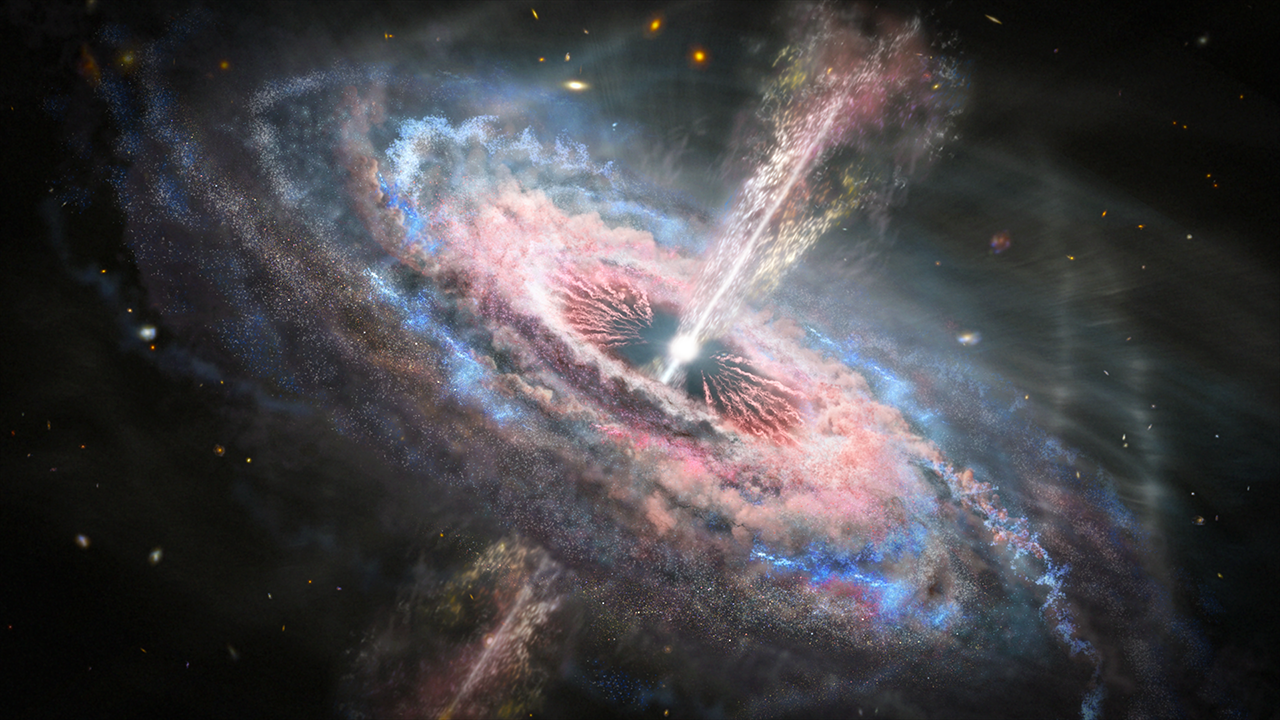
A study conducted by scientists from the University of Arizona, led by Weizhe Liu and Xiaohui Fan, reveals the presence of extraordinary galactic winds emanating from quasars just a billion years post-Big Bang. These quasars, located at the heart of distant galaxies, are known for their immense energy output, often outshining all other celestial bodies in their vicinity.
Quasars and Their Impact on Star Formation
One of the perplexing puzzles in cosmology has been the early cessation of star formation in some young galaxies. “Many of those galaxies looked ‘old’ in the sense that they had stopped forming stars long before it would be expected,” stated Liu, the study’s lead author. This phenomenon, known as “quenching,” might be explained by the intense outflows from quasars, which sweep away the gas necessary for star formation, as suggested by cosmological simulations.
Findings from the James Webb Space Telescope
The team utilized the James Webb Space Telescope to explore quasars in the high-redshift universe, focusing on 27 objects from a billion years after the Big Bang. Among these, six displayed exceptionally swift winds, reaching speeds up to 5,000 miles per second. This indicates that such extreme quasars were more prevalent in the early universe, with their kinetic energy outflow rates significantly higher than those of their lower-redshift counterparts.
Implications for Galactic Evolution
According to Fan, “In other words, quasars with extreme outflows were much more common in the early universe and became scarcer over time, which is surprising.” The study posits that these “super quasars” likely contributed to the premature halting of star formation in many early galaxies.
Unlike the particle jets previously believed to expel gas, these outflows act like stellar winds, potentially driven by radiation pressure from the quasar’s brightness. Fan elaborated, “Those jets move at speeds close to the speed of light. They essentially just punch a narrow hole into the galaxy. In contrast, the outflows we are talking about here are more like stellar wind.”
The Broader Influence of Galactic Winds
Liu’s team estimates that these intense outflows are short-lived, existing for only about 100 million years, yet capable of expelling significant amounts of gas—equivalent to thousands of solar masses annually—from their galaxies. “That is a very high rate of mass loss,” Liu noted, emphasizing the rapid depletion of a galaxy’s gas over a relatively brief period.
Remarkably, these galactic winds might extend beyond their host galaxies, impacting the intergalactic medium. “In other words, these quasars could affect not only their host galaxies, but beyond, with their effects felt possibly hundreds of thousands of light-years away,” Liu explained.
Connecting Black Holes and Galaxies
These findings bridge a gap in understanding the relationship between supermassive black holes and galaxies. As Fan put it, “These winds are a direct result of the black hole growing by accreting mass, and later, when the black hole stops growing, the winds subside as well.”
Early galaxies, characterized by their compact, “gassier,” and “clumpier” nature, were more susceptible to the influence of quasars. Liu concluded, “It is much easier for a quasar to interact with the gas around it if the gas is denser and distributed all around it rather than confined to a thin disk,” suggesting that the structural features of these galaxies facilitated more efficient gas expulsion by quasars.
Read More Here