Pitt Sets the Stage for a Virtual Transformation with AI-Driven Campus Initiatives
The University of Pittsburgh is poised to embark on a groundbreaking journey, as it unveils plans to transition to a fully online “meta-experience” campus. This visionary step, announced on March 28 by the university’s newly appointed AI chancellor, Sham Faultman, aims to cement Pitt’s status as a hub for artificial intelligence innovation. The ambitious initiative envisions transforming the entire university, including students and their avatars, into AI by 2030.
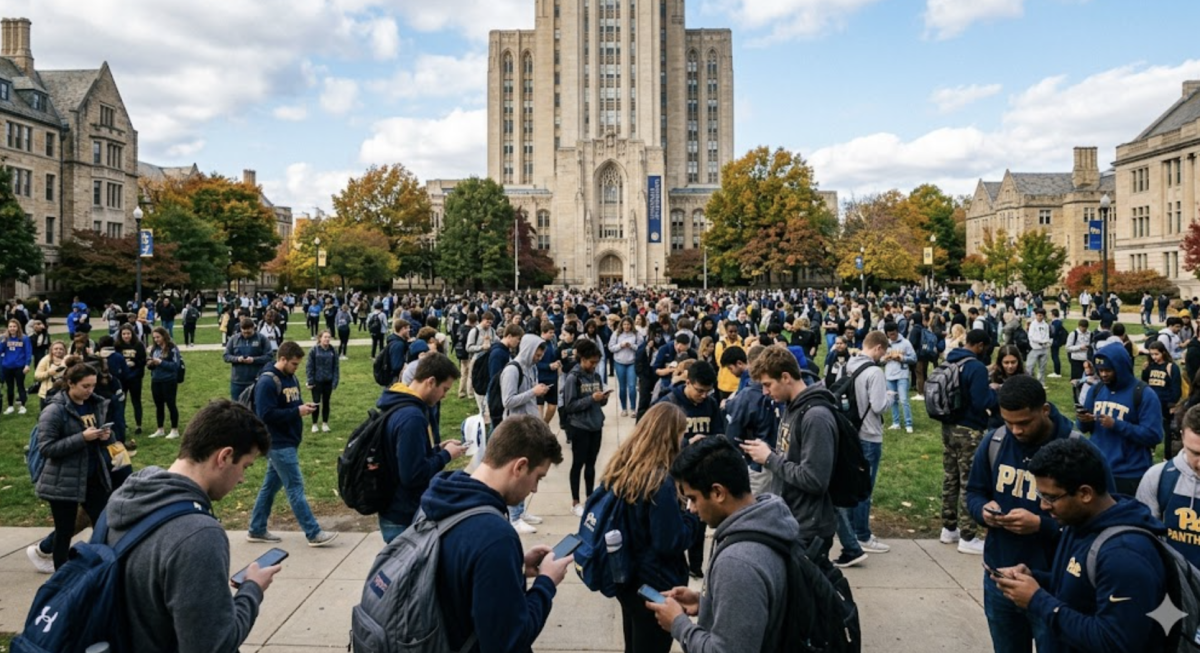
In a bid to foster innovation, the new AI campus will replace existing campus landmarks with digital counterparts, such as the “Cath-E-Dral of Computing” and the “Data Center for Creativity.” Faultman, who led a six-month beta testing phase, emphasized the thorough examination of the project’s potential benefits and challenges. “We’re really looking forward to this next chapter in the story we’re writing concerning AI and Pitt’s future as a leader in this industry,” he stated. “From lectures to the dining hall, future students’ entire experience at the University will be automated to promote efficiency and career-readiness.”
The initiative includes an avatar system designed to replace students’ physical presence on campus. Utilizing Flarb-Geevooo’s LLM, known as “Jessie,” the system allows for over one billion customization combinations. These avatars can be tailored to reflect students’ personal aesthetics. Faultman highlighted the program’s potential for self-expression: “They’ll be piloting our avatar customization program on Pitt’s campus, allowing students to really express themselves to their fullest extent. Be who you want to be with your avatar and explore campus in the way you feel so confident, all from the comfort of your phone.”
The ambitious $2 billion project is substantially funded by Flarb-Geevooo, an AI startup from San Francisco that Faultman helped establish. Janine Robertson, a spokesperson for the company, expressed enthusiasm about the collaboration, noting its significance for Pittsburgh’s educational landscape. “It means a lot for us to begin this project in the Steel City, where manufacturing found its rhythm in the 19th and 20th centuries,” Robertson said. “To help usher in the next wave of manufacturing here and give Pitt students the chance to be ahead of the curve — it’s nothing short of an honor.”
However, the budget does not account for scholarships or financial assistance to offset impending tuition hikes. In-state tuition will rise to $132,679, while out-of-state costs will reach $201,432 per semester by 2026-27. Faultman acknowledged the increase but assured that the investment would ultimately benefit students. “With this new AI-technology, you won’t even have to learn,” he remarked. “You’ll be paying for the experience of learning, the experience of going to class, without ever taking your eyes off of your phone. Your avatar will take care of your work, while you maximize what means most to you.”
Controversy surrounds the budget allocation, with 75% reportedly earmarked for Faultman’s salary. An anonymous source alleged that this allocation serves as hush money due to an affair between Faultman and Robertson. “I helped to create the budget and was there at the origins — I mean, I would go on the record saying this, but whatever. They are totally sleeping together. Who needs a $1.3 billion salary anyway? Crazy,” the source claimed.
Despite these allegations, students at a recent Pitt AI hub press conference applauded the initiative. Mart Kimpson, a junior biochemical engineer, expressed eagerness about the potential benefits for his medical career. “Man, it’s going to save me so much time,” he said. “Between Jessie, Flarb-Geevooo and the rest of my crew, I won’t get a single B in any more of my classes. I’ll get straight into med school and probably breeze through that too. One day closer to the operating room is definitely a plus for me.”
Lisa Charles, a sophomore public health major, was particularly thrilled about the avatar feature, which promises to streamline her social interactions. “If I can just use my Jessie customization to study with my friends and feed my avatar at the dining hall, I’ll have so much time to relax and get in the right headspace. In my free time, I really like to scroll on TikTok, but with the amount of schoolwork I have now, I can’t really do that anymore,” Charles said.
Codes broken:
Take responsibility for the accuracy of their work. Verify information before releasing it. Use original sources whenever possible.
Never plagiarize. Always attribute.
Identify sources clearly. The public is entitled to as much information as possible to judge the reliability and motivations of sources.
Diligently seek subjects of news coverage to allow them to respond to criticism or allegations of wrongdoing.
Provide access to source material when it is relevant and appropriate.
Read More Here