

Innovative research at Northern Arizona University is transforming the concept of waste management into a potential solution for sustainable space travel. By turning human waste into a resource for growing plants, scientists are exploring new ways to support life on other planets.
Revolutionary Composting Experiment
Jeff Meilander, a research scientist and program manager at the Pathogen and Microbiome Institute (PMI) at NAU, has been delving into composting human waste for the past five years. His work aims to enhance global sanitation, decrease water contamination, and find sustainable methods to recycle nutrients from human feces for better soil health and crop production.
In a groundbreaking experiment, Meilander collected human waste from trips along the Colorado River, combined it with Ponderosa pine wood chips, and composted the mixture at temperatures above 55 degrees Celsius for three weeks. After curing for six months, this human excrement compost (HEC) is now being tested for its potential in space exploration.
“As this project evolved, we began collaborating with Nancy Johnson, a Regents’ Professor in the School of Earth and Sustainability, and Haley Sapers and Christopher Edwards in the Department of Astronomy and Planetary Science, which expanded our focus to include the potential application of finished compost in space exploration contexts,” Meilander said. “For long-duration lunar or Mars missions, nothing can be wasted, including human waste itself. We need to create closed-loop, bioregenerative life support systems that compost human excrement and direct it back into food production.”
Simulating Extraterrestrial Agriculture
For the experiment, Meilander’s team is using regolith to mimic the soils of the Moon and Mars. They also incorporate arbuscular mycorrhizal fungi (AMF), which form beneficial partnerships with plant roots to enhance nutrient uptake.
“We have multiple conditions where we have added different combinations of sterilized and microbially active HEC and AMF to the regolith,” said Meilander. “As a result, we have successfully grown red leaf lettuce and are pretty impressed with our preliminary results.”
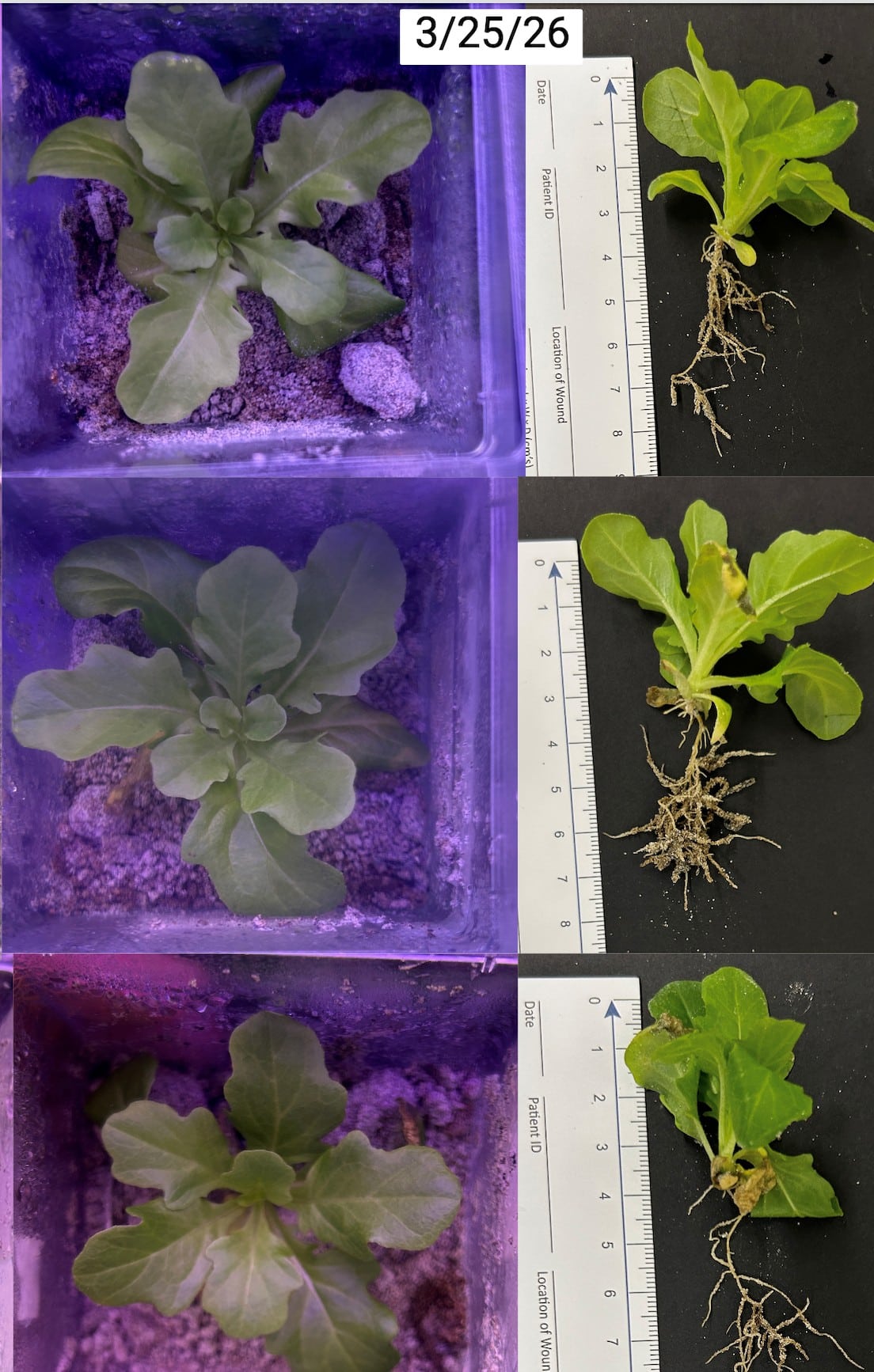 Cianna Brooks, a Flinn Scholar and Interns-2-Scholars student majoring in biomedical science and business management, plays a crucial role in the experiment by germinating seeds, creating substrate mixtures, and harvesting plants.
“I was brought right into the experimentation, and I am very excited to be part of this research,” Brooks said. “This is my first undergrad research, and I am super pumped to keep going with it. In the lab, one day I might be organizing things and another day I might have my coat and gloves on to work with soil samples.”
Future Prospects for Space Travel
The initial phase of the experiment confirmed that HEC can support plant growth. The next phase will focus on observing how microbial communities evolve over time. “Phase two will be a generational study,” stated Meilander. “We will be doing essentially the same thing as phase one but on a larger and longer scale. Once we harvest the plants, we will collect samples of the rhizosphere and substrate and then replant in the same substrate for 10 generations. We will look at the microbial communities and see how they changed over time. Since we can’t take high-quality soil to space, this research can help us determine how to effectively and efficiently amend regolith, which microbial communities we’ll need to bring with us, and how to sustainably reuse waste products in ways that improve plant growth and reduce reliance on resupply missions.”
Phase two is set to commence in the fall, followed by data analysis and publication of the findings. This pioneering research could revolutionize space exploration by transforming human waste into a sustainable food source.
Read More Here






Be First to Comment