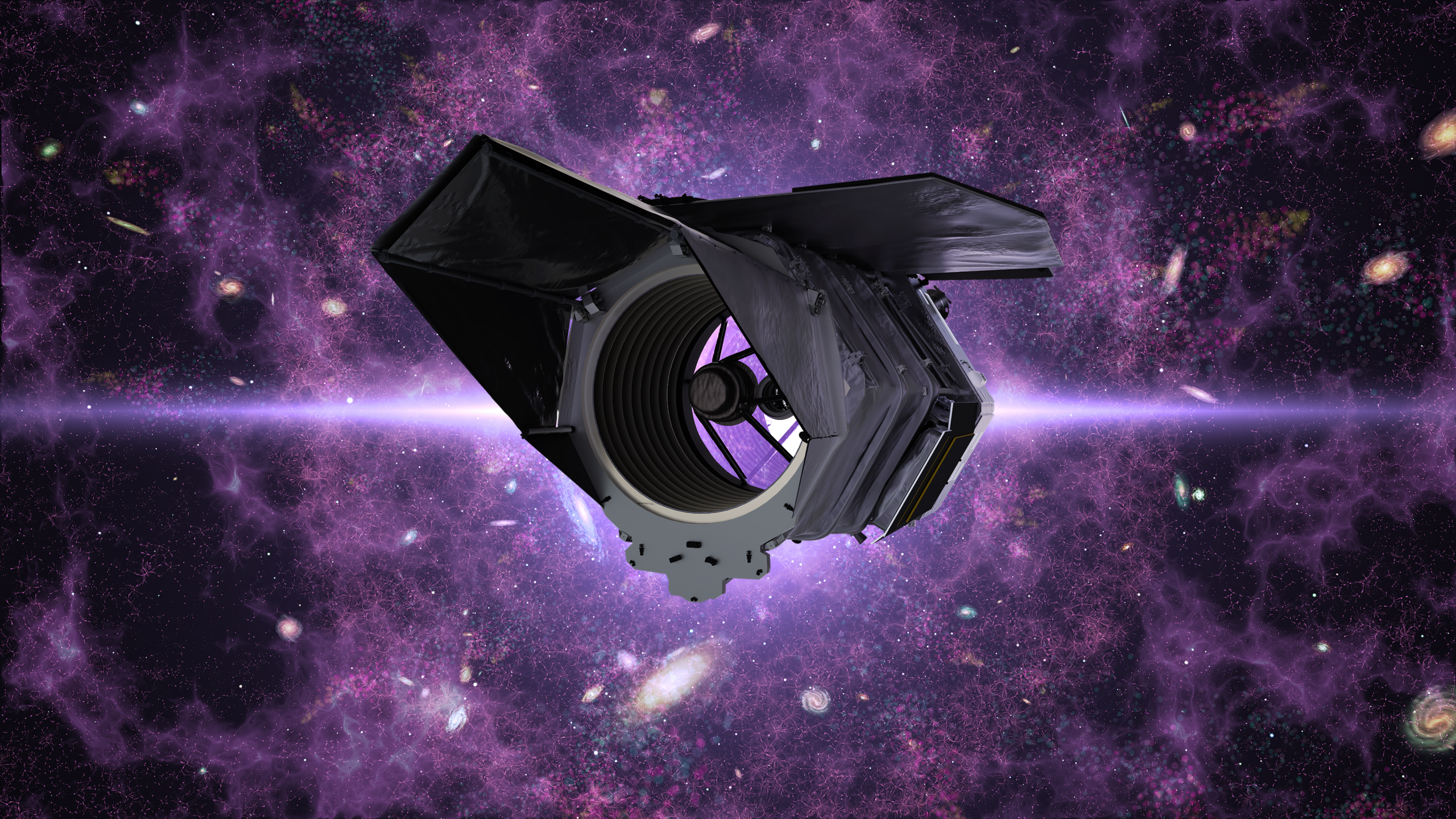
The countdown is on as excitement builds for the launch of NASA’s Nancy Grace Roman Space Telescope, set to take place in just four days from Cape Canaveral. This mission represents NASA’s next step in astrophysics following the James Webb Space Telescope. The University of Arizona’s faculty and students are among those eagerly anticipating the start of science activities, which are scheduled to commence in January 2027.
Watch the launch live Sunday morning at 7:26 am EDT/4:26 am MST on NASA Live.
While the James Webb Space Telescope was designed to observe distant objects, the Roman Space Telescope will focus on wide-field surveys, capturing vast sections of the night sky. Both telescopes are equipped to collect infrared light, allowing astronomers to compare and enhance their data. Working in tandem, these telescopes will offer unprecedented insights into the universe.
The Roman Telescope features a primary mirror measuring 7.9 feet across, comparable to the Hubble Space Telescope’s mirror, and is equipped with two instruments. The Coronagraph Instrument is designed to detect exoplanets and circumstellar disks by filtering out starlight, while the Wide Field Instrument, with sensitivity akin to Hubble’s cameras, is capable of imaging areas 100 times larger. Despite Hubble’s 30-year mission covering only 0.1% of the night sky, Roman has the potential to map the entire sky with similar resolution.
Capable of identifying rare objects and capturing images of phenomena such as dying stars and galaxy clusters, the Roman Telescope will have the University of Arizona playing a vital role in its scientific endeavors.
New techniques in cosmology
One of the primary goals of the Roman Telescope is to explore the mysteries of dark matter and dark energy, which together constitute most of the universe. Dark matter exerts gravitational influence without emitting light, while dark energy is thought to drive the universe’s accelerated expansion.
NASA has enlisted the University of Arizona’s Arizona Cosmology Lab for two key investigations related to these cosmic phenomena. Elisabeth Krause, a professor of astronomy and physics, leads the wide-field science team for “Kinematic Lensing with the Roman Space Telescope,” a project granted $2 million to develop a novel measurement method called kinematic lensing. This technique combines images and spectroscopic data to study dark matter and dark energy with unmatched precision.
The project infrastructure team “Maximizing Cosmological Science with the Roman High Latitude Imaging Survey” includes University of Arizona researchers who will play a leading role in interpreting the cosmological data. Tim Eifler, a professor of astronomy and physics, heads the working group responsible for this analysis.
By detecting nearby and distant galaxies, pinpointing their locations, and measuring specific characteristics, astronomers will create a comprehensive catalog. Utilizing this catalog, they will model the universe’s underlying physical properties. To support these efforts, Eifler’s lab received $800,000 for computing resources and an additional $2.4 million over five years for scientific work.
“This infrastructure will take us from catalogs to cosmological interpretation,” Eifler explained. “We’ll be able to do things like determine how much dark energy and dark matter are in the universe.” Eifler also co-chairs a cosmology group consisting of over 1,000 scientists worldwide.
Planetary pursuit
The Roman Telescope’s Coronagraph Instrument will utilize various masks, prisms, detectors, filters, and self-flexing mirrors to test new technologies for starlight-blocking, enabling direct imaging of planets and disks around stars.
Directly imaging planets marks a significant advancement, as most exoplanets have been discovered through indirect methods like observing dips in starlight caused by transiting planets. The Coronagraph Instrument can detect planets up to 100 million times fainter than their stars, offering performance 100 to 1,000 times better than existing space-based coronagraphs.
“It will be a crucial pathfinder for a future Habitable Worlds Observatory,” said Schuyler Wolff, an associate research professor of astronomy and the observation planning working group leader for the Coronagraph Instrument. This proposed telescope would be designed to search for signs of life in other solar systems.
The team involved in developing the instrument and planning future science includes Lunar and Planetary Laboratory director Mark Marley, associate professor of astronomy Ewan S. Douglas, Steward Observatory assistant research professor Ramya Anche, and astronomy postdoctoral research associate Justin Hom. Marley, together with LPL associate professor Ty Robinson and LPL postdoctoral research associate Zarah Brown, will use Coronagraph Instrument data to study planetary atmospheres.
Brown’s work involves modeling the climate and spectra of self-luminous giant planets, providing predictions essential for planning observations with Roman’s coronagraph. Anche’s team focuses on extrasolar-system structures, while Hom leads efforts to select the best stars for calibrating the Coronagraph Instrument and conducts precursor observations using ground-based telescopes.
The start of science
As science operations start in January, data from the Roman Telescope will become available to the scientific community. The University of Arizona will lead nine NASA-approved investigations utilizing this data, with funding exceeding $2 million. These studies will explore topics such as supermassive black holes, gravitational lenses, galaxy formation, reionization, and cosmic dust.
Read More Here