
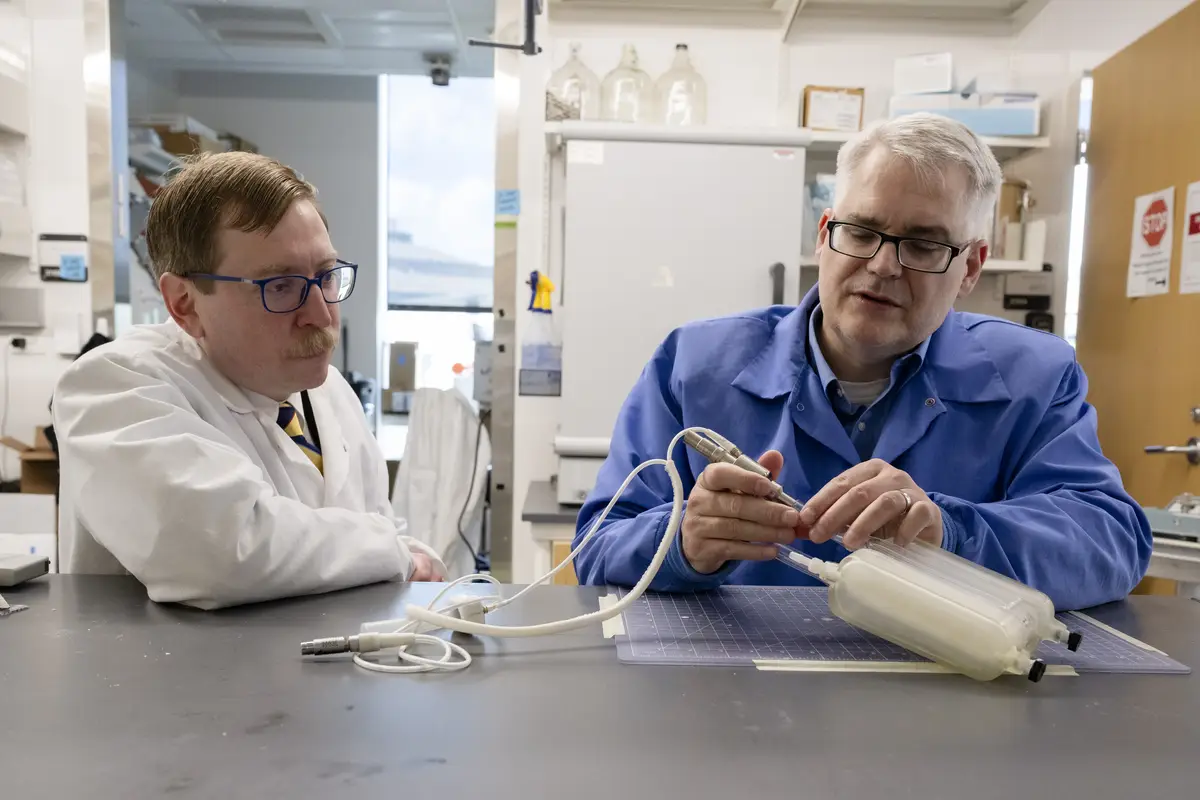
Imagine a future where patients with chronic lung disease can enjoy a significantly improved quality of life without the invasive procedures traditionally associated with lung treatment. Researchers at Carnegie Mellon University are on the cusp of making this a reality with a groundbreaking artificial lung device.
Developed by Advanced Respiratory Technologies, a Carnegie Mellon University spinoff, this innovative device promises to alter the landscape of chronic lung disease management. It is designed to bypass the need for mechanical ventilation, offering a less invasive, more efficient solution for patients.
“If you have chronic cardiac disease or heart failure, you can get an artificial heart or a ventricular assist device. If you have chronic kidney disease and you have kidney failure you can be put on dialysis. For the lungs, there’s been absolutely nothing until now,” said Keith Cook, the David Edward Schramm Professor and head of the Department of Biomedical Engineering in the College of Engineering.
Revolutionizing Lung Treatment
The artificial lung technology is poised to address a significant gap in medical treatment options for individuals with chronic lung diseases such as Chronic Obstructive Pulmonary Disease (COPD). According to the American Lung Association, over 335,000 hospitalizations in the U.S. in 2020 were linked to COPD, a condition that currently lacks a non-invasive long-term treatment.
“What really motivates me to pursue this project are all of the patients who have chronic lung disease who write me and say, ‘I have chronic lung disease and I cannot be transplanted.’ Or, ‘I only have this much time left, where are you on this technology?’ We work on the device for those patients,” said Cook, also the founder and chief strategy officer at Advanced Respiratory Technologies.
Innovative Breathing Solutions
Traditional mechanical ventilation involves inserting a tube into a sedated patient’s throat, mechanically pumping air in and out of their lungs. The new device, however, operates by circulating blood through an external system that removes carbon dioxide and oxygenates it before returning it to the body. This approach allows patients to remain fully awake and active.
“We are focused on creating a device that is highly portable and highly blood compatible,” said David Skoog, chief scientific officer and founder of ART. “Our long-term goal is trying to use this device as an alternative to lung transplantation.”
The non-invasive nature of the device reduces potential lung damage from prolonged mechanical ventilation. “Mechanical ventilation damages lungs over time because it forces positive pressure into the lung — it’s just inevitable,” Skoog explains. “Our technology takes the blood out of the body and doesn’t force air in and out of the lung. It really is a positive alternative to mechanical ventilation.”
Overcoming Challenges
Developing the artificial lung was not without its challenges. A major hurdle was preventing blood from clotting when it encounters the device’s foreign materials. The team minimized this risk by designing a compact device and developing a bioengineered coating that mimics water’s properties, preventing clot formation.
“For many years, researchers thought there would be one technology that takes care of everything,” Cook said. “But we’ve given up on that concept. We don’t think there’s a silver bullet, but we do think that if you layer multiple technologies on top of each other, there will be an outsized positive effect on clot formation in the device. And that’s what’s happened.”
Path to Commercialization
Transforming this innovative research into a viable product required more than scientific breakthroughs. Support from Carnegie Mellon’s entrepreneurial ecosystem and partnerships with organizations like LifeX have been crucial in advancing the technology.
As a 2015 Innovation Commercialization Fellow and a member of the National Science Foundation Innovation Corps, Skoog benefited from entrepreneurial training and commercialization guidance.
Federal funding has also played a role, with $24 million in support from the U.S. Department of Defense, the Defense Advanced Research Projects Agency, and the National Institutes of Health. The technology’s potential to aid wounded soldiers and veterans with chronic lung disease highlights its wide-reaching impact.
“Wounded soldiers who really need portable life support to make it away from the battlefield alive could benefit from our device,” Cook said. “A small, portable and lightweight artificial lung system is fantastic for attaching to someone on a gurney and then flying them out of danger.”
Currently, the artificial lung device awaits approval from the U.S. Food and Drug Administration (FDA). “Our goal is to bring this technology into the hospital in the next 18 to 24 months,” Skoog said. “It is an FDA-regulated medical device and there are a range of tests we need to perform to gain FDA clearance. The good thing is we have a nice, clear 510(k) pathway through the FDA to do exactly that.”
Read More Here





Comments are closed.