
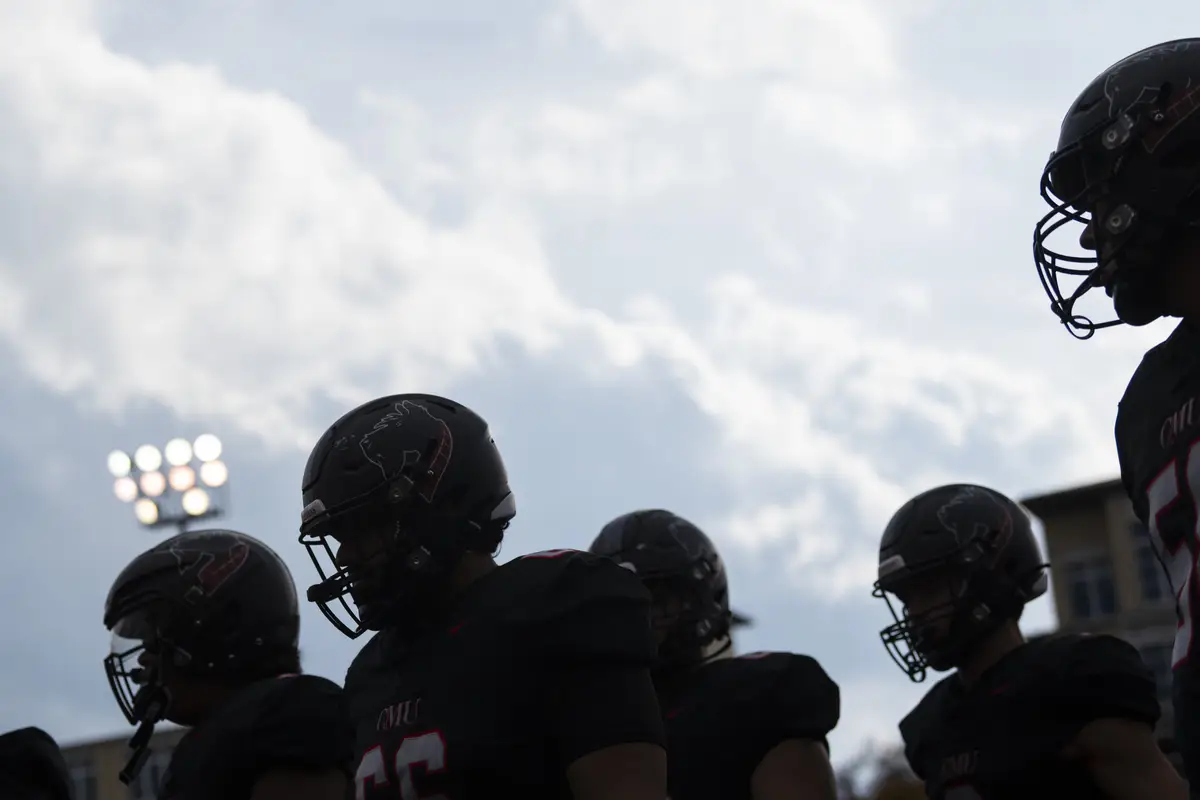
In the high-impact world of football, protecting players from brain injuries is becoming as critical as perfecting a game-winning play. Researchers are pioneering efforts to safeguard the brain without taking players off the field, using technology that could change the future of sports.
Innovative Measures in Football Safety
Football players endure frequent collisions that can cause their brains to move within the skull, even when wearing helmets. While helmets provide protection for the skull, they do not prevent brain movement. Cumulative impacts, even without leading to concussions, can cause unnoticed damage over time.
Brad Mahon, a psychology professor at Carnegie Mellon University, is addressing this issue with the support of the Chuck Noll Foundation and Adnan Hirad from the University of Rochester. They have collaborated with over two dozen student-athletes who wear mouth guards equipped with accelerometers to measure head impacts during games and practices.
“It’s a small contribution with big potential, and for me, it was a way to give back to the sport I love,” said Danny Moynihan, a recent graduate and former Tartans tight end who participated in the study.
The mouth guards track the frequency, direction, and force of impacts in real time, and players undergo MRI scans to observe changes in brain tissue throughout the season. Mahon aims to pinpoint brain regions that are most susceptible to repeated, minor impacts.
Predictive Technology for Brain Health
Carnegie Mellon University holds a patent for an algorithm that predicts when a player’s brain has sustained excessive impact, indicating a need for rest. This technology integrates mouth guard data with MRI scans to assess risk levels and identify vulnerable brain areas.

With the patent secured, Mahon and Hirad are exploring ways to transform this innovation into a practical tool for athletes, teams, and even military personnel. They envision developing an app that could track exposure and provide automated risk assessments.
“We think there may be commercializable technology that is covered by our patent,” Mahon said, indicating plans to potentially form a startup around this concept.
The Broader Impact of Brain Protection Research
While the focus is currently on football, the implications of this research extend to other fields. It could benefit soldiers exposed to blasts, influence automotive safety standards, and even guide neurosurgical practices. The objective is to develop personalized digital models that simulate brain responses to impacts.
“We’re envisioning athletes and soldiers one day having digital twins — virtual models created by combining MRI scans with real-time impact data,” Mahon said. “These models would simulate how forces accumulate in the brain, enabling warnings before subtle injuries become irreversible.”
The research draws from expertise in neuroscience, engineering, and data science, fields where Carnegie Mellon University excels. The university’s athletic program provides real-time data, offering a unique opportunity to refine these predictive models under actual conditions.
“If we can build this system here, there’s no reason it couldn’t scale to collegiate and even high school programs,” Mahon said. “We’ve built strong ties with the football team, and the next step is integrating computer science students into the process. Imagine a course where students run real-time digital simulations of their own football team. That’s the future.”
Read More Here





Comments are closed.