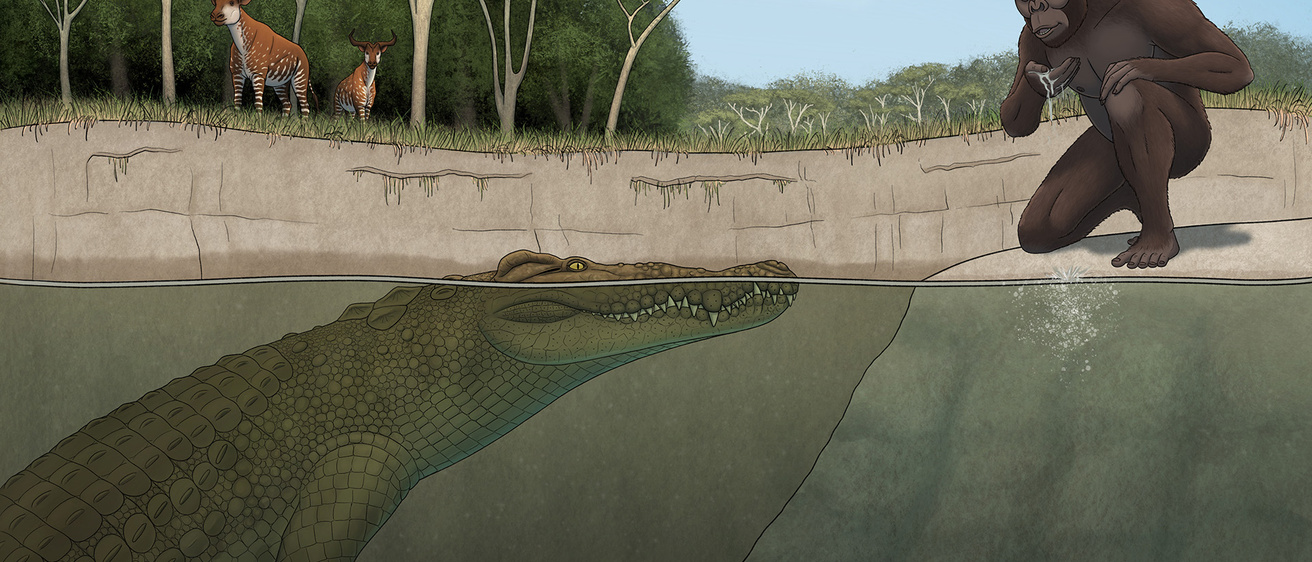
In the lush landscapes of ancient Africa, more than 3 million years ago, our ancestors shared their environment with formidable predators. Among these was a newly identified crocodile species, known as Crocodylus lucivenator or “Lucy’s hunter,” which lurked in the waters of Ethiopia, posing a significant threat to early hominins like the famous Australopithecus afarensis.
Discovery of a New Ancient Predator
Researchers from the University of Iowa have officially classified this ancient crocodile in a study published in the Journal of Systematic Palaeontology. The study sheds light on the predatory dynamics of the time, revealing that Crocodylus lucivenator coexisted with Lucy, whose remains were discovered in Ethiopia in 1974 and stand as one of the most complete early human fossils.
A Formidable Predator
Stretching between 12 and 15 feet in length and weighing up to 1,300 pounds, these crocodiles dominated the region’s ecosystems, which were rich with rivers and wetlands. “It was the largest predator in that ecosystem,” notes Christopher Brochu, a professor at the University of Iowa and the study’s corresponding author. “It’s a near certainty this crocodile would have hunted Lucy’s species.”
Unique Physical Characteristics
Brochu, who has over three decades of experience studying ancient crocodiles, first encountered the Crocodylus lucivenator specimens during a 2016 museum visit in Addis Ababa. He was intrigued by the crocodile’s distinctive features, notably a prominent hump on its snout, likely used by males for mating displays. This characteristic is more commonly seen in modern American crocodiles rather than African species.
Paleontological Insights
The study examined 121 fossilized remains, mainly skulls, teeth, and jaw fragments, excavated from Ethiopia’s Hadar site—a UNESCO World Heritage location rich in paleoanthropological finds. Among the fossils was evidence of injury, suggesting the crocodile engaged in combat with its peers. “The fossil record preserves similar injuries,” comments Stephanie Drumheller, a co-author from the University of Tennessee.
Hadar’s Unique Ecology
Unlike regions to the south, the Hadar area was primarily the domain of Crocodylus lucivenator. “During the Pliocene, Hadar had a variety of habitats,” explains Christopher Campisano, a study co-author from Arizona State University, highlighting the ecological niches that supported this crocodile species.
The study, titled “Lucy’s Peril: A Pliocene Crocodile from the Hadar Formation, Northeastern Ethiopia,” also credits contributions from several other institutions and was funded by bodies including the U.S. National Science Foundation and the Leakey Foundation.
Read More Here