
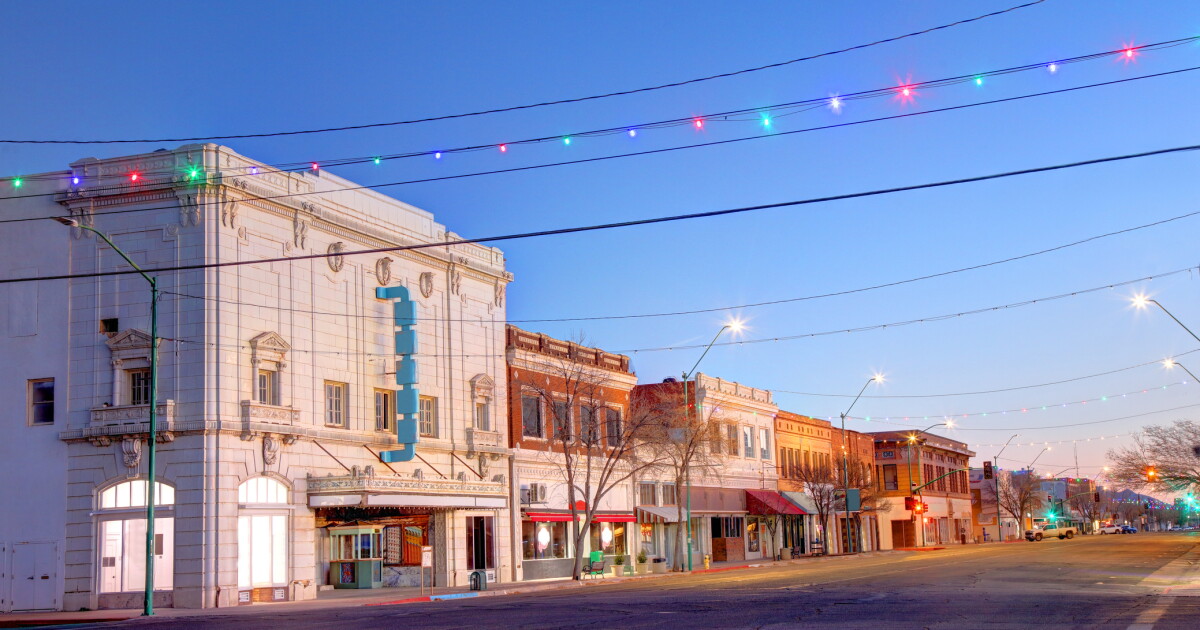
A small airport on the Arizona-Mexico border is getting a major facelift — but the funding didn’t come from where you might expect. Instead of aviation dollars, the City of Douglas tapped into federal historic preservation money to breathe new life into one of America’s most unique airfields.
The Douglas Municipal Airport holds a rare distinction: it was designated the first international airport in the United States by First Lady Eleanor Roosevelt in 1933. The reason for that designation is as unusual as the airport itself. Its runway once extended across the U.S.-Mexico border, meaning a pilot could literally land in Mexico and taxi across into American territory — or do the reverse.
Deputy City Manager Luis Pedroza explained how that worked:
“Basically you could land in Mexico and taxi into the United States and vice versa, so that’s what made it international.”
The airport remains operational today, but its historic status creates a funding challenge. Because the Douglas Municipal Airport is listed on the National Register of Historic Places, it does not qualify for grants from the Federal Aviation Administration. That left city officials searching for a creative solution.
Thinking Outside the Hangar
Rather than accepting the funding gap, Douglas city officials found an alternative path through the National Park Service. The city secured $750,000 in historic preservation funds to rehabilitate the airport’s original hangar — a project that would have been impossible under standard FAA grant programs.
Pedroza described the approach as an unconventional but logical workaround:
“A very thinking-outside-the-box type of initiative that we thought of because we don’t qualify for those FAA funds. We said, ‘Well, we can certainly qualify for historical preservation funds, and that can certainly help us with our airport.'”
To unlock the National Park Service grant, the city had to meet a one-to-one funding match requirement — totaling $750,000 in matched dollars. That match was split evenly, with $375,000 coming from the City of Douglas and another $375,000 from the Arizona State Transportation Board. Pedroza confirmed the city has recently completed all of the prerequisites for the funding.
Additional State Support for Airport Upgrades
The historic preservation grant is just one piece of a broader set of improvements underway at the Douglas airport. The State of Arizona has also stepped in with additional funding for separate projects at the facility. Those grants include $485,000 to install a perimeter security fence and $1.7 million to resurface the airport’s taxiways. The taxiway resurfacing project required the airport to contribute a 10% funding match.
The Douglas airport’s situation is not isolated — Arizona’s aviation infrastructure has been receiving attention across the state. Mesa’s Falcon Field Airport recently received $1.7 million in federal grants for pavement improvements and ground collision warning technology, according to reporting by Connor Greenwall.
Transportation and infrastructure decisions are also making news elsewhere in the region. Valley Metro is asking the public to weigh in on two alignment options for a West Phoenix light rail extension, while the City of Phoenix recently launched a new $2 rideshare service in select parts of the city, as reported by Katherine Davis-Young.
In other Arizona business news, the state is set to receive a share of a $220 million settlement with General Motors, which was sued over allegations it illegally collected and sold driver data, according to Greg Hahne. And on The Show, reporter Mark Brodie examined how car thieves in Arizona are evolving their methods, even as official statistics show theft numbers at their lowest point since the early 1990s.






Comments are closed.