
Innovative strategies are reshaping efforts to conserve Arizona’s natural resources, thanks to the ongoing collaboration between Northern Arizona University (NAU) and Salt River Project (SRP). This decade-long partnership is at the forefront of exploring solutions to challenges such as wildfire prevention, water conservation, and atmospheric carbon reduction.
Revolutionary Carbon Capture Efforts
Could a vacuum-like device, alongside humidity adjustments, effectively remove carbon dioxide from the air? This question drives the research of Jennifer Wade, associate professor of mechanical engineering at NAU. Wade, together with her engineering students Randy Brierley, Elijah Woolridge, Justin Patterson, and Branden Welker, has developed a prototype to test this concept. While further research is necessary to make this technology economically feasible, it marks a significant step in exploring practical carbon capture solutions.
Soil Moisture as a Wildfire Predictor
Advanced Leak Detection for Water Conservation
In an effort to protect Arizona’s water supply, researchers are developing methods to detect leaks in SRP’s water pipes before they become visible. Led by mechanical engineering professor Michael Shafer, students Ben Krotonsky, Elliott Kinsley, and Logan Bankert are working on a technique that utilizes manual tools and a Bluetooth probe to sample moisture near pipes. This approach aims to enable early leak detection with less labor than current methods, with future plans to refine and deepen the soil moisture sampling process.
Efforts to Locate and Support Native Gartersnakes
Despite two years without sightings of northern Mexican gartersnakes in Tonto Creek, the conditions needed for the recovery of this threatened species are present. Research by Erika Nowak, associate research professor in the School of Earth and Sustainability, suggests that these snakes might still exist in small numbers. SRP’s initiatives to control large nonnative fish populations are part of broader efforts to restore habitats for native species, including gartersnakes and lowland leopard frogs. Continued monitoring and habitat improvement efforts are underway to support potential recovery.
Innovative Techniques for Canal Sediment Detection
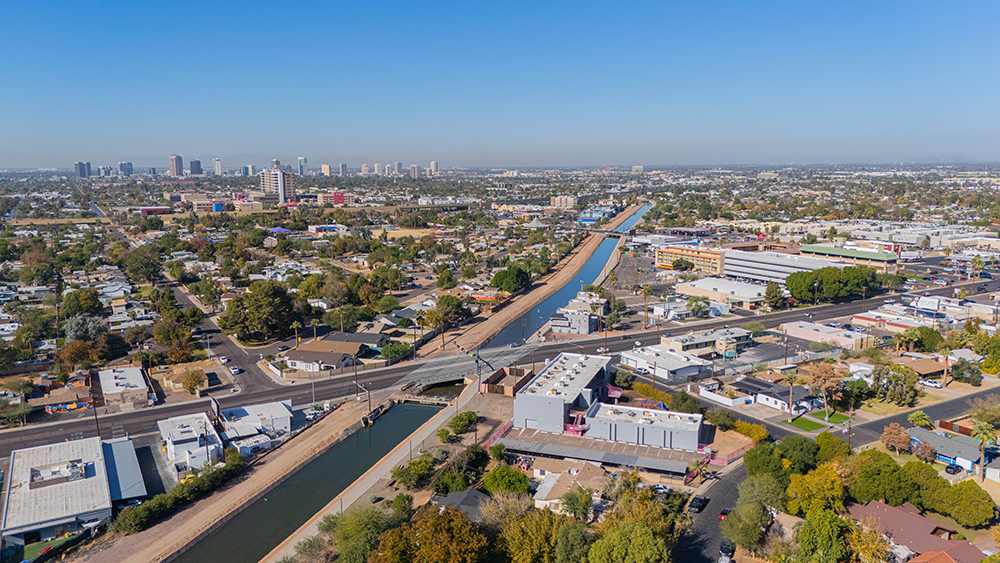
Typically, SRP drains its canals to identify sediment accumulation that could disrupt water delivery. A team of NAU researchers, led by Reza Sharif Razavian and Ben Dymond, is creating a prototype to inspect canals without draining them. This project, involving nine students, uses sonar technology and a machine learning algorithm to detect sediment and foreign objects. While detection accuracy is still improving, the team’s work will be tested during SRP’s canal maintenance in November.
Forest Thinning as a Fire Prevention Strategy

Research led by Temuulen “Teki” Sankey, a professor in the School of Informatics, Computing, and Cyber Systems, is examining how thinning dense forests can reduce wildfire risk. The team is studying areas affected by the 1990 Dude Fire near Payson, using ground-based sensors to measure various ecological factors and satellite images from ECOSTRESS.
Read More Here





Comments are closed.