
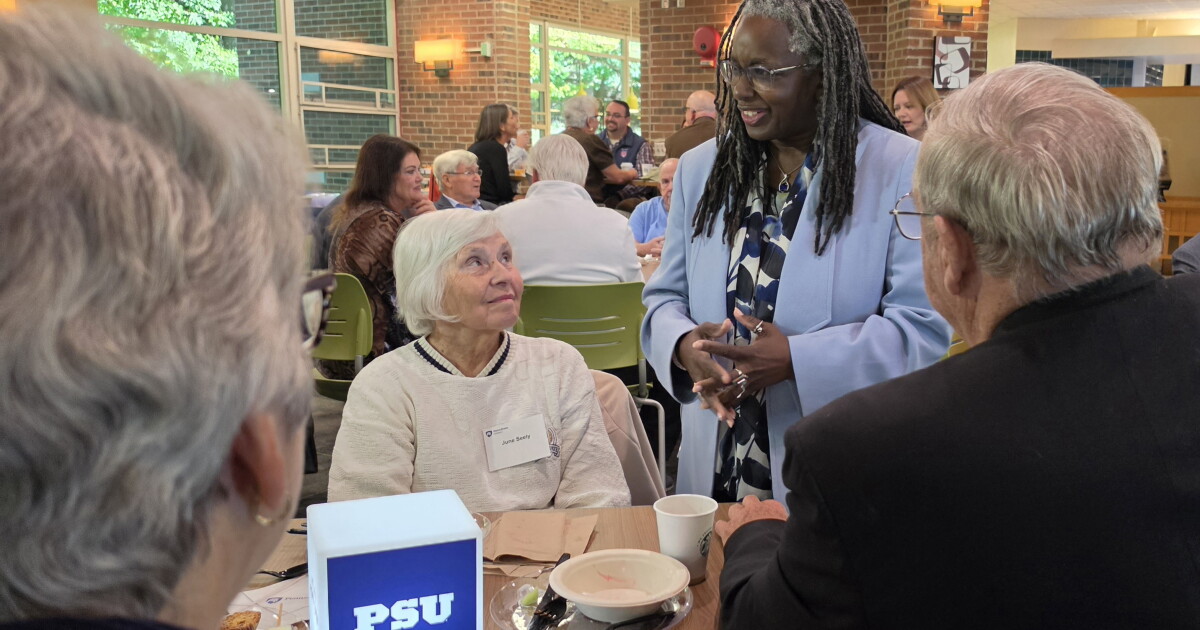
A Penn State regional campus system that was nearly dismantled is now charting a new course — and a new leader with five degrees, a professional tennis career, and a background as a classical pianist is the one holding the map. Menah Pratt, the newly appointed regional chancellor overseeing Penn State Hazleton, Penn State Scranton, and Penn State Wilkes-Barre, is wasting no time making her presence felt across Northeast Pennsylvania.
Pratt, who most recently served as vice president for strategic affairs and professor of education at Virginia Tech, stepped into the regional chancellor role in August. On Tuesday, she hosted a community breakfast at the Hazleton campus to share her vision — the first of similar events planned for Scranton and Wilkes-Barre later this month.
“I moved here. I packed up all my boxes. I unpacked all my boxes, so I’m here to stay. I’m here to do the work. I’m committed to the region, and I’m committed to the mission of a land-grant university. I’m committed to actualizing the potential of the region,”
Pratt told those gathered at Tuesday’s event.
Her arrival comes at a pivotal moment. The Wilkes-Barre campus is set to close after the spring 2027 semester, following a board of trustees vote last month to sell the property to a developer with plans for a golf club expansion, an event center, and academic space to be offered to Misericordia University. Meanwhile, Penn State is now focused on growing the Hazleton and Scranton campuses — a reversal from just over a year ago, when the board had considered closing them as well.
The path to Tuesday’s breakfast was not easy. Community members and local leaders fought hard to keep the Hazleton campus — which opened in 1934 during the Great Depression — from shutting its doors. Many of those same advocates were in the room when Pratt spoke. Joseph Clifford, chairman of the Penn State Hazleton advisory board, captured the shift in mood.
“There was the phase to save the campus. Now we have to build the campus,”
Clifford said.
“Were it not for the community, I’m going to tell you, I don’t think we’d be here.”
Pratt has moved quickly to get up to speed. In her first 50 days on the job, she logged 350 meetings with students, faculty, community leaders, and advocates. She has spoken with school principals, business owners, and alumni. She toured a local coal mine, learned about the area’s nonprofit landscape, and watched WVIA’s The Secrets Beneath Hazleton to better understand the region’s history.
“I want to understand this region’s history, its people and what makes it such a unique place to live, work and build communities,”
she said.
Clifford noticed the effort.
“She’s working really, really hard to not only understand Penn State regional campuses, but the community, and that’s the part I really like,”
he said.
A New Leadership Academy
The centerpiece of Pratt’s vision is the Penn State Northeast Regional Leadership Academy — a program designed to develop, in her words, “lifelong leaders at the intersection of technology and humanity.” The academy would serve high school students, college students, and working professionals.
Possible components include a pre-college summer program for rising juniors and seniors, dual-enrollment courses for high schoolers, and an adult leadership track for those already in the workforce. The curriculum would center on STEAM education — science, technology, engineering, art, and math — with additional tracks in business and healthcare.
“Higher education has always been a powerful partner in helping our communities adapt to the evolving challenges in society. As we think about the complexity of today’s society, I feel like this moment requires a new type of leader — a leader that understands the power of both technology and humanity,”
Pratt said.
She connected that vision to the urgency of the current moment:
“This moment requires developing leaders and learners at all levels who understand technology and AI and other complex intelligence systems. Equally importantly, we must understand each other, our humanity and how to work and live together as human beings. We must understand that leadership in this increasingly complex and polarized world requires experts in the art of compassion, empathy, collaboration, compromise and communication.”
Local business leaders responded warmly. Mary Malone, president of the Greater Hazleton Chamber of Commerce, praised Pratt’s early work and saw the academy announcement as a sign that Penn State was listening.
“Menah was the perfect pick for our community. She has hit the ground running, has great ideas. The announcement of the Leadership Institute I think really shows that they heard our feedback about the potential and possibilities that can happen here when a community connects to an asset like a Penn State regional campus,”
Malone said.
Pratt envisions the Hazleton and Scranton campuses, along with the Penn State LaunchBox in downtown Wilkes-Barre, forming a connected regional “learning ecosystem” that serves the broader Northeast Pennsylvania community.
Navigating Loss at Wilkes-Barre
While growth is the focus at Hazleton and Scranton, Pratt is also preparing to help the Wilkes-Barre community through a difficult goodbye. The Penn State trustees voted to close the Wilkes-Barre campus along with six others in 2025. The developers’ plans for the Penn State Wilkes-Barre property — including a golf club and event center — were finalized last month.
Pratt knows what that kind of loss feels like. When a program she founded at Virginia Tech was shut down, she experienced the grief that follows firsthand.
“I felt that I had healed enough from that that I could help this community go through that experience,”
she said.
Pratt brings substantial executive experience to the role. Before Virginia Tech, she held senior leadership positions at the University of Illinois Urbana-Champaign and Vanderbilt University. Her academic credentials include a doctorate and master’s degree in sociology, a law degree from Vanderbilt, a master’s in literary studies, and a bachelor’s degree in English from the University of Iowa. She is also a published author whose work examines race, gender, spirituality, and feminism.
Born in Pittsburgh and raised in Illinois, Pratt will regularly travel the 45-mile stretch of Interstate 81 that separates the Hazleton and Scranton campuses. She has made clear that those drives will be opportunities to deepen her understanding of the people and places she now serves.
The broader Penn State regional story has been closely followed by WVIA reporters. Coverage has tracked the community’s fight to keep campuses open, the Hazleton community’s push for expansion, and previous leadership transitions for the regional campuses. Elizabeth Wright, who had been named regional chancellor in 2024, stepped down in August 2025. Two interim chancellors served before Pratt took over. Reporting by WVIA News has documented each stage of this evolving story, and more coverage is available at WVIA’s Penn State coverage hub and across local news and higher education topics. Supporters had long argued there was significant growth potential at Penn State Hazleton, and Pratt’s arrival suggests the university is now acting on that belief.









Comments are closed.