Envision a future where stairs are no longer an obstacle for individuals with motor impairments due to neurological disorders. This future is becoming a reality thanks to an innovative wearable device that can significantly improve mobility and independence.
Sam Hopkins, a dedicated doctoral student at Northern Arizona University (NAU), is at the forefront of this groundbreaking work. Supported by a fellowship from the National Institutes of Health, he is developing a flexible ankle orthotic designed to assist children with cerebral palsy in navigating their world more freely.
New Hope for Enhanced Mobility
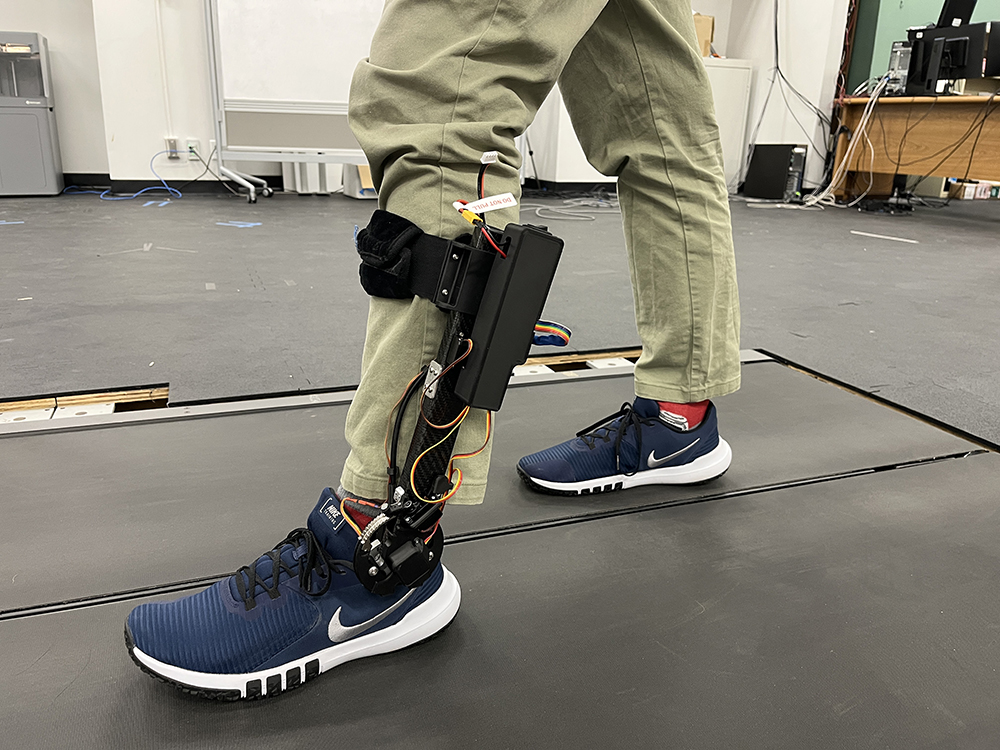
Working in Professor Zach Lerner’s Biomechatronics Lab, Hopkins was awarded an F31 fellowship, a prestigious grant aimed at supporting doctoral students conducting health-related research. This funding is key to advancing Hopkins’ project, which focuses on building a flexible, yet robust, robotic ankle-foot orthosis.
“I’m so thrilled that Sam has received this prestigious fellowship because he is one of the most talented, hardworking, deserving Ph.D. students I’ve ever had,” said Lerner. “This award will provide exceptional doctoral training while advancing a transformative robotic ankle-foot orthosis design that may significantly improve mobility for individuals with cerebral palsy.”
Innovative Design and Functionality
The current ankle orthotics market offers solutions that tend to be rigid and limit the range of motion necessary for activities like climbing stairs. Hopkins aims to overcome these limitations with a device constructed from carbon fiber tubing and carbon-reinforced nylon plastic. This design ensures the orthotic is both strong and adaptable, eliminating the need for custom fittings and reducing the expected commercial cost to around $2,000 per leg.
Hopkins describes the device as a bridge between passive spring-like devices and fully powered exoskeletons, offering adaptability without the bulk. “Our device is that bridge. It’s more lightweight than other devices, using smart and adjustable springs instead of a bulky motor; it’s kind of passive but it still has that adaptability we want,” he explained.
Personal Inspiration and Broader Impact
Hopkins’ journey into this field was inspired by personal experiences. He witnessed his grandfather’s struggles with cancer, which required assistance from multiple caregivers for basic tasks. This personal challenge, combined with the influence of technology seen in pop culture, like Ironman’s suit, fueled his passion for creating assistive devices.
“I’ve fallen in love with the fact that I can build something and test it to see if it helps people,” Hopkins shared. He is also involved in projects aimed at mitigating pain from osteoarthritis of the knee, further showcasing his commitment to enhancing quality of life through technology.
For more information on Hopkins’ work and the Biomechatronics Lab, visit the Biomechatronics Lab website.
Contact: Heidi Toth | NAU Communications
(928) 523-8737 | heidi.toth@nau.edu
Read More Here