The Birth and Development of Solar Systems: Insights from Webb Telescope
Today’s solar system may appear as a vast expanse of empty space punctuated by planets, asteroids, and comets. However, in its infancy, it was a turbulent, swirling mass filled with 100 times more gas than dust. This transformation is at the core of recent research leveraging data from NASA’s James Webb Space Telescope, spearheaded by Naman Bajaj, a doctoral student at the University of Arizona.
The study, one of the most extensive on planet formation using the JWST, delves into the initial 10 million years of a solar system’s life. It confirms previous findings about two sequential mechanisms responsible for the early dissipation of gas in solar system disks, providing new insights into the timing of these transitions.
A real image of disk winds carrying out molecular hydrogen gas from a planet-forming disk located about 450 light-years from us. The white line is the plane of the planet-forming disk, while the bright yellow, orange, pink and purple represent ejected gas.
Naman Bajaj/JWST/MIRI-IFU
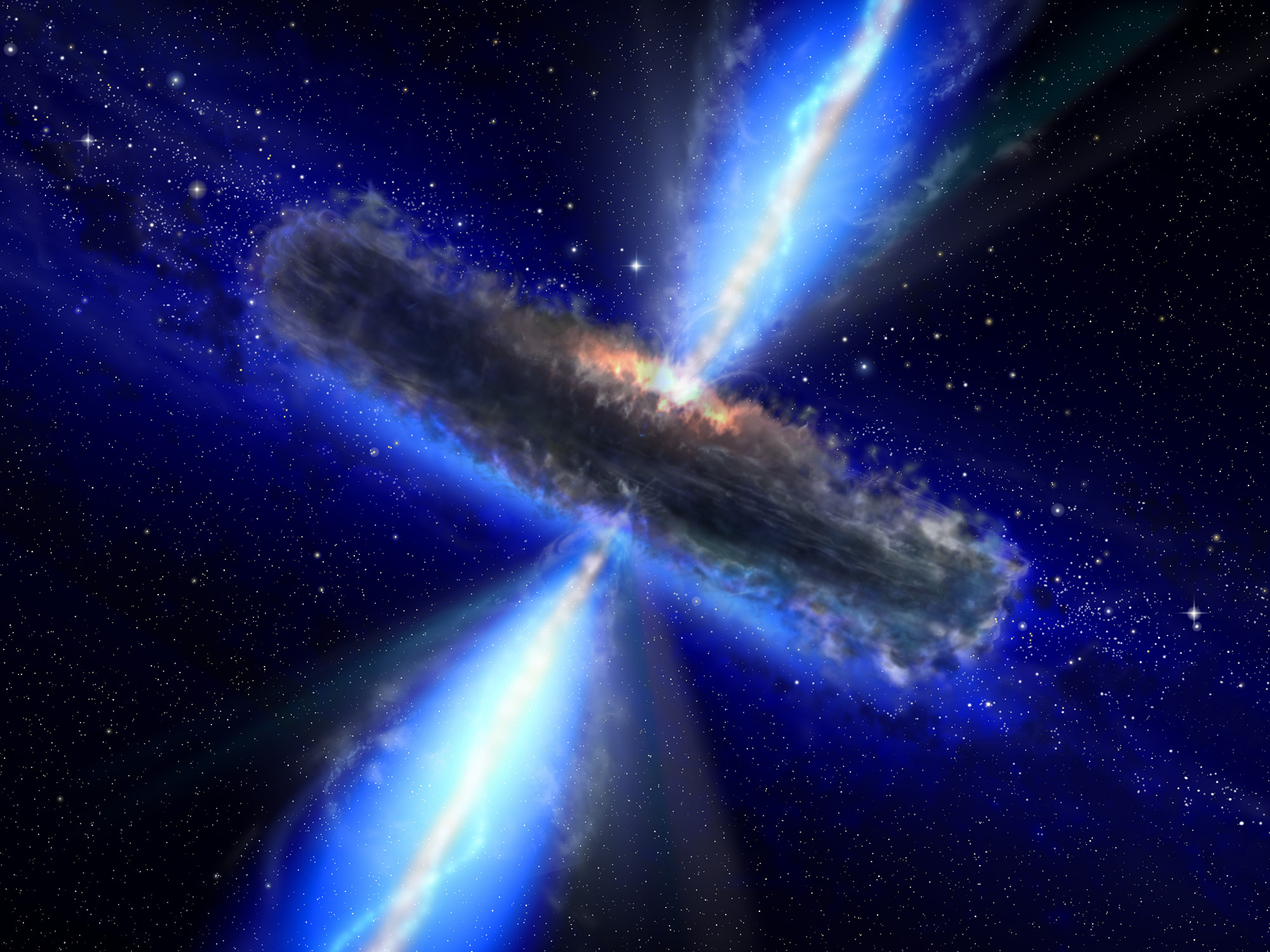
Bajaj’s team published their findings in the Astronomical Journal. The research describes a newborn star encircled by a dense protoplanetary disk, which supports a robust magnetic field. This magnetic field channels gas out of the disk at velocities of 10-100 miles per second, a phenomenon known as “magnetic winds,” effectively blocking X-ray photons from reaching the disk.
Over time, these magnetic winds diminish, and the study suggests that “photoevaporative winds” take over. These winds, composed of energetic X-rays and ultraviolet light, excite the gas in the disk and lead to its ejection. Bajaj likens this to solar energy evaporating water on Earth.
“After a few million years, the jets disappear and the molecular winds fade, leaving behind only gentler atomic winds that quietly erode what remains,” Bajaj explained. “This means that every planetary system with a sun-like star, including our own, likely underwent a vigorous phase of magnetic wind-driven mass loss early in its history, before transitioning to a calmer dispersal phase.”
“Planet formation is therefore a race against time,” he added. “Gas giants like Jupiter must assemble their massive atmospheres while the disk is still substantial enough to supply them, before winds and jets carry that raw material away into space.”
The study analyzed 72 images of young sun-like stars and their disks, each capturing a different life stage. By assembling these images like frames in a film, researchers created a timeline showcasing how planetary systems lose the materials necessary for planet formation.
Researchers focused on molecular hydrogen and ionized neon gas. Molecular hydrogen, a major component of the universe’s mass, was traced based on previous research, while neon, detectable by Webb’s mid-infrared detectors when ionized, indicated the presence of high-energy radiation in the photoevaporative wind.
“Neon initially traces the fast-moving jets while molecular hydrogen is tracing wider winds,” Bajaj noted. “Later, we see neon in the slower, broader motion of the photoevaporative wind when the magnetic jets and winds weaken, and the X-ray photons can excite neon. During this phase, molecular hydrogen seems to trace weaker winds or nothing at all.”
In 2020, a similar study led by LPL professor Ilaria Pascucci, Bajaj’s advisor, suggested the existence of massive molecular winds capable of blocking X-ray photons. The current study, utilizing JWST data, confirms these hypotheses by observing molecular hydrogen directly.
Bajaj expressed surprise at the stunning beauty of the images. “I mean, we expected the images to be nice, we didn’t expect them to be absolutely stunning,” he said.
The team aims to refine their understanding of gas mass loss over time and determine the exact distance from the star where gas is launched from the disk, crucial for understanding planet formation distances.
Additional co-authors of this study include Sylvie Cabrit, Suzan Edwards, Gabriele Cugno, Andrew Sellek, Joan Najita, Ke Zhang, Richard Alexander, Gregory Herczeg, Uma Gorti, Sophie Clark, and Tracy Beck.
A mosaic of the James Webb Space Telescope images used in this study. Each of these images is about 750 astronomical units, or AU, wide and tall. For context, one AU is the average Earth-Sun distance.
Read More Here