
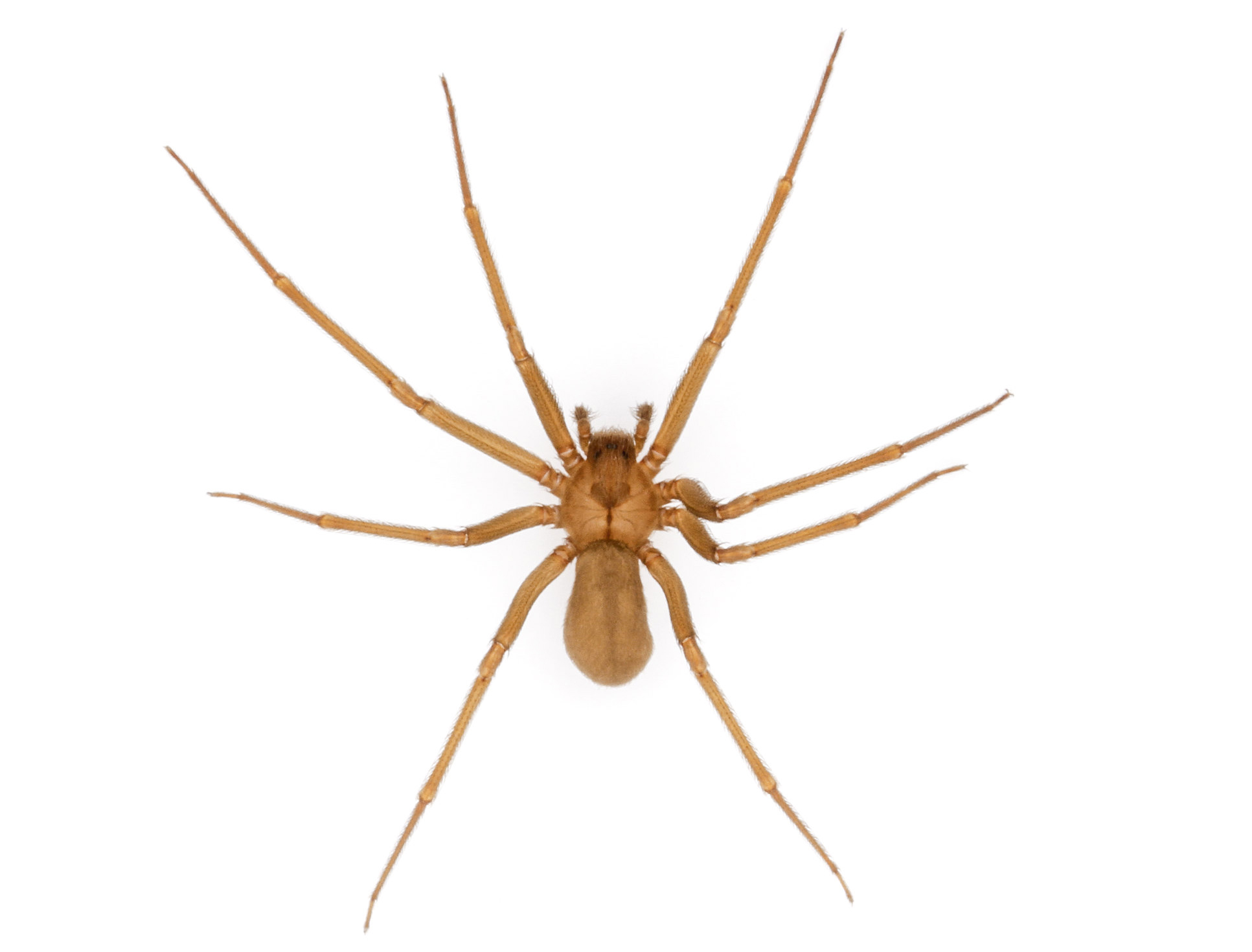
Known for their elusive nature and unique violin-shaped marking, brown recluse spiders are often misunderstood. Despite their fearsome reputation, these tan, spindly creatures rarely bite humans, and recent research has provided new insights into the complex nature of their venom.
Brown Recluse: Common Yet Rarely Seen
Brown recluse spiders, scientifically known as Loxosceles reclusa, are widely distributed, inhabiting every continent except Antarctica. However, sightings are uncommon. Matthew Cordes, associate professor emeritus at the University of Arizona Department of Chemistry and Biochemistry, explains, “They like to hide in wood piles, sheds, things like that. They prefer dark, covered spaces. Recluse spiders are actually quite common and easy to find if you look for them.”
These spiders are prevalent in the central and southeastern United States, with related species residing in west Texas, New Mexico, and Arizona, where Loxosceles arizonica is common. Despite their presence, encounters with humans are rare, and bites even more so. “Residents are much more likely to encounter black widows around their property than brown recluses,” Cordes notes, dispelling myths about their aggressiveness.
Unlike most other spiders, those belonging to the Sicariid family, which includes the brown recluse, have six eyes instead of eight, arranged in three pairs.
Public domain via Christopher Johnson and the “Insects Unlocked” Project (University of Texas at Austin)
Understanding Recluse Venom
The unique venom of the recluse spider family, known as Sicariids, is effective at destroying tissue rather than impeding nerve function like most other spider venoms. The extensive tissue damage, sometimes requiring medical intervention, is a hallmark of a recluse bite. Cordes and his team have made strides in understanding this phenomenon, identifying the venom’s molecular mechanism through X-ray crystallography.
“We believe a likely mode of operation for this thing is to attach itself to a cell and chew up its lipid molecules,” Cordes said. These enzymes operate like a “molecular lawnmower,” moving from molecule to molecule, causing significant damage. The study reveals that the venom produces a unique compound, cyclic ceramide phosphate, previously unknown in nature.
Misidentification and Misdiagnosis
Identification of brown recluses isn’t straightforward. Greta Binford, arachnologist and professor of biology at Lewis & Clark College and the study’s second author, highlights the confusion, stating, “Brown recluses are often confused with a whole range of other spiders.” Correct identification requires both a violin marking and three pairs of eyes.
Misdiagnosis is also common, often confusing recluse bites with conditions like MRSA. Cordes explains, “MRSA produces a sore that presents somewhat like a recluse spider lesion.” Accurate diagnosis often hinges on geographic location and the presence of a spider post-bite.
Read More Here







Comments are closed.