
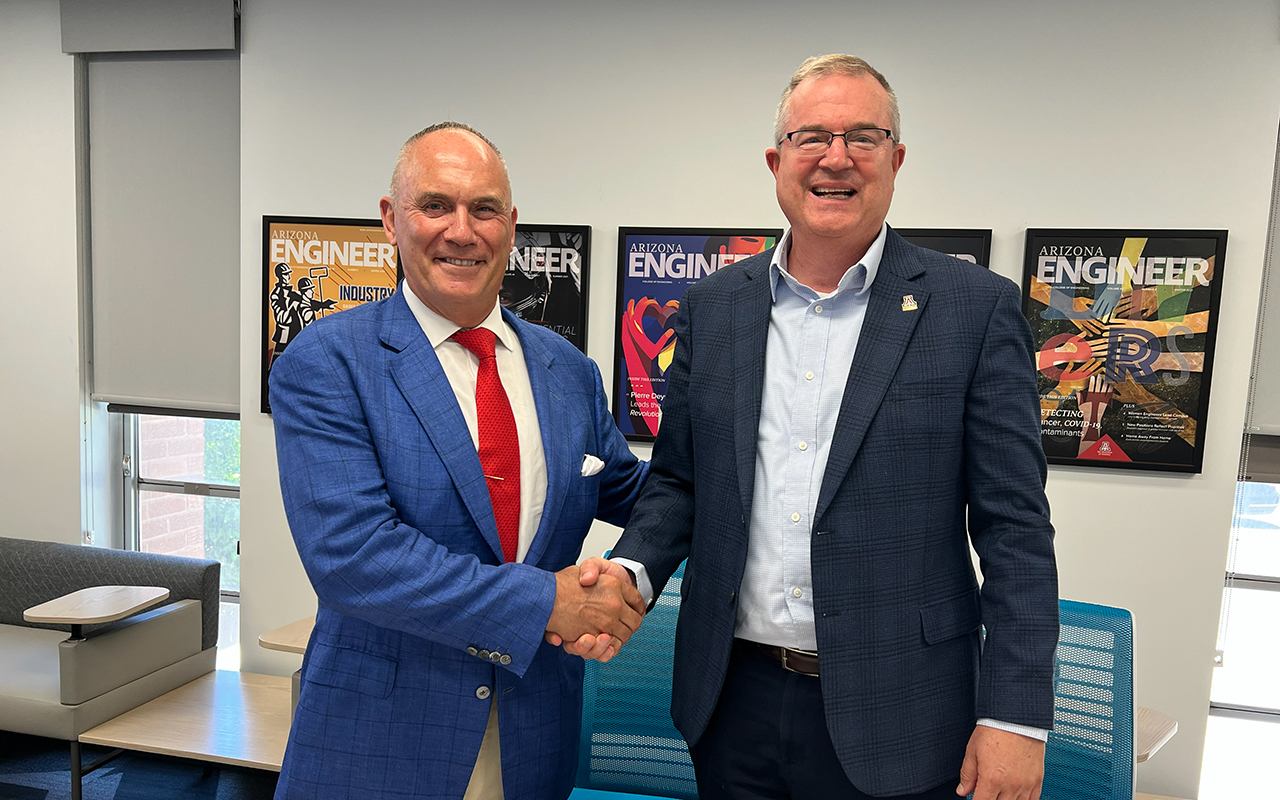
In a significant move towards enhancing defense education, the University of Arizona College of Engineering has teamed up with the Missile Defense Advocacy Alliance (MDAA) to introduce the Advanced Education in Terrestrial Operations and Space (AETOS) program. This initiative aims to equip military leaders with crucial skills in near-space and drone defense.
The AETOS certificate program, scheduled from July 16, 2026, to February 20, 2027, is designed to address the pressing challenges posed by low-flying drones. Riki Ellison, the founder and chairman of MDAA, emphasized the urgency of innovation in this area, stating, “Our ability to defeat low-flying drones at a massive scale is a challenge right now. We are reaching out to the University of Arizona to be faster and to reach innovation quicker.”
This initiative follows the establishment of the Institute for Near Space Studies on October 19, 2023, and the expansion of MDAA’s Youth Impact Program at the university. The AETOS program represents the latest development in this collaborative effort.
Near space, defined as the region between 60,000 to 300,000 feet above Earth, remains largely unregulated, exposing the U.S. to potential threats from foreign balloons, airships, and certain aircraft. Drones have also become a prevalent tactic in low-altitude airspace, prompting the AETOS program to explore new defense technology opportunities.
David W. Hahn, the Craig M. Berge Dean of the College of Engineering, highlighted the potential for innovation, stating, “On the lower end, you can develop balloons with unique sensing and other mission-critical platforms. We have a lot of expertise in this area to do open space communications, optics, aerodynamics, balloons and space domain awareness.”
Participants in the program will benefit from the expertise of college faculty through lectures on hypersonics, artificial intelligence, and flight mechanics. This knowledge will be applied in capstone projects aimed at providing practical solutions to national security issues.
Inspired by the success of the college’s interdisciplinary capstone program and the MDAA-USC Shield program, the AETOS initiative targets promising officers, potentially future generals and thought leaders, to collaborate with faculty on advancing homeland security through innovative design projects.
The inaugural cohort is expected to consist of 12 to 18 students, primarily military personnel recommended by their commanding officers or government officials. Ellison expressed enthusiasm for the partnership, stating, “The university can do things faster and better. We’re excited to have the University of Arizona expertise on this.”
Read More Here








Comments are closed.