
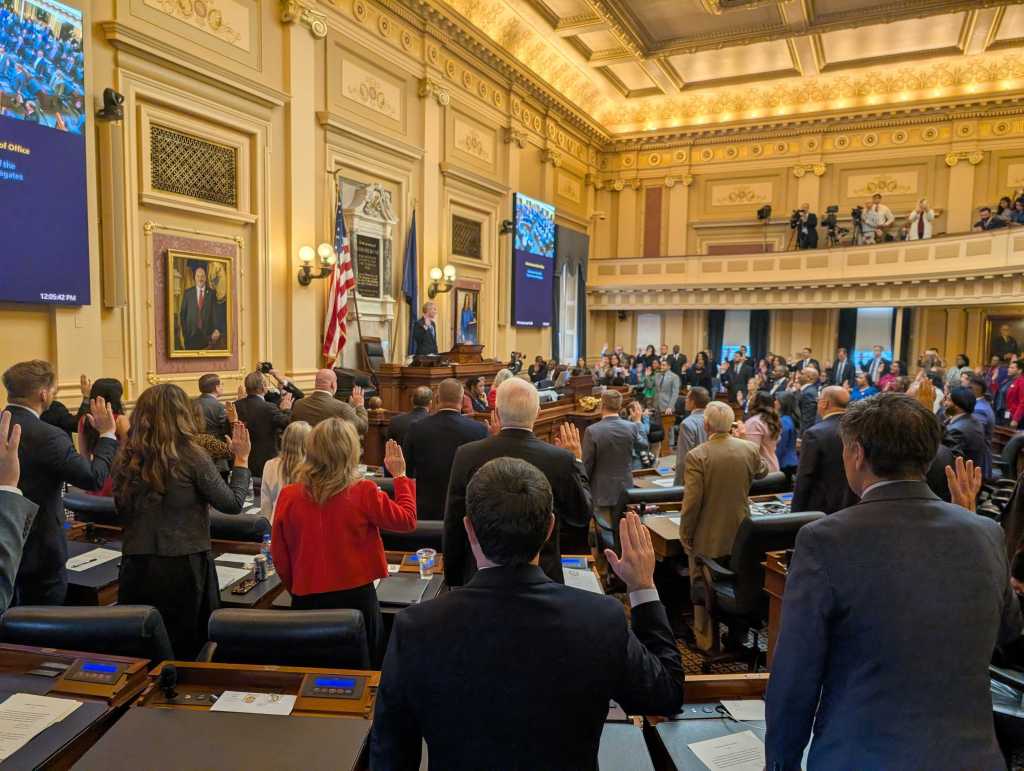
The Virginia legislative session, which spans 60 days, commenced on Wednesday with Democrats in the House of Delegates and Senate accelerating efforts to pass four constitutional amendments by the end of the week.
Having secured control of both the legislature and governorship in the recent November elections, Democrats are focusing on an agenda aimed at enhancing affordability and adopting a redistricting amendment that could limit future Republican influence.
The proposed amendments include securing access to reproductive healthcare, including abortion, rescinding the ban on same-sex marriage, and automatic restoration of voting rights for individuals who have completed their sentences. Additionally, the amendments aim to authorize the General Assembly to redraw congressional maps in advance of the 2026 midterms, potentially reducing Republican seats in Congress.
Led by Democrats, these resolutions are anticipated to easily pass through the Democrat-controlled legislature. Since the votes represent the second approval for these amendments, they do not require gubernatorial signature but must be presented to the public for a referendum. The public will vote on these in November, except for the redistricting amendment, which will appear on the ballot in April.
Following the swearing-in of delegates on Wednesday, the Privileges and Elections Committees in both the House and Senate plan to expedite the resolutions through committee review. The House aims to finalize the resolutions on the same day, while the Senate, which must hear legislation read three times, is expected to conclude by Friday.
Delegate Cia Price, D-Newport News, and chair of the House Privileges and Elections Committee, stated, “We will let the voters decide if they want the freedom and control over their own bodies…if they want to be able to marry who they love, and…if they want us to fight fire with fire to protect our democracy.”
The push for redistricting arises from President Donald Trump’s advocacy for Republican-led state legislatures to undertake redistricting efforts to maintain congressional majorities.
Price emphasized the temporary nature of the redistricting amendment. Typically, a bipartisan commission redraws congressional maps every decade post-census. However, the last attempt in 2020 saw the Virginia Supreme Court step in after the commission failed to agree. Presently, the U.S. House representation from Virginia consists of six Democrats and five Republicans.
According to Price, “House Joint Resolution 4…is a temporary, one-time execution that gives Virginians a crucial voice…while ensuring that the bipartisan redistricting commission comes back when hopefully our nation gets back to normal.” Voters are expected to view a revised map before the redistricting amendment vote, anticipated by January 30.
Senator Louise Lucas, D-Portsmouth, suggested a map potentially favoring Democrats in 10 out of 11 districts. Meanwhile, House Speaker Don Scott expressed uncertainty regarding the final distribution of seats but emphasized striving for a competitive political landscape.
“I don’t know if we’re going to get 10-1 maps, 11-0 maps, 8-3 maps,” Scott remarked. “We will have maps and we will try our best to get maps that create a more competitive environment…we’re not going to stand aside and watch Washington decimate the game while we do nothing to level the playing field.”
States such as California, Missouri, North Carolina, Ohio, Texas, and Utah have previously supported mid-decade redistricting. However, with a new redistricting map due soon, Price and Sen. Aaron Rouse, chair of the Senate’s Privileges and Elections Committee, abstained from disclosing the individuals responsible for the redraw.
“Of course, people are trying to offer their input,” Price commented. “They may have different feelings about certain things, but the legislators are focused on the legislative process.”
House Minority Leader Terry Kilgore criticized the redistricting amendment as gerrymandering, asserting, “This is not the Virginia way…It doesn’t matter what some of these other states are doing.”
Republicans have initiated legal action to block the amendment, arguing that the resolution’s passage does not comply with procedural requirements due to early voting commencement. A judge declined to intervene before the session’s start, citing a lack of actionable steps prior to legislative decisions.
Kilgore also opposed amendments regarding abortion access and same-sex marriage. He criticized the abortion amendment for insufficiently restricting late-term procedures and deemed the marriage amendment unnecessary due to the Supreme Court ruling legalizing same-sex marriage, which overrides Virginia’s constitutional ban.
Kate Seltzer, (757)713-7881, kate.seltzer@virginiamedia.com
Read More Here



![Robert Harmon Celebrates 99th Birthday at UVA’s Homecomings Weekend[embed]https://www.youtube.com/watch?v=c_VPFnE8x-w[/embed]](https://realnewsfast.com/wp-content/uploads/2026/10/Robert-Harmon-Celebrates-99th-Birthday-at-UVAs-Homecomings-Weekendembedhttpswwwyoutubecomwatchvc_VPFnE8x-wembed-300x200.jpg "Robert Harmon Celebrates 99th Birthday at UVA’s Homecomings Weekend[embed]https://www.youtube.com/watch?v=c_VPFnE8x-w[/embed]")
![Environmental Opera “Auksalaq” Opens UVA’s Arts on the Hill Series[embed]https://www.youtube.com/watch?v=PjYuP9wh3Hw[/embed]](https://realnewsfast.com/wp-content/uploads/2026/10/Environmental-Opera-Auksalaq-Opens-UVAs-Arts-on-the-Hill-SeriesembedhttpswwwyoutubecomwatchvPjYuP9wh3Hwembed-300x200.jpg "Environmental Opera “Auksalaq” Opens UVA’s Arts on the Hill Series[embed]https://www.youtube.com/watch?v=PjYuP9wh3Hw[/embed]")
![New documentary explores Elizabeth Holmes’ final days before prison[embed]https://www.youtube.com/watch?v=GGJSRFWALTI[/embed]](https://realnewsfast.com/wp-content/uploads/2026/10/New-documentary-explores-Elizabeth-Holmes-final-days-before-prisonembedhttpswwwyoutubecomwatchvGGJSRFWALTIembed-300x200.jpg "New documentary explores Elizabeth Holmes’ final days before prison[embed]https://www.youtube.com/watch?v=GGJSRFWALTI[/embed]")