
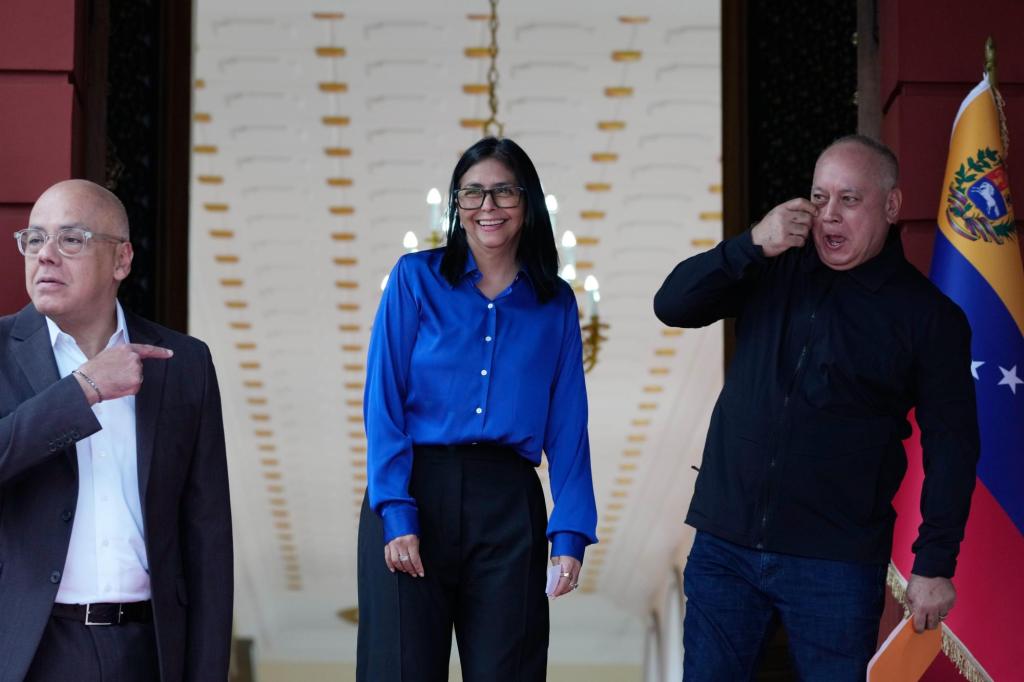
Venezuela’s Acting Leader Proposes Oil Industry Reforms for Foreign Investment
By REGINA GARCIA CANO, Associated Press
CARACAS, Venezuela (AP) — In an address aimed at reshaping Venezuela’s economic landscape, acting President Delcy Rodríguez proposed significant changes to the nation’s oil industry on Thursday. This move comes shortly after the United States’ intervention led to the toppling of Venezuela’s long-standing leader. Rodríguez’s request to lawmakers is seen as an effort to attract greater foreign investment, marking a notable shift in the country’s approach to international relations.
Under pressure from the Trump administration, Rodríguez emphasized that revenue from oil sales would be directed towards improving the country’s healthcare system, economic development, and infrastructure. Her speech outlined a strategic vision that departs from previous anti-American sentiments held by Venezuelan leadership. Rodríguez stated, “Let us not be afraid of diplomacy” with the U.S., as she navigates the complex political pressures from both the U.S. and supporters of former President Nicolás Maduro. More details on the political dynamics can be found here.
The speech was aired a day after Rodríguez announced her government’s intention to continue releasing political prisoners, marking “a new political moment” following Maduro’s removal from power. The context of these developments is expanded here.
Meanwhile, President Trump held a meeting at the White House with Venezuelan opposition leader María Corina Machado. Despite her party’s claim of victory in the 2024 elections, which were dismissed by Maduro, Trump has expressed support for Rodríguez, sidelining Machado. For more insights on this political interaction, visit this link.
Rodríguez’s plan involves using oil revenue to revitalize the crumbling healthcare infrastructure, where patients often have to supply their medical necessities. Her leadership faces the challenge of balancing U.S. expectations with the resistance from Venezuelan officials who oppose external influence. The acting president’s public statements oscillate between calls for cooperation with the U.S. and echoes of anti-imperialist rhetoric, reflecting her precarious position.
While American officials have criticized Venezuela’s government as a “dictatorship,” the country has maintained a strong populist stance against U.S. intervention. Rodríguez’s temporary presidential term, granted by Venezuela’s high court, is renewable every 90 days. This ruling effectively postpones the need for elections in the near future.
Despite past sanctions for human rights violations, Trump has sought Rodríguez’s cooperation to secure U.S. interests in Venezuela’s oil sales, even issuing a stark warning of potential consequences if she does not comply. Details of this geopolitical maneuvering are available here.
Meanwhile, Nicolás Maduro, who faces drug-trafficking charges and is currently detained in Brooklyn, continues to claim the presidency, supported by his loyalists. A group of supporters recently gathered at the presidential palace, voicing their allegiance to Maduro with chants of “Maduro, resist, the people are rising.” More on Maduro’s legal battles can be found here and here.
Read More Here
![Robert Harmon Celebrates 99th Birthday at UVA’s Homecomings Weekend[embed]https://www.youtube.com/watch?v=c_VPFnE8x-w[/embed]](https://realnewsfast.com/wp-content/uploads/2026/10/Robert-Harmon-Celebrates-99th-Birthday-at-UVAs-Homecomings-Weekendembedhttpswwwyoutubecomwatchvc_VPFnE8x-wembed-300x200.jpg "Robert Harmon Celebrates 99th Birthday at UVA’s Homecomings Weekend[embed]https://www.youtube.com/watch?v=c_VPFnE8x-w[/embed]")
![Environmental Opera “Auksalaq” Opens UVA’s Arts on the Hill Series[embed]https://www.youtube.com/watch?v=PjYuP9wh3Hw[/embed]](https://realnewsfast.com/wp-content/uploads/2026/10/Environmental-Opera-Auksalaq-Opens-UVAs-Arts-on-the-Hill-SeriesembedhttpswwwyoutubecomwatchvPjYuP9wh3Hwembed-300x200.jpg "Environmental Opera “Auksalaq” Opens UVA’s Arts on the Hill Series[embed]https://www.youtube.com/watch?v=PjYuP9wh3Hw[/embed]")
![New documentary explores Elizabeth Holmes’ final days before prison[embed]https://www.youtube.com/watch?v=GGJSRFWALTI[/embed]](https://realnewsfast.com/wp-content/uploads/2026/10/New-documentary-explores-Elizabeth-Holmes-final-days-before-prisonembedhttpswwwyoutubecomwatchvGGJSRFWALTIembed-300x200.jpg "New documentary explores Elizabeth Holmes’ final days before prison[embed]https://www.youtube.com/watch?v=GGJSRFWALTI[/embed]")