

In the early 20th century, a 10-foot-tall liquid-fueled rocket briefly soared over Auburn, Mass., marking the humble beginnings of modern rocketry. Fast forward to today, the aerospace industry has evolved into a bustling arena of technological marvels and ambitious missions, capturing global attention with feats of engineering and scientific exploration.
NASA’s Artemis program exemplifies this evolution. Despite initial setbacks, such as the helium flow issue that delayed Artemis II in February 2026, the mission proceeded successfully by April, marking the first crewed lunar flight in over fifty years. Future missions are on the horizon, including Artemis IV, set to explore the lunar South Pole in 2028.
Innovation in aerospace is not limited to large organizations. Institutions like Villanova University contribute significantly to the field’s development with unique projects and educational programs.
Sergey Nersesov, PhD, helped design and develop courses for the MSAE program based on his background and research in aerospace engineering.
Research in Flight
The interest in aerospace at Villanova University led to the launch of a Master of Science in Aerospace Engineering (MSAE) program in the Fall 2025 semester. Sergey Nersesov, PhD, an associate professor of Mechanical Engineering, played a pivotal role in establishing this program. He developed courses covering topics from space flight mechanics to advanced flight dynamics.
This graduate program stemmed from the popularity of Villanova’s undergraduate minor in Aerospace Engineering, which attracts students from various disciplines. Dr. Nersesov collaborated with Aedan Disanto ‘26 CLAS on satellite control systems, emphasizing the importance of maintaining proper satellite spacing to ensure functionality.
“If you look up at the sky, sometimes you see satellites chasing each other,” said Dr. Nersesov. “Dynamics and control researchers develop algorithms to ensure proper spacing between the satellites so they can function correctly.”
Such research is crucial not only for satellite functionality but also for ensuring safe spacecraft docking procedures, which require precise control over multiple variables.
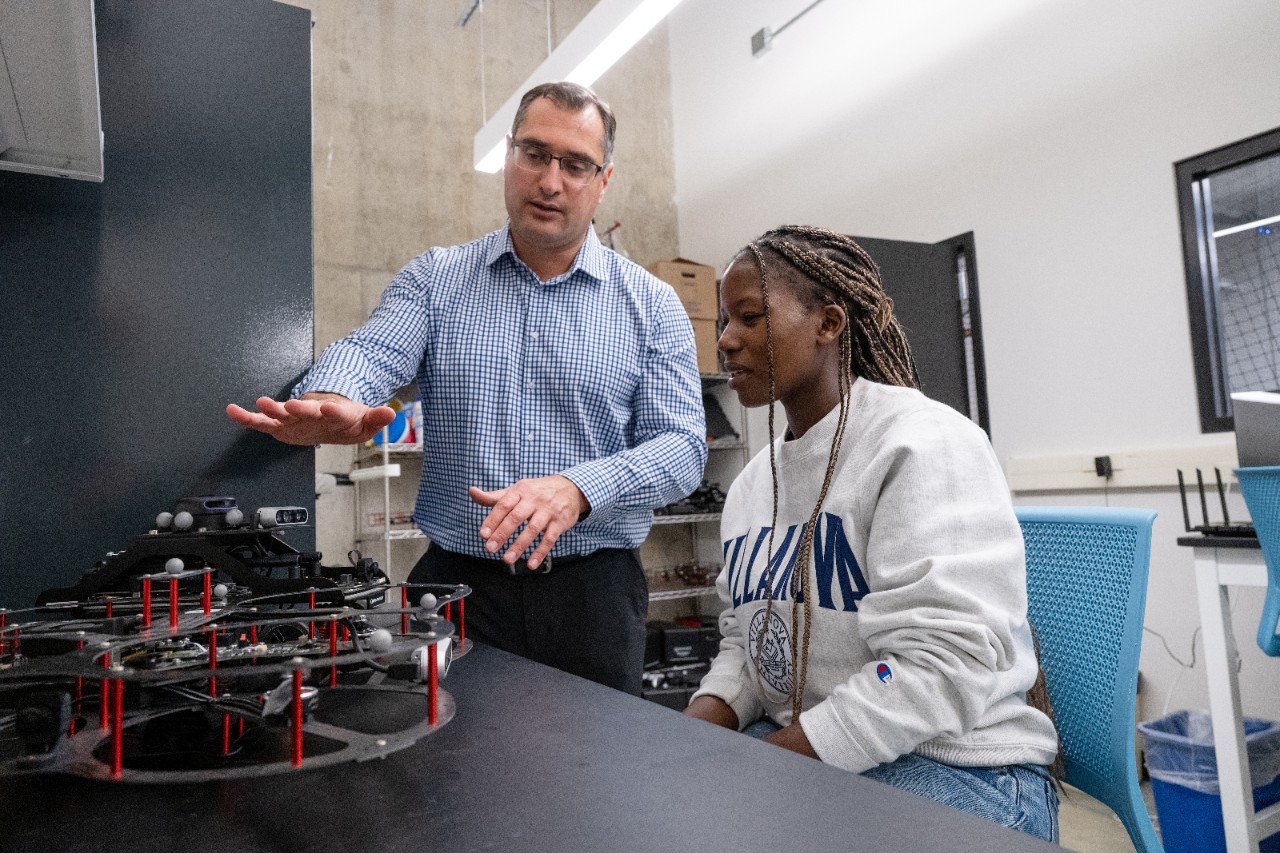
Drone and satellite technology is highly nuanced, with some spacecraft requiring the coordination of up to 12 variables to function properly.
This summer, Dr. Nersesov and his team will embark on designing a new drone prototype. Conventional drones, reliant on thrust for lift, consume significant energy. The innovative design aims to incorporate vertical takeoff and landing (VTOL) capabilities, enabling the drone to transition from helicopter-like vertical flight to airplane-like horizontal flight, thus extending airborne duration up to ten times longer.
Aerospace Engineering with Biology
In another interdisciplinary effort, Qianhong Wu, PhD, chair of Mechanical Engineering, explores super-lubrication, inspired by red blood cells’ movement within the human body. Mimicking the endothelial glycocalyx layer’s function, which facilitates smooth blood flow, Dr. Wu’s research aims to dramatically reduce aerodynamic friction on aircraft, potentially improving fuel efficiency and flight endurance.
“Our work is an example of how thinking outside your traditional field can lead to innovation,” said Dr. Wu. “Sometimes the solution comes from a completely different subject, like biology.”
A Century of Momentum
One hundred years after Goddard’s pioneering flight, aerospace innovation thrives on both monumental missions and the continuous advancements driven by researchers. At Villanova, interdisciplinary collaboration is at the heart of these advancements, fostering new ideas and technologies that propel the field forward.
Read More Here





Comments are closed.