
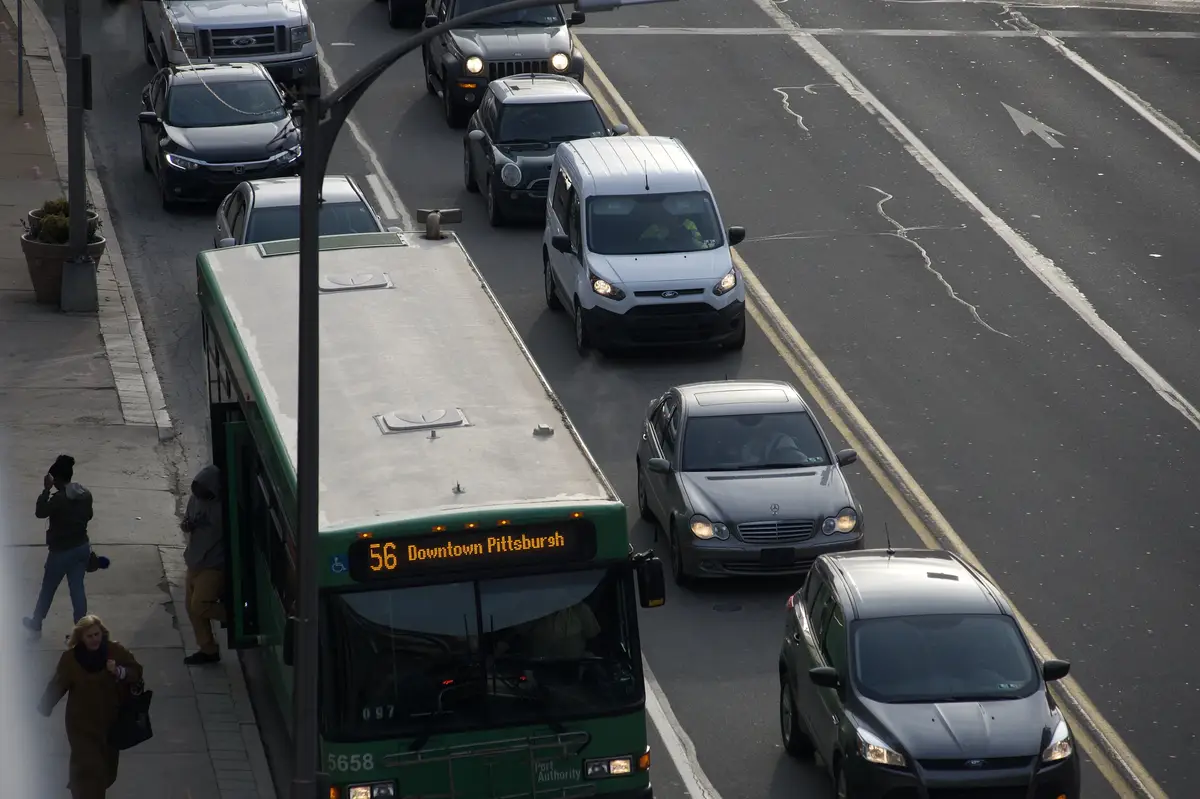
Pittsburgh commuters are bracing for a major traffic disruption as a crucial section of the I-376 Parkway East is set to close for a significant period. This closure will affect thousands of daily travelers, leading to heightened stress and logistical challenges.
Starting July 10, the Parkway East will be shut down in both directions between the Edgewood/Swissvale interchange and the Squirrel Hill Tunnel for about 25 days. This closure, necessitated by the replacement of the Commercial Street Bridge, is expected to impact approximately 100,000 vehicles daily, causing significant congestion on detour routes and nearby roads.
David Creswell, a psychology professor at Carnegie Mellon University, explains that commuting in traffic embodies a classic stress-inducing scenario due to its unpredictability and lack of control. “These sort of mismatches between what we’re expecting versus what’s actually happening really drive a lot of the machinery of one’s psychological and biological stress responses,” Creswell noted.
Creswell refers to a landmark study on New York rail commuters, which found that longer commute times correlated with higher cortisol levels, a stress hormone. This stress also affected performance negatively, as commuters fared worse on tasks like proofreading after lengthy trips.
However, Creswell points out a key difference with the upcoming Parkway East closure: the community has been forewarned. “Public officials have done a great job signaling to the community that this is going to be a major disruption,” he said, adding that this foreknowledge could transform the closure from an uncontrollable stressor to a more manageable event.
More of a Human Coordination Problem than an Infrastructure Problem
The ripple effects of the Parkway East closure extend beyond just the time spent in traffic. Sarah Fox, an assistant professor at CMU’s Human-Computer Interaction Institute, highlights the hidden coordination work this kind of disruption creates for everyone involved, from drivers to transit operators.

“For bus riders, a disruption like the Parkway East closure means constantly recalculating — checking apps, adjusting childcare plans, messaging employers and figuring out backup routes. Transit operators are doing a parallel form of that work at a much larger scale,” Fox explained. She urged commuters to be patient with transit workers as they navigate these challenges.
How to Prepare for the Stress of the Parkway East Closure
Creswell advises commuters to focus on controllable aspects during the closure. “You can’t control the traffic, but you can reach out to your bosses and others and communicate what the challenges are,” he remarked. Mindfulness practices can also help manage frustration, allowing individuals to acknowledge their feelings without letting them dominate the day.
For those dwelling on the disruption after leaving their vehicles, Creswell suggests journaling as a way to process and understand their experiences. Additionally, he encourages commuters to use the extended travel time for personal enjoyment, such as listening to new podcasts or audiobooks, or reconnecting with friends and family through hands-free calls.
Although these strategies may not eliminate the inconvenience of the extended commute, they can help reduce stress and make the closure more manageable.
Read More Here






Comments are closed.