University of Iowa Secures $1.5 Million to Propel Quantum Material Research
The University of Iowa is set to significantly advance its materials science research following a substantial grant of nearly $1.5 million. This funding aims to enhance the university’s capabilities in exploring innovative material combinations for quantum technologies.
The grant, awarded by the U.S. Department of Defense, facilitates collaboration among experts in chemistry, engineering, and physics. Their collective goal is to investigate material combinations that form the basis for quantum systems reliant on light or electronics.
Award Details
Title: “Heterogeneous Nanoscale Materials Collaborative for Quantum Technologies at The University of Iowa”
Total award amount: $1,498,989
Sponsor: U.S. Department of Defense, AFOSR
GAO award date: Sept. 9, 2025
Potential breakthroughs from this research include advanced remote sensors capable of detecting toxins in drinking water and the development of faster, higher-resolution battlefield mapping technologies.
A key aspect of the project is acquiring new equipment to pattern and etch materials, alongside a system that permits layering, similar to constructing a nano-sandwich, to refine their optical and electronic characteristics.
“We want to utilize the quantum mechanical properties of new materials,” stated Ravitej Uppu, assistant professor in the Department of Physics and Astronomy and a principal investigator on the project. “If we can harness these new materials, functionalize them, then we could make sensors that can achieve better image quality and better sensing performance.”
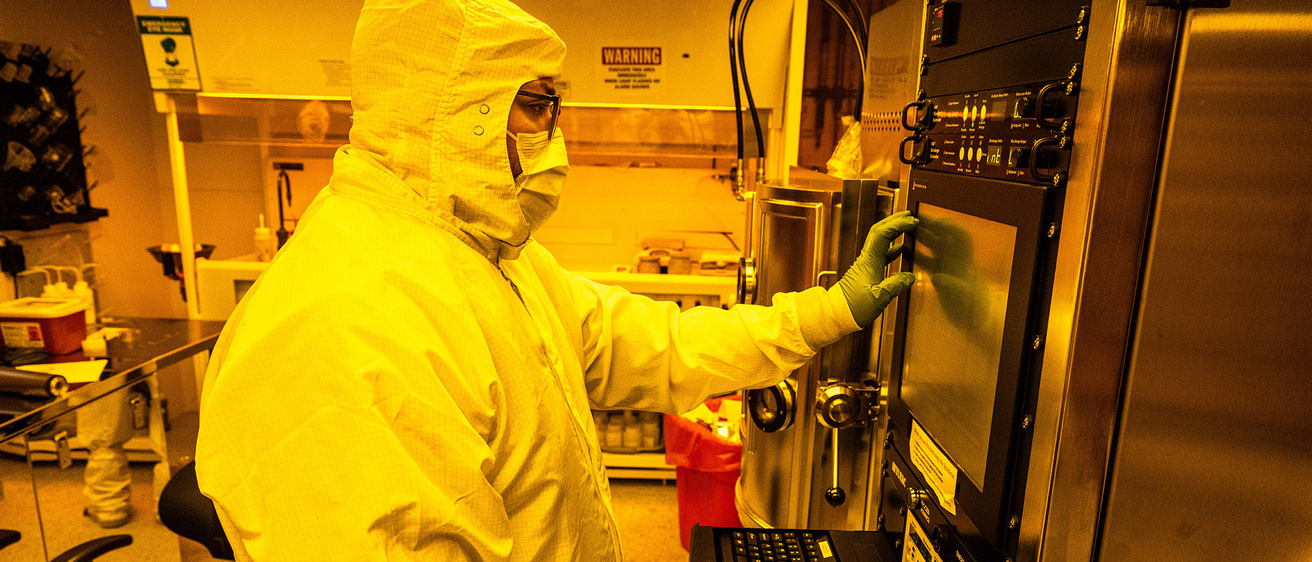
The research will be centralized at the Materials Analysis, Testing, and Fabrication (MATFab) Facility, established in 2019 by the Office of the Vice President for Research (OVPR). This facility, located within the Iowa Advanced Technology Laboratories, spans 1,500 square feet of clean room space and is equipped with tools for micro and nanoscale fabrication.
“This award represents a transformative investment in Iowa’s capacity for advanced materials research and nanofabrication,” remarked Aliasger Salem, associate vice president for research in OVPR. “It enables MATFab to expand into emerging areas such as heterogeneous material integration and quantum device fabrication — fields critical to national competitiveness in defense and energy-efficient technologies.”
“This award will ensure that students can receive training on state-of-the-art equipment and faculty can continue to innovate.”
—Tori Forbes, MATFab director
According to Tori Forbes, professor in the Department of Chemistry and MATFab’s director, the award will replace outdated infrastructure, making it easier for faculty and students to conduct cutting-edge research.
The exploration of quantum technologies by examining materials at the micron and nanoscale level holds significant potential. However, understanding each material’s unique advantages can be complex. The new equipment, funded by the award, will allow Iowa researchers to delve deeper into these materials.
One notable acquisition is a maskless grayscale lithography system, which allows researchers to use a laser to create intricate 3D shapes.
“It has a resolution down to 300 nanometers, so it can make really fine points and make a pattern that can change in height from the surface,” Uppu highlights.
This technology, along with complementary equipment, will enable researchers to etch and stack materials to develop and test compact devices.
“It could help us move our conceptual structures into working devices,” Uppu notes. “That flexibility lets us fabricate everything from light-routing devices to tiny transistors relevant for quantum technologies in a university research setting.”
The opportunities created by the award will be accessible to students and faculty from various Iowa colleges and universities, with MATFab establishing itself as a regional hub for innovation.
“We will train University of Iowa students to use the facilities, and we plan to host a summer school for students from regional colleges where they would learn to use the new materials fabrication tools,” Uppu added. “That way, we create a new bridge between the universities to start thinking about potential collaborative projects. And naturally, MATFab becomes the central hub for that, because it hosts all the required facilities.”
The project is jointly led by John Prineas and Thomas Folland from the Department of Physics and Astronomy.
Read More Here