In a testament to the University of Arizona’s academic excellence, two of its faculty members have been inducted into the prestigious Institute for Advanced Study in Princeton, New Jersey. This century-old institution, known for fostering intellectual growth, has welcomed a select group of about 200 scholars annually to collaborate and engage in research across diverse fields.
Eleni Hasaki, a professor specializing in anthropology and classics, and Irene Bald Romano, who teaches art history and anthropology, are among the newest members of this elite community. This honor highlights their significant contributions to the study of ancient Mediterranean cultures.
The Institute for Advanced Study, once graced by the likes of Albert Einstein, relies on its permanent faculty of about 30 scholars to select visiting members. The focus is on fostering curiosity-driven research, encouraging scholars to pursue innovative ideas in a collaborative environment.
Romano’s primary appointment is with the School of Art in the College of Fine Arts, marking her as the first from her school to earn this recognition. She also serves in the School of Anthropology within the College of Social and Behavioral Sciences and is the curator of Mediterranean archaeology at the Arizona State Museum.
Romano recently embarked on a journey to Kurdistan to examine a collection of Greek marble sculptures unearthed in eastern Iraqi Kurdistan by a British Museum team between 2016 and 2021. Her upcoming spring residency at the institute will allow her to finalize and publish her research on these sculptures.
Courtesy of Irene Bald Romano
“It is a great honor to have been selected to be a member of the esteemed Institute for Advanced Study,” Romano stated, acknowledging her husband, David Gilman Romano, who joined the institute last year. His term focused on editing a second volume of reports from the ongoing Mt. Lykaion Excavation and Survey Project in Greece.
“It is very unusual that three of us from the University of Arizona have been invited to be members of this very selective institute,” Romano remarked, emphasizing the recognition of the university’s faculty quality and program excellence.
Both Hasaki and Romano are eager to engage with leading scholars worldwide through their time at the institute. “It’s one of the greatest recognitions of your work to become a member,” Hasaki shared via Zoom from her institute office, highlighting the diverse expertise and interests of her fellow scholars.
Exploring Ancient Artistry
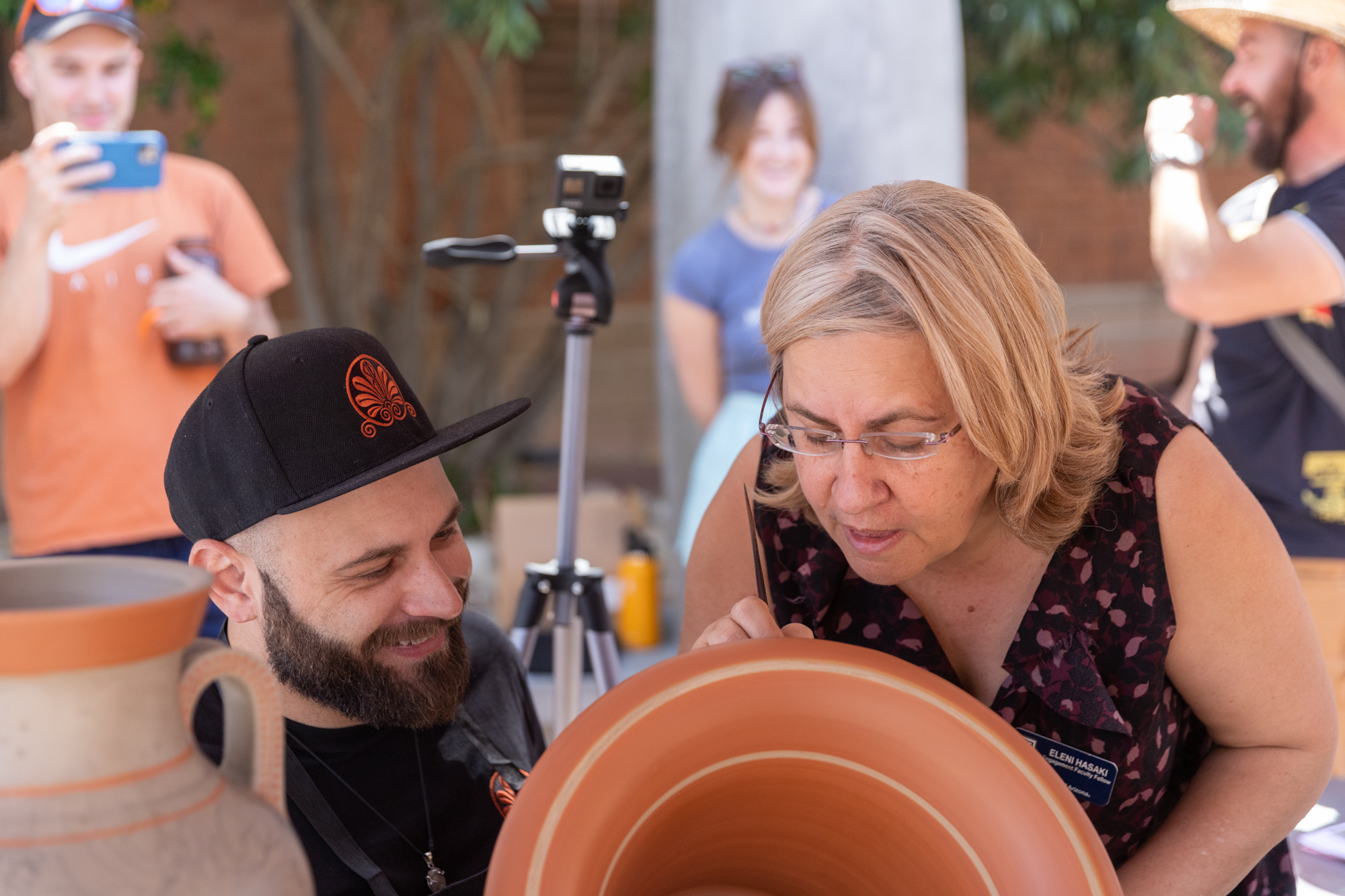
Hasaki’s research delves into the craftsmanship of ancient Greek ceramic artisans. Her work, recognized by the National Endowment for Humanities, has facilitated collaborations with Italian and Greek institutions, bringing traditional artisans to Arizona to demonstrate ancient techniques. Her latest publication, a co-edited book on Mediterranean artisanal networks, showcases innovative ceramic practices by over 50 international experts.
Hasaki also co-leads the School of Anthropology’s Laboratory for Traditional Technology and holds a faculty position in Religious Studies and Classics within the College of Humanities. Her IAS residency will focus on completing a book on ceramics artisans, integrating research from her lab and fieldwork in Greece and Italy.
Romano, an authority on ancient Mediterranean sculpture, began her archaeological career in Greece in 1976. Her extensive experience includes roles at the University of Pennsylvania Museum of Archaeology and Anthropology and as executive director of the American School of Classical Studies in Athens. Recently, her research has explored the fate of antiquities plundered by the Nazis, culminating in an online publication with international scholars.
Romano, who prefers museum storage rooms to excavation sites, will use her institute residency to finalize a publication on Greek sculptures excavated in Kurdistan. She visited the site in October to study these artifacts firsthand.
Hasaki, originally from Greece, believes studying her homeland’s history is vital for understanding modern life. “The culture and the language of ancient Greece surround us,” she noted. “It is a great culture to understand our humanity.”
Read More Here