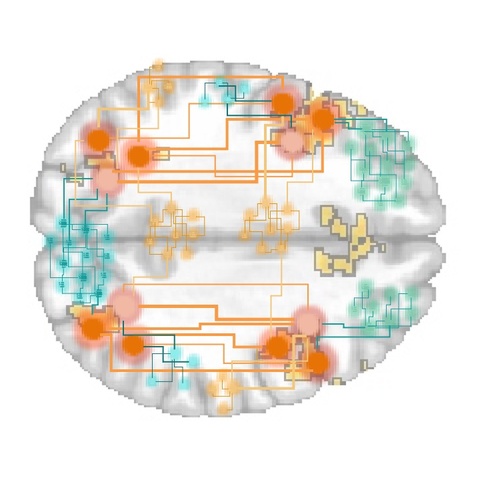
The intricate workings of the human brain are akin to a bustling metropolis, constantly processing and reacting to a myriad of information. During activities like driving, the brain efficiently manages tasks such as route memory, vehicle operation, and adapting to unexpected road changes.
The frontoparietal cortex, situated at the core of this cerebral activity, functions as a central hub, sorting and prioritizing signals, and orchestrating subsequent actions. Researchers from the University of Iowa have delved into the mechanics of this brain region, unveiling its role in managing uncertainty during decision-making processes.
Utilizing a combination of computational modeling and brain imaging, the study highlighted how the frontoparietal cortex dynamically alters its communication with other brain areas based on the decision-making requirements. This research could pave the way for understanding alterations in information exchange in conditions such as ADHD and schizophrenia.
According to Kai Hwang, associate professor and corresponding author, “Our study shows in more detail how the frontoparietal cortex operates — what kind of information it extracts from other systems and how it uses its connectivity pattern to integrate information that is coming in from different areas of the brain.”
Neuroscientists have long acknowledged the frontoparietal cortex’s pivotal role in decision-making. It functions not merely as a data repository but actively filters and prioritizes information based on the task at hand, much like an air traffic controller directing multiple flights.
In a study published in 2025, Hwang and his team found that the frontoparietal cortex builds a high-level summary from various incoming signals, distilling them into a coherent picture to guide the brain’s responses.
“It’s like where other areas of the brain don’t have all the information, so they send what they have to the frontoparietal cortex for guidance,” Hwang explains.
The team further investigated the cortex’s adaptability by instructing 38 participants to learn and then adapt to changing associations between colors, faces, and scenes. This shifting scenario induced uncertainty, providing insights into the cortex’s connectivity with other brain systems.
“If they always get it right, they know they’ve made the correct association, but once they start doing it wrong, they will have to guess, ‘Oh, did the context change, or did I not see the color clearly?’ That creates uncertainty,” Hwang says.
Leveraging data from these experiments and functional MRI scans, the researchers developed a computational model to isolate signals from different brain regions and demonstrate the integrative role of the frontoparietal cortex.
“Rather than simply becoming more active during difficult tasks, we observed how this network dynamically changes how it communicates with other brain regions depending on what information is needed at each stage of a decision,” Hwang says.
This research could significantly impact understanding psychiatric disorders where behavioral adaptation is impaired, such as inappropriate noise levels in quiet environments or impulsive actions, often seen in ADHD.
“These are situations where people struggle with regulating their behavior. That, to me, is an integration problem. If that integration function is not working properly, then that could very likely mean they didn’t use the right context to regulate their behavior,” Hwang says.
Stephanie Leach, a key contributor to the study and the first author, expressed, “Having the opportunity to conduct this research has been especially rewarding because it has allowed me to contribute to answering questions about the most fascinating, mysterious, and complex system we know—the human brain.”
The study, titled “Frontoparietal hub connectivity integrates information from multiple sources,” was published online on July 6 in the Journal of Neuroscience.
Contributing authors include Jiefeng Jiang and Shannon Stokes from the Department of Psychological and Brain Sciences. The research received funding from the National Institute of Mental Health and the Iowa Neuroscience Institute.
Read More Here