In the heart of Washington, D.C., the National Archives Rotunda quietly houses the Declaration of Independence, the U.S. Constitution, and the Bill of Rights. These documents, collectively revered as the Charters of Freedom, draw over a million visitors annually. Few realize that beneath the protective glass lies a testament to the University of Iowa’s (UI) innovative spirit—custom archival paper from the UI’s Center for the Book (UICB).
Watch UI Center for the Book staff create archival paper
Want to see the Center for the Book papermaking process? Watch this video of staff creating the archival paper in 1999.
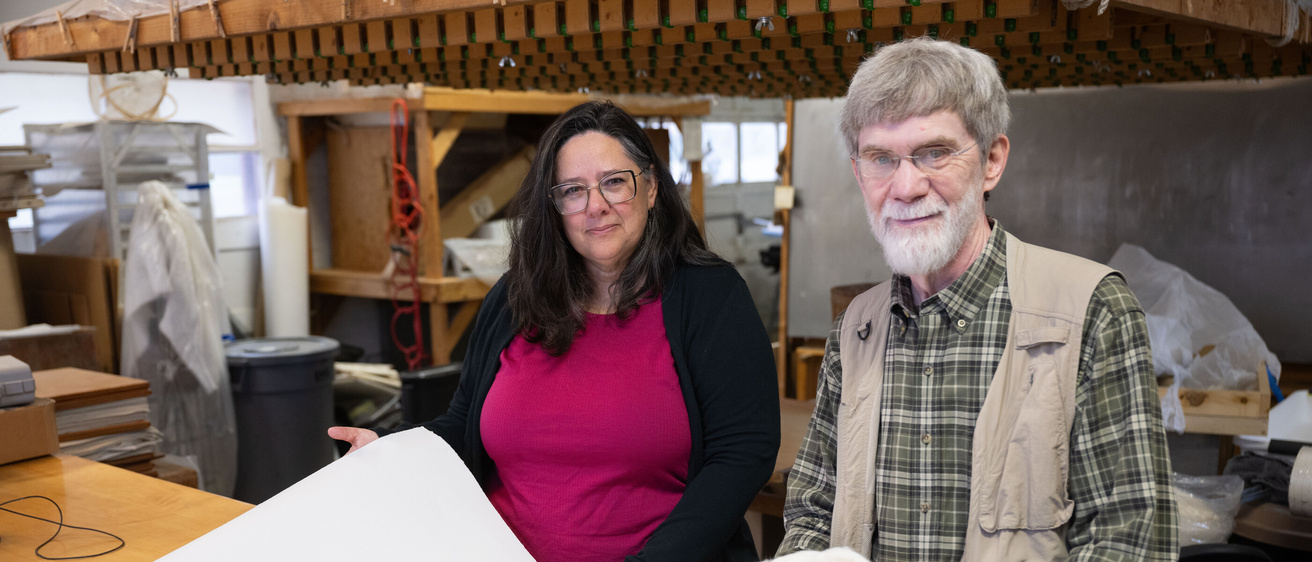
The UICB’s craftsmanship was selected to create this specialized paper due to its established reputation for excellence in paper conservation and innovation. Established in 1986, the center uniquely blends traditional crafts like papermaking with the scholarly study of books’ societal impacts.
“It’s so magical to have been part of that experience, knowing that the work we were doing was helping keep these vital documents safe,” remarked Sara Langworthy, UICB director, who contributed to the project as a graduate student in 1999. The archival paper has also been used for other significant historical documents, including the Magna Carta.
A Call from the National Archives
In 1995, the National Archives and Records Administration (NARA) uncovered microscopic flaws in the cases protecting the Charters of Freedom. This prompted a $5 million project to replace the encasements as part of a broader $100 million refurbishment of the National Rotunda, enhancing accessibility for the countless history enthusiasts.
The new encasements featured titanium frames and tempered glass, along with climate-control systems to preserve the documents. Inside, an aluminum platform with thousands of holes was designed to circulate humidified argon gas, safeguarding the documents from deterioration. The UICB’s paper served three essential functions: enhancing document legibility, providing a cushioning effect, and maintaining stable encasement conditions.
Internationally acclaimed conservation expert Don Etherington led the encasement project. Upon realizing the need for a unique paper solution, he turned to Timothy Barrett, then-UICB director and a MacArthur “genius” fellow. Barrett, who had been experimenting with American-grown cotton and European techniques, provided the ideal solution. The UICB team embraced the challenge, driven by a profound sense of responsibility.
Making Paper
The project demanded unprecedented efforts from the UICB team, including 10 UI students, who had to craft oversized paper sheets. This involved building custom equipment like a 30-by-30-inch press and ensuring paper thickness precision to meet conservation requirements.
At the UI Oakdale Campus’ Paper Research and Production Facility, the team worked diligently. They transformed high-quality cotton into pulp, formed thin sheets, and pressed them into durable paper. After meticulous testing, 25 sheets met the strict specifications, shipped to the National Archives for final installation.
Today, the UI-crafted paper supports the Charters of Freedom, proudly displayed in the Rotunda since 2003. “Iowa helped preserve America’s founding documents, and really, at the end of the day, it’s because the people of the state of Iowa support the UI and make this kind of innovative research possible,” Barrett stated, emphasizing the community’s role in this achievement.
Read More Here