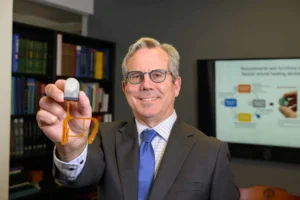
In an era where artificial intelligence (AI) is rapidly transforming workplaces, researchers from Carnegie Mellon’s Tepper School of Business are exploring how this technology can enhance teamwork rather than replace human interaction. Their inquiries delve into the role AI could play in reshaping workforce dynamics and improving collective performance.
AI and Teamwork
Anita Williams Woolley, a professor specializing in organizational behavior, is leading the charge in this investigation. Her research focuses on collective intelligence and the potential impact of AI on it. Woolley is particularly interested in “technology that can help us become a better version of ourselves individually,” and how it could reshape work structures for greater effectiveness.
Woolley and her team have developed a framework called Collective HUman-MAchine INtelligence (COHUMAIN) to identify the appropriate spaces for AI within organizational social psychology. Their work suggests AI should not be treated as just another teammate but as a partner that can enhance existing capabilities and relationships. “AI agents could create the glue that is missing because of how our work environments have changed,” Woolley noted.
While AI’s integration might change how work is done, it won’t alter the core principles of organizational intelligence. The framework advises against relying on AI to fulfill human roles, such as interpreting social cues during meetings, which remains a human domain.
Safety and Risk Considerations
With the increasing digitization of workplace interactions, AI tools could help bridge gaps between colleagues. However, this raises concerns about data privacy and the implications of recording interactions. “People have a lot of sensitivity, rightly so, around privacy,” Woolley mentioned, emphasizing the trade-offs between privacy and technological benefits.
Allen Brown, a Ph.D. student, is examining how AI affects users’ willingness to take risks and speak up in group settings. He believes AI could foster environments where people feel more comfortable sharing ideas. Yet, he also notes that the digital trace left by AI interactions could lead to concerns over evaluation and monitoring, which might affect user behavior.
Brown aims to identify how AI can enhance psychological safety, allowing for more open communication in various professional relationships. “How does AI help resolve the decision-making process or enhance the resolution so that people actually feel increased psychological safety?” he asks.
Building Trustworthy AI
At the individual level, Tepper researchers are studying how AI’s transparency affects user trust and decision-making. Researchers Zhaohui (Zoey) Jiang and Linda Argote focus on comparing transparent versus black box AI systems. Jiang points out, “We see a lot of people advocating for transparent AI,” but notes that high-ability participants might benefit from less transparency to avoid overconfidence and AI aversion.
For less-skilled decision-makers, transparent AI can improve outcomes by offering insights into the AI’s decision-making process. Jiang explains, “When we’re not telling these participants how the model arrived at its answer, participants judge the model as the most complex,” underscoring the perceived sophistication of opaque systems.
Future AI systems might dynamically adapt to user needs, enhancing decision-making efficiency. Jiang envisions AI that could “recognize the decision-making inefficiencies of that particular individual that it is assigned to collaborate with.”
Read More Here