Innovative Approach by Villanova Researchers Revolutionizes Nanomaterial Integration on Varied Surfaces
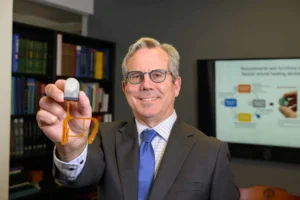
Bo Li (left) with Liang Zhao (right).
VILLANOVA, Pa. (October 8, 2025) — Bo Li, PhD, associate professor at Villanova University, along with Liang Zhao, PhD, a recent graduate and postdoctoral scholar, have secured a patent for a novel method of applying nanomaterial coatings that could transform multiple sectors.
Amanda Grannas, PhD, Vice Provost and Chief Research Officer at Villanova, remarked, “This patent represents a significant leap forward in how nanomaterials can be integrated onto everyday surfaces. Dr. Li and Dr. Zhao have developed a versatile solution to a longstanding challenge in materials science, and we are excited to see how this technology will drive real-world applications across multiple sectors.”
Nanomaterials, due to their microscopic scale, are widely applicable in fields like medicine and clean energy but require deposition onto larger substrates to function. Challenges arise when nanomaterials and substrates differ chemically, hindering adherence.
Dr. Li and Dr. Zhao have created a technique that allows nanomaterials to adhere to substrates with differing properties. This is achieved by introducing a solute, such as salt, into a water solution with the nanomaterials, enabling uniform coatings on any given substrate. Traditional methods often damage materials by converting their surfaces from hydrophobic to hydrophilic.
Dr. Li explained, “Adding a bit of salt becomes a magic ingredient to modulate the interface between nanomaterials and the substrate. They may not like each other at first, but after adding salt they start to work together.”
This solute-assisted method broadens the scope of nanomaterial applications, including in advanced textiles and flexible electronics. “In the future, with artificial intelligence and the continued development of electronics, we may want clothes to be more functional—able to monitor health, block UV radiation, or even self-heat. Our technology can help enable that,” Dr. Li noted.
The patented technology enhances polymer functionality in textiles, facilitating the integration of electronic devices for heating or health monitoring. Dr. Zhao emphasized the method’s adaptability, stating, “Until now, we have not found a single nanoparticle that cannot be adapted using our method.”
The patent paves the way for industry partnerships and commercialization. Dr. Li and Dr. Zhao are exploring licensing opportunities, with future efforts aimed at incorporating nanomaterials into smart home cooling solutions.
Read More Here