A Pathway to Wellness: Arizona’s Ambitious Trail Project
Northern Arizona University (NAU) is leading a transformative effort to enhance Arizona’s outdoor recreational landscape. Supported by a grant from the National Park Service (NPS), NAU researchers are collaborating with the Sun Corridor Trail Association, NPS Rivers and Trails Conservation Assistance Program, and multiple counties to create an extensive trail system known as the Sun Corridor Trail. This ambitious undertaking aims to connect the state through a continuous 1,500-mile trail.
Over the last six years, Franklin Vernon, an associate professor in the Department of Geography, Planning, and Recreation, has led a team of students in mapping trails across Arizona. With new funding, their work will continue for another five years, focusing on enhancing connectivity between cities like Flagstaff and Williams.
“The idea is to increase connectivity, for example, between Flagstaff and Williams through front-country experiences where you could get on an e-bike in Flagstaff and go over to Williams to have lunch there with your family and then be able to come back to Flagstaff,” Vernon explained. “All while never really having to venture into remote, rugged, primitive trails and terrain.”
The extensive trail will start in Douglas, a town on Arizona’s southern border, and stretch northwest to Bullhead City, eventually reaching Las Vegas. NAU’s role began with developing criteria for trail routes, involving extensive research and collaboration with local experts.
“There are a lot of people all over the state actively working on this project,” Vernon said. “We developed the inclusion and exclusion criteria, the minimum qualifications, the field guides for going out and ground truthing—and the processes for post-field analytic work.”
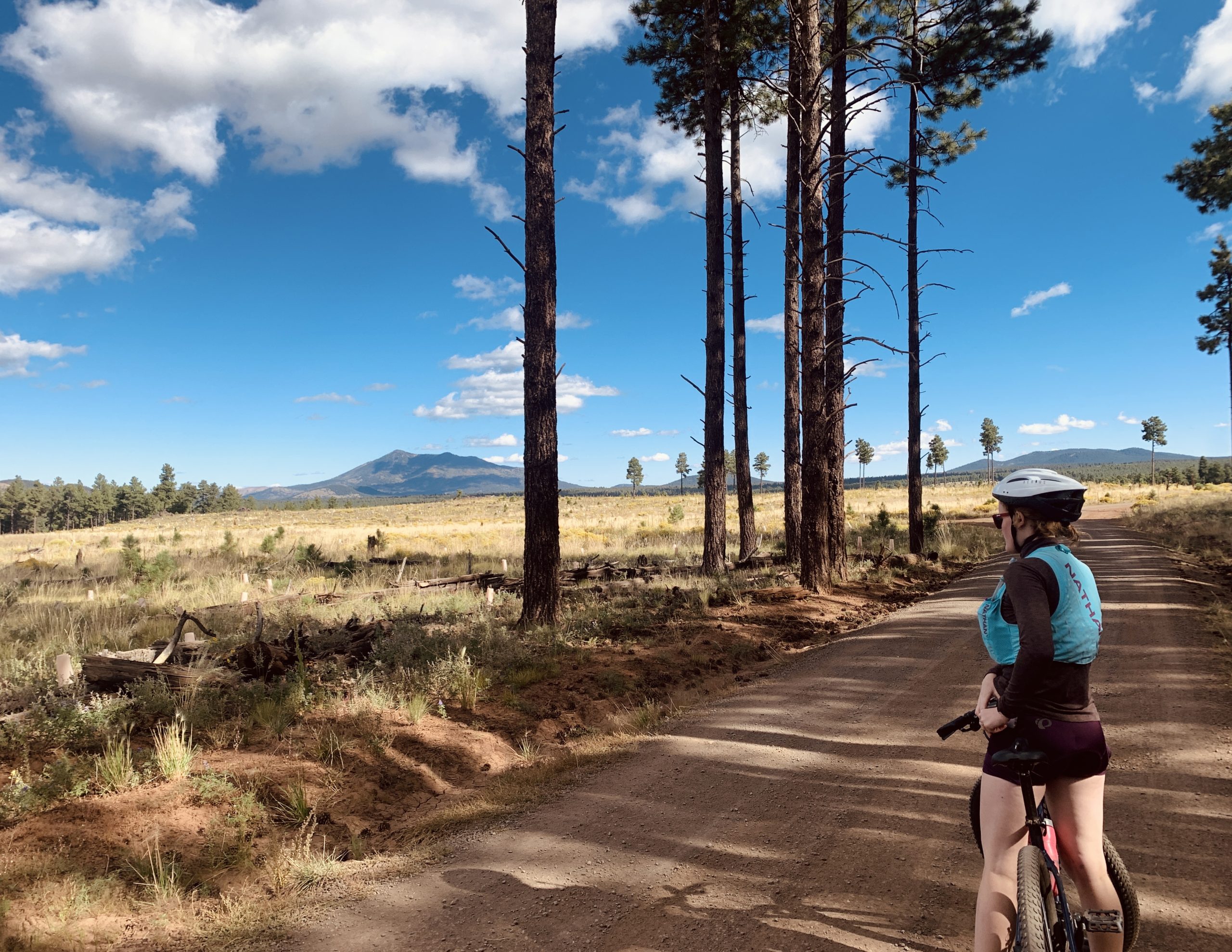
The trail mapping is a meticulous process, contingent on seasonal weather variations. In summer, work is focused in northern Arizona, while cooler months are reserved for southern regions. Before fieldwork begins, Vernon’s team consults with local experts to establish potential trail alignments. Equipped with GPS devices, cameras, and field journals, the team conducts detailed mapping on mountain bikes.
“Over the course of the day, we’ll be navigating some section of an alignment to connect those communities and spending a whole lot of time just standing around with our field guides open, taking notes and collecting data,” he noted. “We look at the surface material and terrain conditions, exposure and elevation change, gradient, escape routes and access to resources, among other criteria.”
Data collected on these expeditions is compiled into a database, where potential routes between communities are evaluated and refined. The team’s recommendations are then shared with partner organizations, offering insights into possible trails and necessary infrastructure.
Collaborative Efforts for Expedited Progress
Recognizing the scale of the project, Vernon’s team plans to train additional fieldworkers over the next two years. This will enhance their capacity for data collection, with NAU serving as a central data repository. The initiative promises to bolster community connections and outdoor activity, potentially increasing property values and fostering greater public engagement with nature.
Community feedback has emphasized the desire for trails that serve both recreational and practical purposes. “People want options and ways to travel without necessarily needing to get into a car,” Vernon remarked. “Having access to trail systems, especially active transportation kinds of trails, provides people with ample opportunity for relatively accessible, low-risk outdoor recreation where people can be outside exploring, exercising and spending time with friends. Evidence-based research shows that spending regular time in natural environments, especially doing low-stress recreation, can provide not only physical benefits but also psychological ones by reducing stress and improving one’s perception of well-being.”
Read More Here