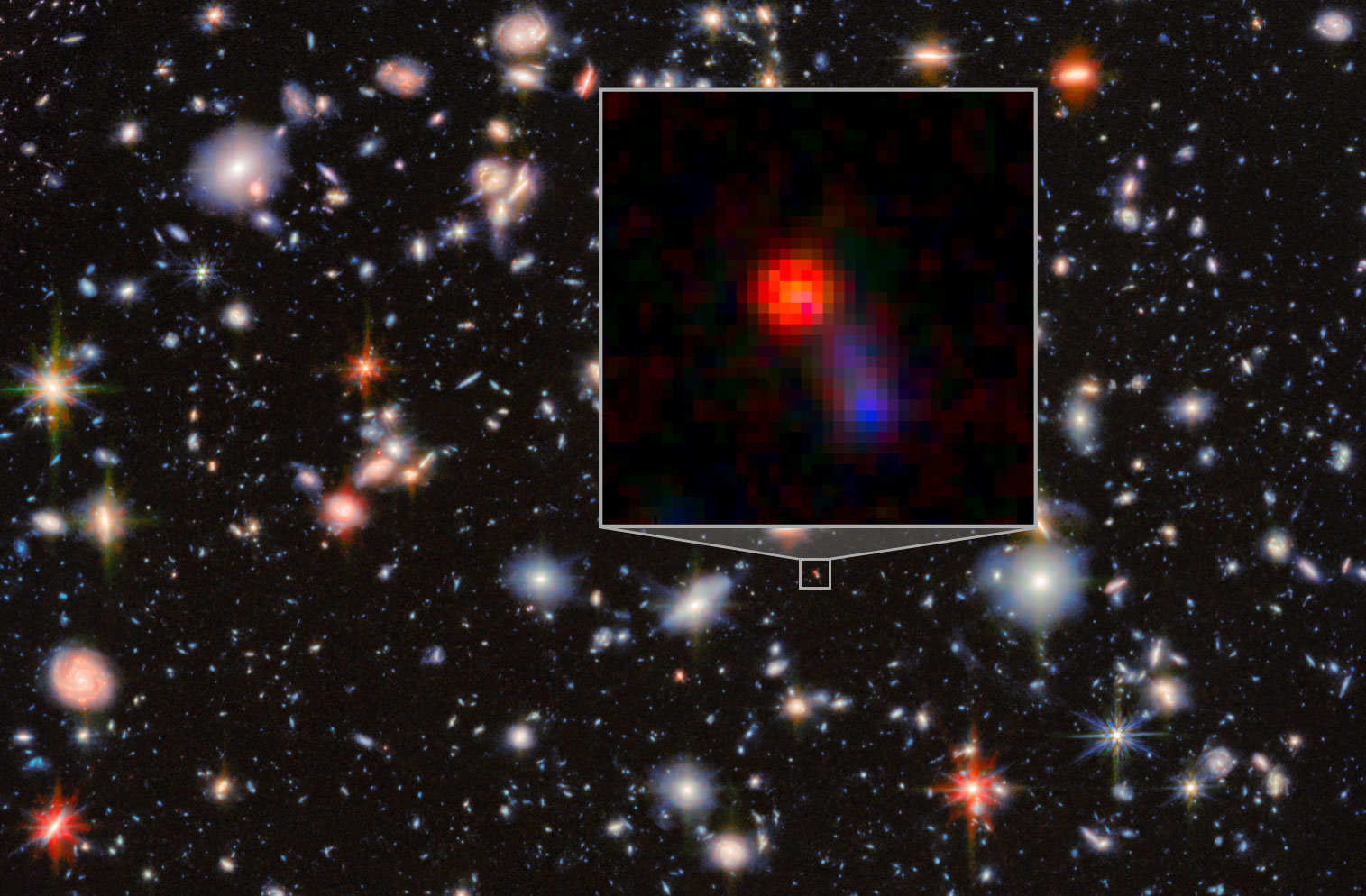
In an extraordinary observation of the cosmos, astronomers have captured a galaxy from the universe’s youth, appearing only 800 million years post-Big Bang. This galaxy, named Virgil, presents a dual nature: it resembles typical galaxies in visible and ultraviolet light but reveals a hidden side when viewed in infrared.
Virgil has prompted a reevaluation of how supermassive black holes may have evolved soon after the universe’s inception. The research, conducted by University of Arizona Steward Observatory astronomers George Rieke and Pierluigi Rinaldi, now with the Space Telescope Science Institute, was published in The Astrophysical Journal. It uncovers Virgil’s concealed feature: a supermassive black hole at its core, consuming matter at an exceptional pace, with its energy output masked by dense dust. The black hole’s size exceeds expectations for its host galaxy, classifying it among “overmassive” black holes that challenge existing theories about early universe black hole formation.
The findings question current hypotheses on the co-evolution of supermassive black holes and galaxies. Prior to NASA’s James Webb Space Telescope (JWST), it was thought that galaxies formed first, with black holes growing within them over time. However, Rieke, a Regents Professor of astronomy, notes, “JWST has shown that our ideas about how supermassive black holes formed were pretty much completely wrong.”
Virgil is part of a peculiar group known as Little Red Dots (LRDs), characterized by their extremely red appearance due to cosmic expansion. Detected by JWST, these objects sparked debate, appearing plentiful 600 million years after the Big Bang but nearly vanishing by 1.5 billion years. Their origins are debated, ranging from star formation to exotic phenomena like matter-antimatter annihilation.
As the reddest of the LRDs found so far, Virgil’s existence raises questions about the fate of these early cosmic structures since they must persist in some form today. This discovery deepens understanding of early black hole development and may help resolve the LRD enigma.
The University of Arizona’s contributions are highlighted by the discovery, made possible by JWST’s Mid-Infrared Instrument (MIRI), led by Rieke. Observations using only JWST’s Near Infrared Camera (NIRCam) or Near-Infrared Spectrograph (NIRSpec) would misclassify Virgil as a typical star-forming galaxy.
The study indicates that some extreme cosmic objects may be undetectable without infrared observation, which reveals phenomena obscured by dust. Rieke describes Virgil’s dual nature: “The UV and optical show its ‘good’ side – a typical young galaxy quietly forming stars. But when MIRI data are added, Virgil transforms into the host of a heavily obscured supermassive black hole pouring out immense quantities of energy.”
Rinaldi, who focused on MIRI observations, explains, “MIRI basically lets us observe beyond what UV and optical wavelengths allow us to detect.” This capability is crucial, as many high-redshift JWST surveys prioritize NIRCam imaging over MIRI due to time constraints, potentially missing dust-concealed black holes like Virgil.
The implications are significant, suggesting a concealed population of black holes may have influenced cosmic history, possibly contributing to the universe’s reionization during its early “cosmic dawn.” Rinaldi questions whether Virgil’s uniqueness is due to observational limitations rather than rarity, stating, “Are we simply blind to its siblings because equally deep MIRI data have not yet been obtained over larger regions of the sky?”
The team anticipates conducting more in-depth MIRI observations to determine if Virgil is an outlier or part of a larger, hidden population. Rinaldi concludes, “JWST will have a fascinating tale to tell as it slowly strips away the disguises into a common narrative.”
Read More Here