Under the leadership of Deena Weisberg, PhD, Villanova’s Scientific Thinking and Representation (STAR) Lab explores the role of imagination and storytelling in learning and scientific comprehension
The human brain, capable of holding as much data as 20,000 iPhones, remains a vast and intricate frontier for scientific exploration. This complexity and potential for discovery lie at the heart of the research conducted by Deena Weisberg, PhD, who directs the Scientific Thinking and Representation (STAR) Lab at Villanova University. Dr. Weisberg, alongside a team of 12 researchers, delves into how stories and narratives can shape our understanding of the world.
“Essentially, there are two umbrella questions that guide our lab’s work,” says Dr. Weisberg. “First, ‘How do we think scientifically?’ In other words, how do we engage in those habits of mind that allow science to happen… Second, ‘How does the imagination work in adults and in children?’ How does it develop, and how does it play a role in our real lives?”
The Wonders of “What If”
Since 2018, the STAR Lab has been a hub for research on cognition, but Dr. Weisberg’s interest in the mind’s imaginative capabilities began long before her tenure at the university.
“When I was a young child, I would just spend hours and hours buried in books about Narnia, Middle Earth and the Land of Oz—any of these fantastical, amazing places where novels can take you,” she shares. “Even then, I wondered, ‘How does this work?’ ‘How do we get from black squiggles on a white page [to] a picture in my head of these characters and their struggles and these magical objects and these incredible faraway places that don’t actually exist?'”
Her curiosity led her through studies in English, linguistics, philosophy, and computer sciences, eventually guiding her to research in cognitive processes and imagination.
“When I say ‘imagination,’ people usually think that I’m talking about creativity, which isn’t always the case,” says Dr. Weisberg. “Creativity is really a very small slice of imagination. There’s very little that any of us do on an ordinary day that could be considered truly creative, but there’s a lot that all of us do on an ordinary day that’s imaginative—that is to say, not tied to the current truth of reality.”
Imaginative thinking, or “what if” scenarios, range from mundane choices like dinner options to fantastical dreams of space travel, allowing us to explore the possible and the impossible alike.
This fascination with the imaginative processes of the brain forms a central theme in Dr. Weisberg’s work at Villanova, providing insight into educational materials and programs—a key focus of the STAR Lab.
Science, Imagination and Media
Dr. Weisberg’s research team tackles a variety of projects, including how science fiction influences perceptions of reality and how well people can discern AI-generated content from human-made. One significant area of study is how science-focused media resonates with audiences.
“Science is a really fun area for so many reasons,” says Dr. Weisberg. “But one of the main reasons is that real-life science is fantastical in a lot of ways. What we know to be true about reality—the things our best science tells us about reality—are a little bit strange.”
For instance, the fact that matter is mostly empty space challenges our perceptions of solidity, as Dr. Weisberg demonstrates by tapping on a table. Communicating such concepts effectively is a primary goal for the lab.
One of their experiments explores anthropomorphism in children’s educational books. By presenting preschoolers with different versions of “The Lost Little Quoll,” researchers investigate how different character presentations affect information retention.
“We were really interested in seeing whether having a human character say, ‘Quolls are nocturnal,’ as opposed to having a kangaroo share the same information, would help with retention,” shares Dr. Weisberg. “Early evidence seems to indicate it does.”
Another study, published in the Journal of Children and Media, examined children’s responses to a PBS program episode focused on conservation. Led by Aarti Bodas, the research assessed whether children could learn water-saving strategies from the show.
Dr. Weisberg explains, “We basically gave kids a choice at pre-test: ‘The character is deciding what to do. Should they take a short shower or a bath?’ And then they watched the episode—where the narrator emphasizes the positive impact of taking short showers and the ‘Nature Cat’ gang do so—and we asked them again afterward, ‘What should this character do to help nature? Should they take a short shower or a bath?'”
The study found that participants struggled with the conservation messages, highlighting challenges in making such concepts relatable to young viewers.
“I think the final results speak to an imaginative disconnect,” says Dr. Weisberg. “Some of the actions presented within the video, like fixing leaks, are not really meeting kids where they currently are. Your average six-year-old isn’t going to be finding leaks and pointing them out to their parents or getting a wrench and fixing them like the show’s characters.”
Building the Braintrust
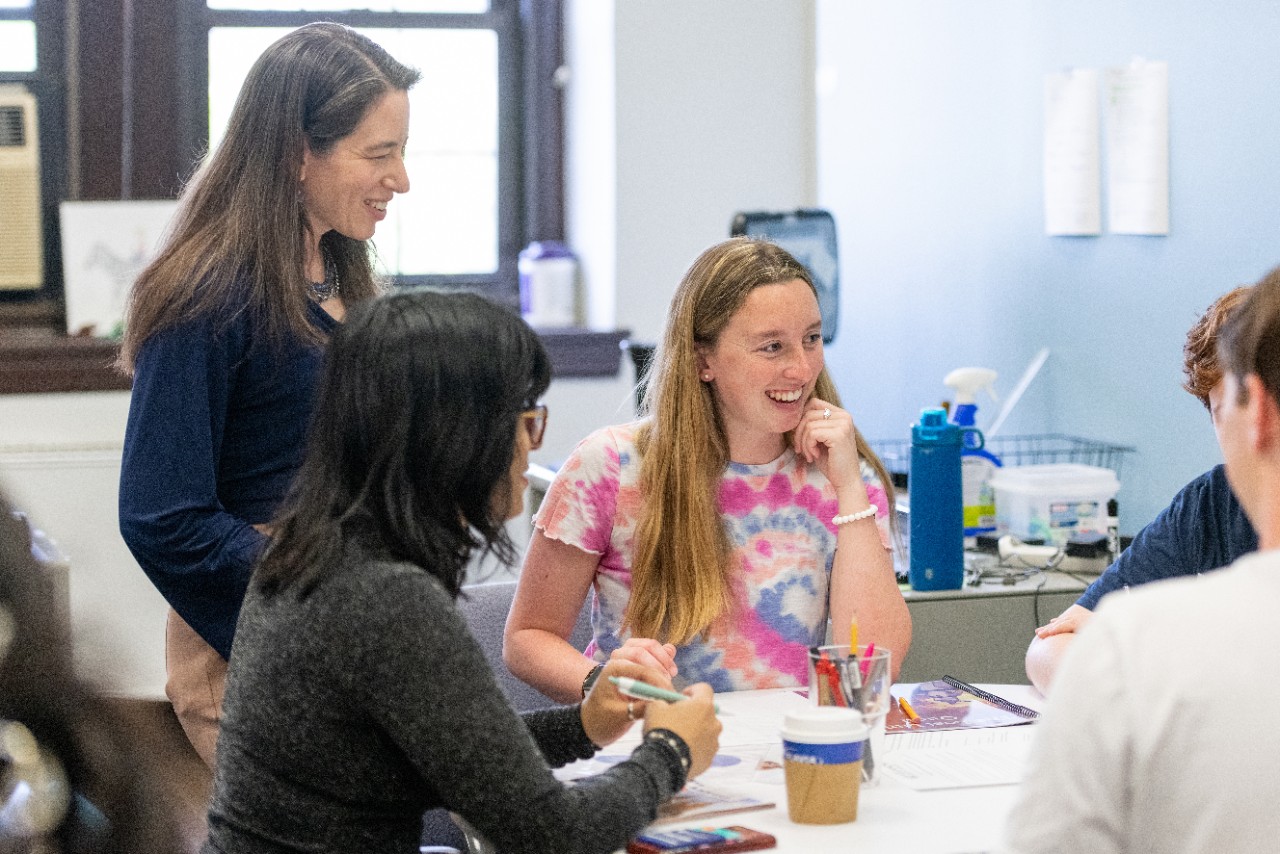
Though Dr. Weisberg jokes about the personal nature of her lab’s work as “me-search,” the research extends beyond individual interests to offer broader implications for education and communication.
“Through our research, we’re shaping the way we reach and teach people, particularly children,” says Nick Menendez ’26 CLAS, who has worked on Dr. Weisberg’s project on anthropomorphism. “I find working with kids especially meaningful, because they’re the wave of the future. They’re the ones who are going to drive innovation, and make advancements, as we move forward.”
“The abilities we study are not just significant for scientists,” adds Jillian Umstead ’26 MS, a graduate assistant at the STAR Lab. “Whether it’s a child learning from a storybook, an adult becoming more empathetic after reading a novel or someone struggling to make sense of scientific information in a classroom, these processes shape how all of us understand the world. Studying them also then helps us to improve education, foster creativity and strengthen critical thinking across all stages of life.”
By intertwining storytelling with scientific inquiry, the STAR Lab provides insights that are valuable to educators, content creators, and parents, revealing the hidden forces that shape how we think and learn. Dr. Weisberg and her team continue to explore the imaginative questions that lead to meaningful discoveries.
Read More Here