
From the intricate formations on your eyelashes to the delicate patterns that dissolve on your tongue, snowflakes have long captured human fascination as winter’s unique artistic creations.
These frozen wonders, known for their singular and unrepeatable designs, are shaped by a blend of scientific processes. Water molecules freeze and adhere in the cold air, forming intricate hexagonal designs often invisible to the naked eye. The ever-changing temperatures and humidity levels ensure that no two snowflakes are identical.
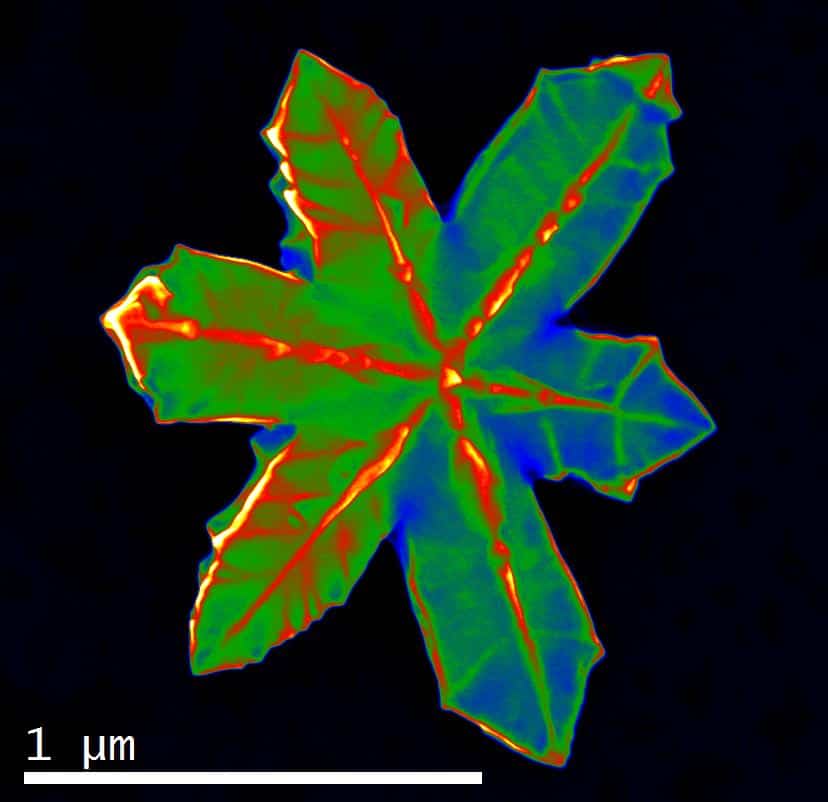
Intriguingly, snowflakes are not the only microcrystals to form through complex processes. According to a recent study by Northern Arizona University’s Department of Applied Physics and Materials Science, similar phenomena occur with artificially created gold, copper, and iron nanocrystals. These metal particles, when subjected to rapid chemical reactions, cluster into pentagonal structures reminiscent of snowflakes, signaling a potential breakthrough in nanotechnology.
Joelin A. Agyei-Mensah, a doctoral student in applied physics and the study’s lead author, conducted this research over two years as part of her graduate work. The study also involved contributions from Philip Asare, another doctoral student, J. Jesús Velázquez Salazar, a research scientist at the Center for Materials Interfaces in Research and Applications (¡MIRA!), and Miguel José Yacamán, a Regents’ Professor.
Their paper became the cover story for the journal Small, spotlighting their findings in nanoscience and nanotechnology.
“For the first time, we demonstrate that the emergence phenomenon seen in snowflakes plays a key role in nanotechnology,” explained José Yacamán. “By introducing the physics of complex systems, we can help individuals understand and control nanomaterial synthesis and advance the field toward broader applications.”
In the challenging realm of modern nanotechnology, scientists strive to influence the formation of nanomaterials reliably. The growth of nanoparticles hinges on a blend of thermodynamic and kinetic elements that make it hard to predict or replicate the outcomes.
To counter these challenges, researchers typically build materials slowly at high temperatures, methods that often result in imperfect shapes for nanoparticles. However, in this study, Agyei-Mensah and her team adopted a novel approach characterized by rapid reactions.
They heated a silicon chip to approximately 280 degrees Celsius (over 500 degrees Fahrenheit) and applied metal salts with chemical agents to promote growth. This rapid reaction, occurring in less than 10 seconds, allowed them to observe and document the nanoparticle growth process.
Their experiment yielded a variety of unique multimetallic structures. While smaller crystals showed simple shapes, larger ones exhibited pentagonal symmetry, concave surfaces, and hollow interiors. Though overall shapes were repeated, each particle differed in metal composition.
José Yacamán attributes these unique formations to the scientific concept of emergence. This principle describes how complex systems manifest properties absent in their individual components. It offers insights into phenomena across multiple fields, from biology to poetry.
 “An important example of emergence is human reproduction,” José Yacamán noted. “When the embryo starts to grow, many chemical reactions and physical phenomena are present during the self-assembly, and the result is diversity. No two humans are the same, just like snowflakes, because the self-assembly can follow different paths.”
The study suggests that both metal crystals and snowflakes are shaped by similar emergence dynamics. Nanoparticles aggregate to form larger superstructures, resulting in distinct metallic forms akin to snowflakes.
This revelation paves the way for numerous applications of multimetallic nanoparticle synthesis. By harnessing the principles of emergence, scientists might achieve improved control over nanomaterial creation, addressing a widespread challenge and enabling unprecedented scientific advancements.
“Most natural phenomena are complex and can become chaotic, such as the weather or the stock market, in which long-term predictions are very difficult,” José Yacamán stated. “Nevertheless, complex systems result in a state which is not necessarily chaotic. Our possibility of prediction is very limited, but we can get an approximate idea of the outcome.”
Further details on this study are available in Small’s virtual publication.
Read More Here