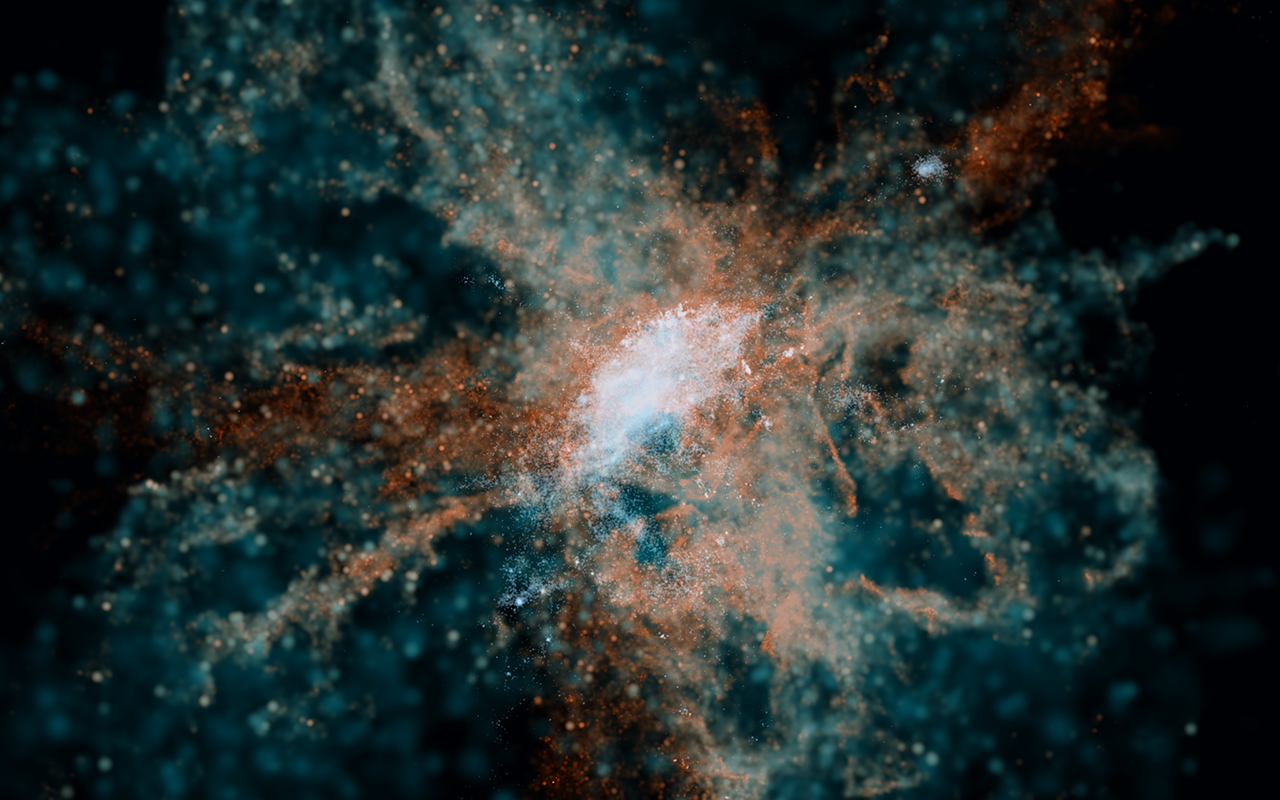
Long before the universe reached its current maturity, stars and galaxies were already forming and shaping the cosmos. Just 500 million years after the Big Bang, or a mere 3% of the universe’s current age, celestial bodies had begun to emerge. While it was previously believed that the gas surrounding these young galaxies was largely untouched and consisted mostly of hydrogen and helium, recent findings challenge this assumption.
A study conducted by astronomers at the University of Arizona and published in Nature Astronomy suggests that galaxies were dispersing heavy elements such as oxygen and carbon much earlier than previously thought.
“We observed that heavy elements escaped from galaxies very, very early in cosmic time,” stated Yongda Zhu, the study’s first author and a postdoctoral researcher at the University of Arizona’s Department of Astronomy and Steward Observatory. “Not only were the galaxies producing these elements, but they were also dispersing them, possibly seeding other galaxies.”
Origins of Cosmic Elements
The early universe was predominantly filled with hydrogen and helium. Over time, these elements coalesced under the influence of gravity to form stars. Within the intense environment of stars, nuclear fusion and other reactions led to the formation of more complex elements like carbon and oxygen. When stars reached the end of their lifecycle, often exploding as supernovae, they spread these elements into the cosmos, contributing to the formation of planets and even life itself.
Despite these processes being understood, the timeline and mechanisms through which heavier elements disseminated from early galaxies remained unclear until now.
Investigating Early Galaxies
Zhu’s research focused on three ancient galaxies, whose light has journeyed for over 13 billion years, offering a glimpse of them 500 million years after the Big Bang, during the Epoch of Reionization. This era marked the ionization of hydrogen gas, ending the cosmic “dark ages” by allowing ultraviolet light to traverse the universe more freely.
“We used the galaxies themselves as background light sources,” explained Zhu. “As light from the galaxies traveled toward Earth, it passed through surrounding gas, and we were able to look at the light’s absorption patterns to detect specific elements.”
The observations were facilitated by NASA’s James Webb Space Telescope, which, with its infrared capabilities, allowed researchers to detect faint absorption patterns in the galaxies’ spectra, revealing the presence of heavy elements like carbon, oxygen, and silicon. The absorption lines appeared “blue shifted” relative to the galaxies’ redshift, indicating that these elements were being propelled into intergalactic space.
The chemical signatures of these nascent galaxies bore a striking resemblance to those of more evolved galaxies billions of years later, suggesting that even at this early stage, galaxies were producing and disseminating heavy elements into their surroundings.
“Think of these elements, which originated from the galaxies’ stars, as food dye dropped into a cup of water,” Zhu described. “The color begins to spread through the water, and, in a similar fashion, these heavy elements from early galaxies began to escape into space and ‘enrich’ their surroundings.”
Baryon Cycling in the Early Universe
The exchange of material between galaxies, known as baryon cycling, underscores the interconnected nature of galaxies within a larger cosmic ecosystem. Material generated by one generation of stars can be recycled and redistributed, contributing to the ongoing cycle of matter.
This early baryon cycling might elucidate why astronomers struggle to locate the first generation of stars, known as Population III stars. These stars, believed to have formed from pristine gas consisting only of hydrogen and helium, may have been scarce if galaxies were already enriching their environments soon after the Big Bang. As Zhu metaphorically put it, “If you start out with pure vanilla ice cream but start mixing in sprinkles soon after, it won’t be long until you can no longer find any pristine, plain, vanilla ice cream.”
Read More Here