An Innovative Approach to Water Scarcity: Harnessing Sunlight to Capture Water
Amidst growing concerns about global water shortages, a groundbreaking study from the University of Iowa presents a potential solution that leverages sunlight to capture and store water from the air. This innovative method could offer a sustainable and energy-efficient way to deliver water to areas with limited resources.
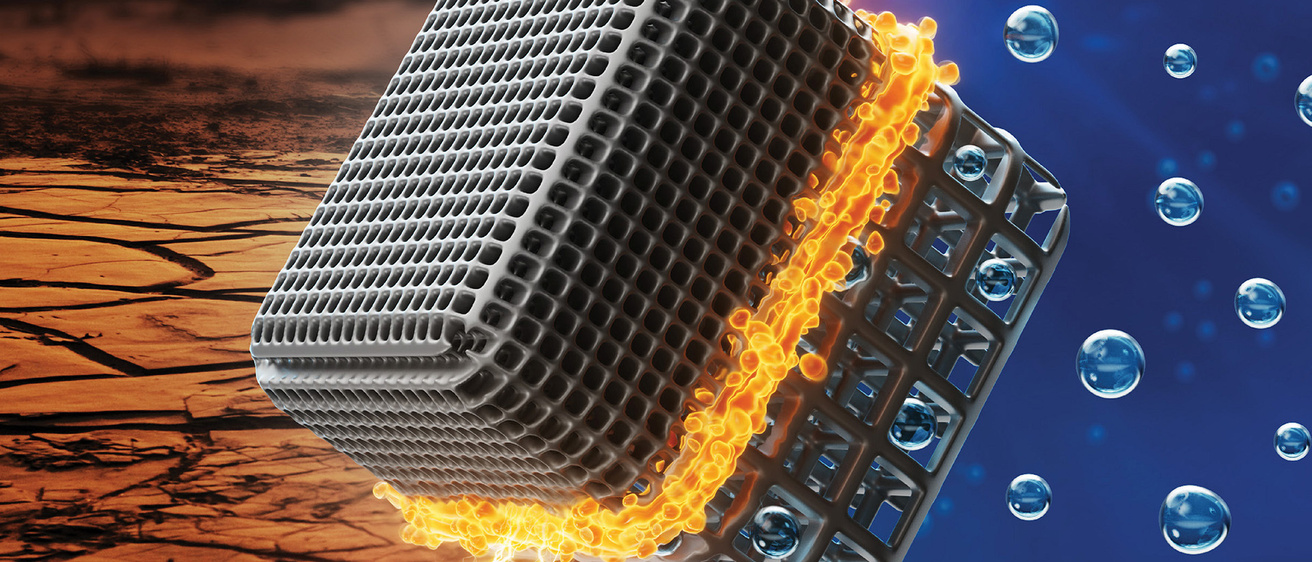
Researchers at the University of Iowa have developed a novel three-dimensional lattice structure capable of extracting water from the atmosphere. This lattice, composed of metal atoms linked by organic molecules, undergoes a transformative chemical reaction when exposed to ultraviolet light. The reaction reshapes the material, forming cavities within the lattice that attract and store water molecules, functioning like numerous miniature reservoirs.
The implications of this research are significant, considering that by 2050, approximately 5 billion people could face water stress or scarcity, as projected by the United Nations. Leonard MacGillivray, an adjunct professor in the Department of Chemistry, highlighted the potential impact: “We have found and validated a way to capture and to store water that would require only sunlight.” MacGillivray further explained that the lattice could be transported and the stored water released when needed, marking a significant advance in water collection technologies.
This discovery emerged from explorations into metal-organic frameworks (MOFs), structures known for their pore-like openings. While initial attempts by MacGillivray’s team to create MOFs resulted in no cavities, exposure to ultraviolet light led to the unexpected formation of cavities and water retention within the crystal structure. Using X-ray diffraction, the team confirmed the presence of water inside the crystals.
The UV light-induced chemical reaction is the cornerstone of this water-capturing method. The lattice’s linkers, initially arranged in a parallel alignment resembling the letter “H,” rearrange into an X-shaped pattern upon exposure to light. This new structure creates multiple cavities, each capable of holding two water molecules, accounting for 5% of the lattice’s mass when filled. MacGillivray noted, “When the light hits the crystal, all these cavities start to pop open, water migrates in, then finds a resting place in the cavities.”
While each cavity holds a small amount of water, the scalability of this approach could be impactful. MacGillivray pointed out that these structures can be produced in large quantities, suggesting a promising start for future applications.
The research team, including Nevindee Samararathne Muhandiramge, emphasized the potential for “intelligent” water harvesting technologies, triggered intentionally by sunlight. “UV light is freely available from the sun. So, the next step would be to determine the limits of the water uptake in terms of mass percent and push that limit as far as we can,” expressed Samararathne Muhandiramge.
Although the study initially used cadmium atoms, the team is exploring less toxic alternatives to ensure safety and practicality. The findings were published in the Journal of the American Chemical Society under the study titled “Photo capture of water by single crystals of a nonporous metal−organic material.”
The research, funded by the U.S. National Science Foundation, involved collaboration with experts from the Università degli Studi di Milano, Rigaku Americas Corporation, the University of Sherbrooke, and Khalifa University of Science and Technology. Analytical techniques, including X-ray diffraction, were conducted at the Materials Analysis, Testing, and Fabrication Facility in Iowa.
Read More Here