Innovative Drone Technology Unlocks Mysteries of Martian Glaciers
Exploring hidden glaciers on Mars requires more than just laboratory work; it begins in the challenging terrains of Alaska and Wyoming. Researchers from the University of Arizona are taking on this task, equipped with drone batteries charged overnight, mosquito repellent, and bear spray.
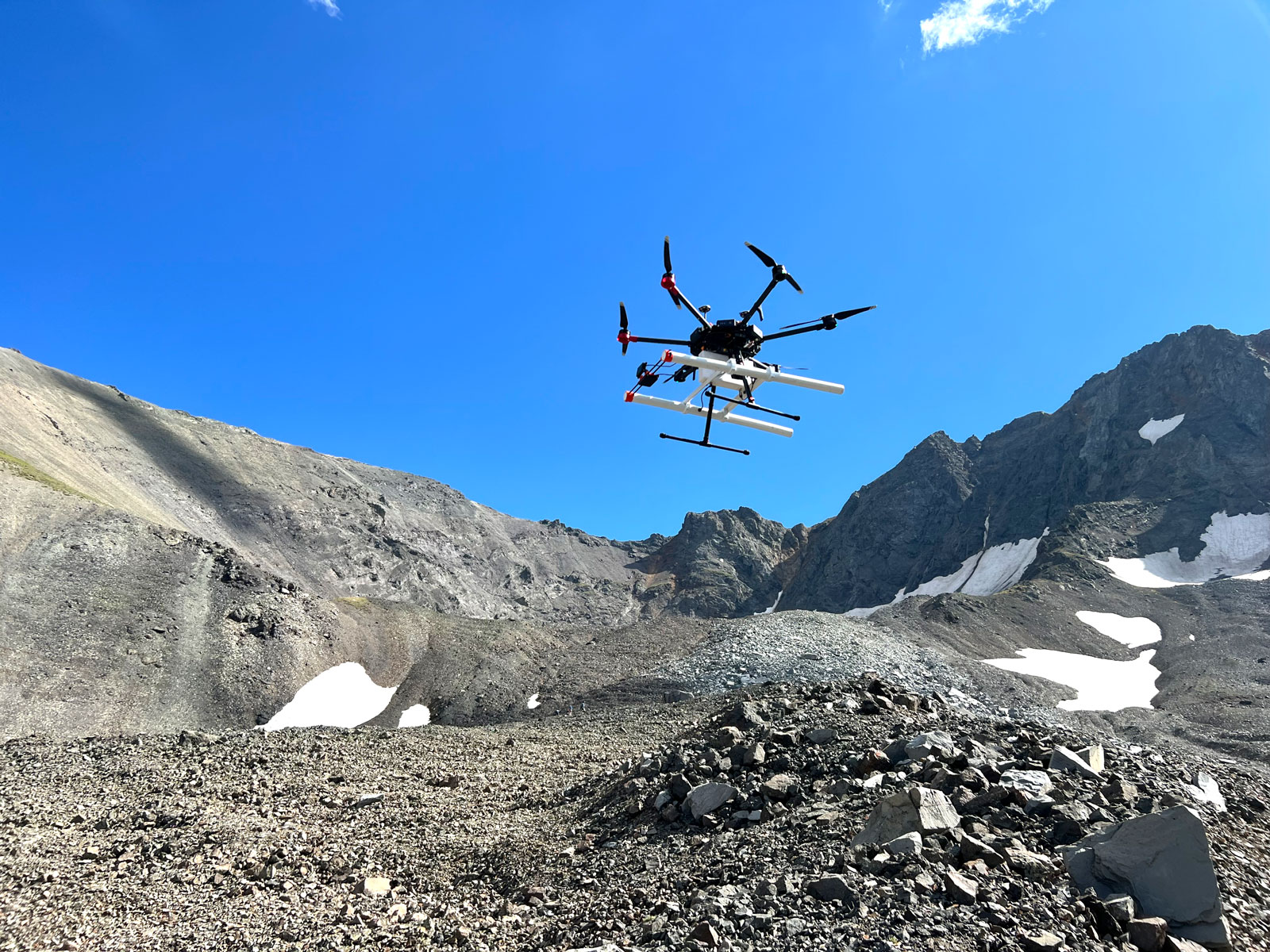
In a recent study published in the Journal of Geophysical Research: Planets, the team showcased the potential of drones equipped with ground-penetrating radar to measure the thickness of rocky debris covering glaciers on Earth. This breakthrough could guide astronauts in locating buried ice on Mars.
Obscured by rocky debris, the Sourdough Rock Glacier flows down from the Wrangell Mountains in Alaska.
“If you want to make decisions about where to drill on Mars, you need to know if the ice you’re trying to find is under one meter of debris or 10,” explained Roberto Aguilar, a doctoral researcher at the University of Arizona Lunar and Planetary Laboratory, and the study’s lead author. “That’s the kind of information a drone-based system could provide.”
Debris-covered glaciers differ significantly from the typical image of glaciers as large icy masses sprinkled with snow. Instead, these glaciers are cloaked in layers of rock and sediment, insulating the ice beneath. On Mars, similar formations are found in mid-latitude regions, shielded by dust and debris, sometimes in craters or valleys.
“Some of these deposits are large enough that radars on orbiting spacecraft can detect and estimate the amount of ice, but current technology cannot determine fine details, such as how thick the overlying debris layer is, or if there are internal, rocky layers hidden from view,” noted Aguilar.
This stereo image taken by the UofA-led HiRISE camera aboard the NASA Mars Reconnaissance Orbiter shows a viscous flow feature in Deuteronilus Mensae, a region on Mars believed to contain large amounts of ice.
The research team is optimistic that drone radar could help identify glacier ice and map the rocky debris that conceals it. This would allow mission planners to strategically target drilling sites where ice is close to the surface.
Buried ice on Mars is seen as a highly valuable resource. It could not only preserve historical environmental records but also support human missions by providing water, producing oxygen, and aiding agriculture. Aguilar emphasized, “We already knew ground-penetrating radar works, but this was the first time we mounted it to drones and tested how we could put it into practice.”
The team conducted trials in Alaska and Wyoming, where extensive research provided insights into glacier characteristics. Aguilar remarked, “These debris-covered glaciers on Earth are some of the best analogs we have for similar glaciers that spacecraft have photographed on Mars.”
A research drone equipped with ground-penetrating radar takes off for a reconnaissance flight on Galena Creek Rock Glacier, Wyoming.
Results from radar measurements were compared to physical excavations, confirming the technology’s reliability. Drones, flying lower than spacecraft, provided high-resolution imaging, enabling the team to gauge debris thickness and ice purity while detecting hidden rocky layers.
“The internal layers we’re seeing are important because they’re a record of past climate cycles,” Aguilar stated. “Each layer represents a different period of ice accumulation and environmental conditions over centuries or millennia, and it is likely we would see similar layers on Mars.”
Simulations ensured that radar signals were not confused by surface obstacles like trees or boulders. Aguilar elaborated, “We are filling the gap between today’s orbital observations and a more distant future, where astronauts land on Mars and make observations on the ground.”
The fieldwork, though demanding, provided crucial insights. Researchers navigated mosquito-infested, rugged landscapes in Alaska and the mountainous terrains of Wyoming, often trekking across boulder fields to reach target sites. Aguilar humorously commented, “It’s not fun walking on those rocks. That’s why it’s better to fly a drone.”
Read More Here