
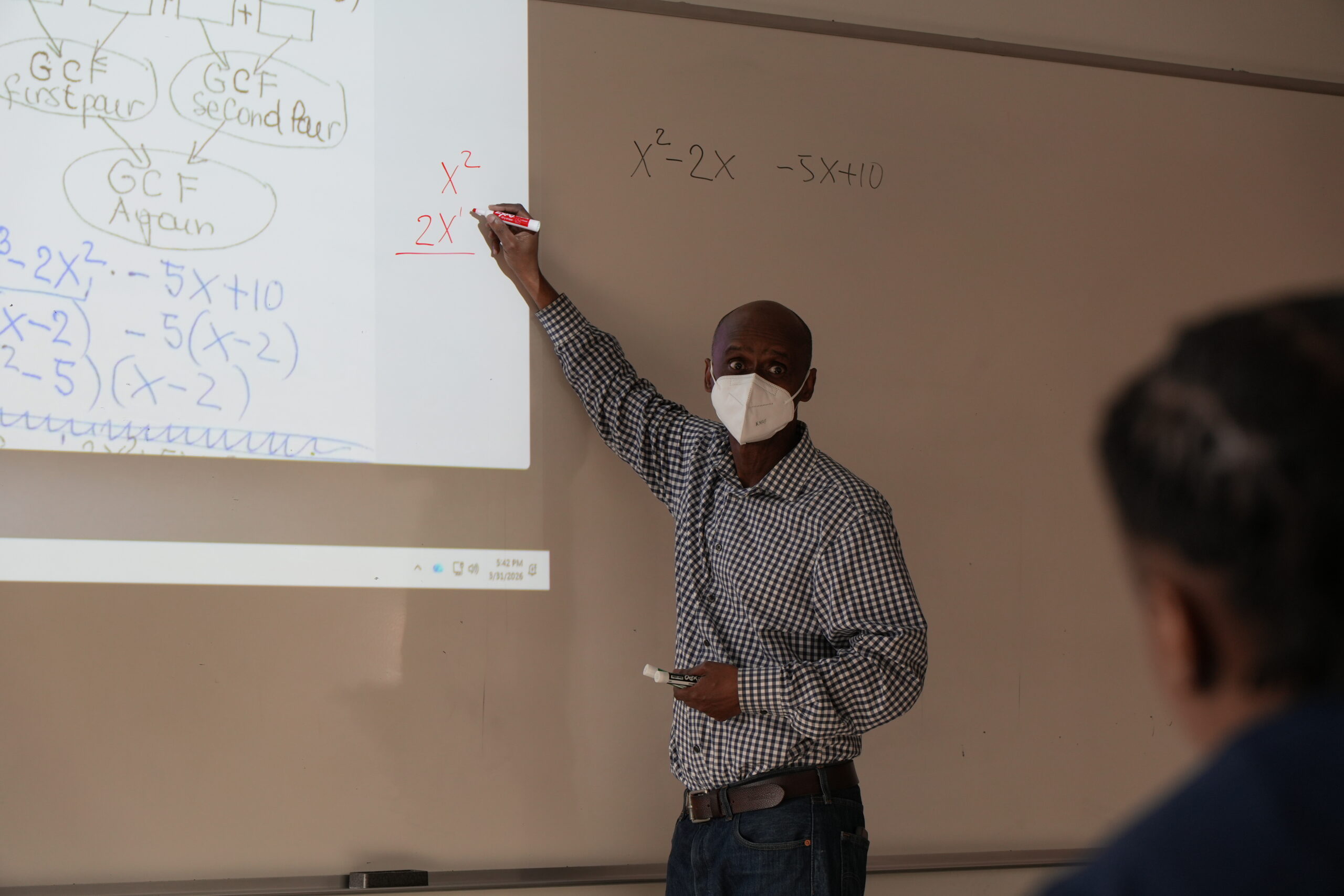
With more students enrolling in foundational math courses, colleges are witnessing a significant shift in academic preparedness. At Temple University, the enrollment in Intermediate Algebra reached 1,174 students this fall, a clear indicator of growing challenges in math proficiency.
Students who score at the lower end of the spectrum on SAT, ACT, or ALEKS placement exams are typically placed in this course, designed to build essential math skills for college-level courses.
Nationwide, the struggle with math is becoming increasingly apparent. In 2024, 45% of high school seniors scored below the basic achievement level on the National Assessment of Educational Progress. Jessica Babcock, the director of developmental mathematics at Temple, noted, “Students are struggling more with basic things. And as a result, there are more students taking this course.”
The course, MATH 0702, is a prerequisite for majors requiring College Algebra and Quantitative Methods for Business I. Babcock explains that it assumes prior knowledge of basic algebra and arithmetic.
Boris Datskovsky, director of undergraduate studies in the math department, attributes the increased enrollment to Temple’s strategy to counter budget challenges by accepting more students. “Declines are due to the fact that Temple is in a survival mode,” Datskovsky stated. “They admit almost everyone who applies.”
This fall, Temple welcomed its largest first-year class of 5,378 students, prompting the math department to add six more sections of Intermediate Algebra. The acceptance rate also climbed to 88%, up from previous years.
Across the nation, similar trends are evident. For instance, the University of California, San Diego reported a dramatic rise in freshmen unprepared for college math, increasing from 30 to 900 students from 2020 to 2025 according to a November 2025 report.
Babcock remarked that the data from UCSD aligns with what she observes at Temple. “This is clearly a nationwide thing that’s happening,” she said. “And we are seeing the same exact things that people are seeing in California and kind of across the country.”
Datskovsky suggests that the online learning shift during COVID-19 may have exacerbated the issue. “It’s not very easy to learn math online,” he noted. “You need to be really disciplined, and there are so many ways to cheat on tests and exams.”
Reports show that students fell behind more in math than other subjects post-pandemic, with a noticeable drop in readiness for foundational math skills by the 2021-22 school year.
Babcock observed a decline in basic math skills as early as 2017 or 2018, particularly in operations like adding and subtracting negatives and fractions.
The struggle is not limited to Intermediate Algebra. A record 141 students withdrew from Calculus 1 in Fall 2025. Meanwhile, more than 620 students are enrolled in the Journey of the Algorithm course, aimed at those with lower math placement scores.
Susan Jansen Varnum, who teaches this introductory course, emphasized the importance of sensitivity and respect towards students aware of their struggles. “Because the students in front of you know that they have performed poorly on the placement test. They know that they have struggles with math,” she said.
Evelyn Jaison, a freshman at the Fox School of Business, echoed these challenges, noting how quickly students can fall behind in Quantitative Methods for Business 1.
In response to these issues, Babcock spearheaded the development of a math oversight team to ensure consistency in teaching across developmental math courses. The team has introduced structured worksheets to improve engagement and understanding among students.
“I just think that there’s a lot of factors working against students who want to be successful in math,” Babcock remarked. “And I don’t know what the answer is other than to try to do as much as you can for as many students as you can.”
Read More Here





Be First to Comment