
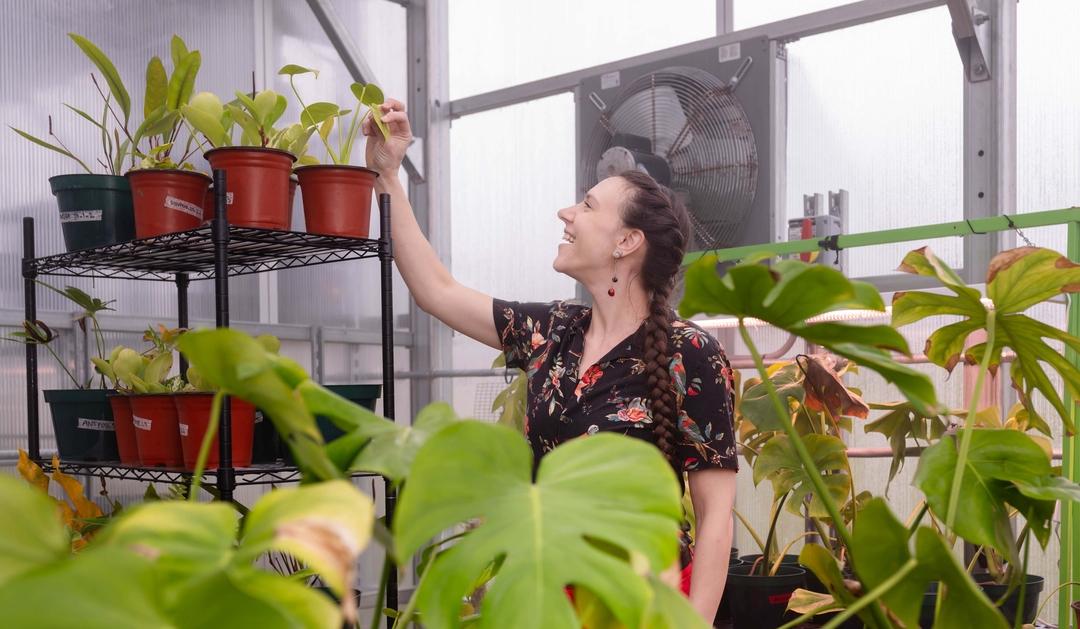
Amidst the lush greenery of Washington’s rainforests and Panama’s tropical landscapes, and even within the serene groves of Lehigh University, Michelle Spicer ’12 M’14 delves into the intricate world of forest ecosystems. As an assistant professor of Earth and environmental sciences, Spicer explores the complex interactions of plants and microbes, offering insights into climate change through her research.
Spicer’s work centers on community ecology, examining plant adaptations to environmental shifts and their implications for climate dynamics. During a recent Research Symposium at the university, she outlined her study’s core inquiry: How do plant and microbial communities adapt to increased heat and dryness?
Epiphytes and Their Role in Understanding Climate Change
A significant aspect of Spicer’s research investigates epiphytes, focusing on tropical canopy plants such as orchids and bromeliads. These plants, which grow on other plants and spend part of their lifecycle above the ground, are highly sensitive to temperature and moisture variations. This sensitivity allows them to act as indicators of ecosystem responses to climate change.
“Canopy plants can tell us a lot about how our world is changing, how plants are responding to those changes, and how biodiversity may shift in the future,” Spicer said.
In tropical rainforests, environmental gradients are pronounced, with less than 1% of light reaching the understory and the canopy experiencing intense light, heat, and dry conditions. Spicer’s research uses these gradients to model the impacts of climate change on organisms in warmer habitats.
Exploring Climate Effects in Diverse Forest Ecosystems
Spicer leads field projects in both the temperate Hoh Rain Forest of Washington and the tropical forests of Panama, studying how epiphyte communities form and react to environmental disturbances in different forest layers. Her research in Panama, supported by a National Science Foundation grant, extends below the plant surface to examine soil microbes across vertical forest gradients.
Collaborating with Jane Lucas and Evan Gora from the Cary Institute of Ecosystem Studies, Spicer conducts experiments in Panama’s Santa Fe National Park and at the Smithsonian Tropical Research Institute. Early findings indicate that certain microbes thriving in the understory are replaced by different communities in the canopy.
Insights into Forest Ecosystem Responses to Climate Change
Preliminary results from Spicer’s research reveal how plant communities cope with environmental shifts. By transplanting epiphytes between canopy layers, the study tracks their adaptation to new conditions. Findings suggest some species recover swiftly post-disturbance, while others, especially in hotter and drier canopy zones, face challenges in recovery as global climate conditions evolve.
Bridging Global Ecology with Local Impact
At Lehigh University, Spicer’s greenhouse on the Mountaintop campus serves as a hub for student-driven research, simulating tropical systems to study plant responses to light and moisture changes. This work connects researchers to global ecological questions and highlights the urgency of climate change.
“I think it’s really important to have a branch of my research that is really accessible. Right here on campus we’re also looking at regional challenges to forest diversity,” Spicer said. “What’s going on right here in Pennsylvania has an incredible impact.”
Fostering Community and Mentorship in Ecology
Spicer has cultivated a vibrant community of ecologists at Lehigh, drawing on her experiences as both a student and educator. She collaborates with Robert Booth, department Chair of Earth and environmental sciences, and John Paul Balmonte, assistant professor, to share insights and nurture scientific passion among students.
“There are these overarching, core questions that are large in ecology,” Spicer said. “It feels like a community where not only do we get along, but share scientific passion as well.”
Read More Here






Be First to Comment