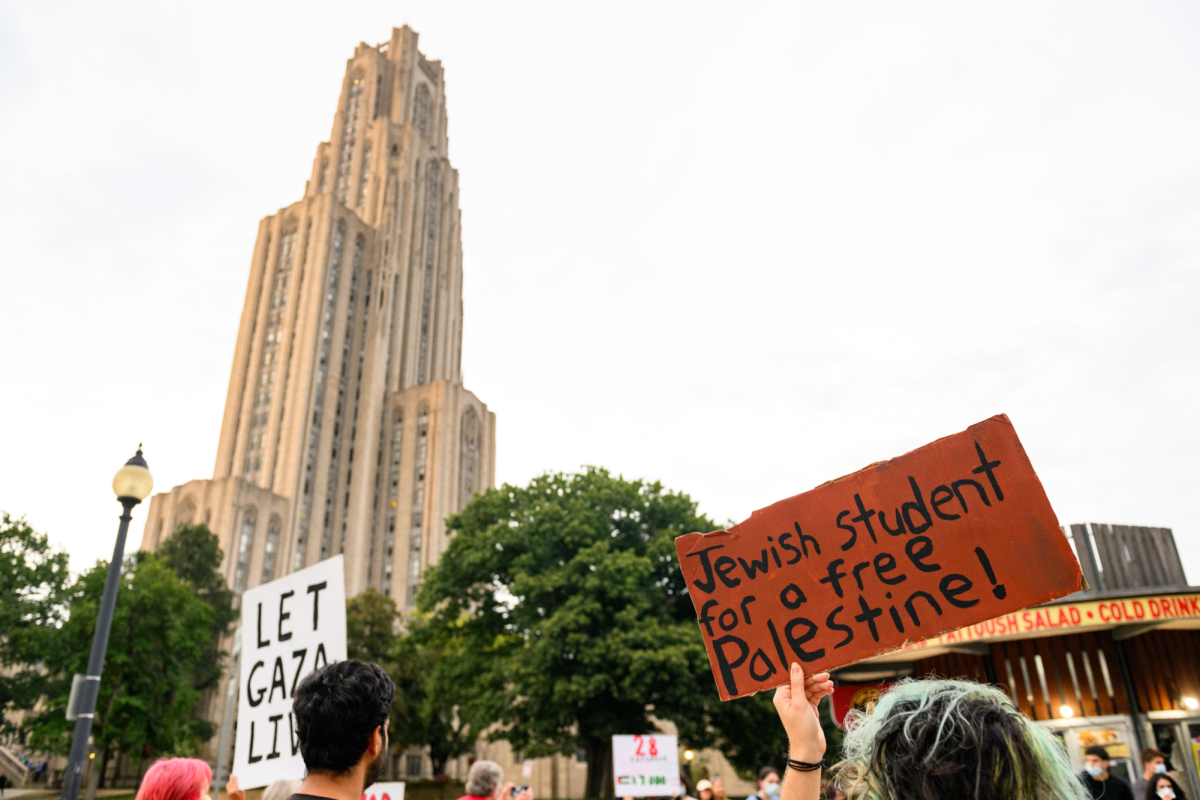
On Saturday evening, the University of Pittsburgh became a focal point for voices demanding justice for Palestine. A gathering of students and community members, emboldened by a recent legal victory for Students for Justice in Palestine (SJP), took to the streets in a vibrant demonstration of solidarity.
Approximately 100 individuals convened at Schenley Plaza, with their voices echoing down Forbes Ave. Their destination was the residence of Chancellor Joan Gabel, where signs like “Genocide Joan” were held aloft, accusing her of complicity in the ongoing conflict.
Protest and Global Context
This demonstration came on the heels of a United Nations commission’s report accusing Israel of genocide in the Gaza Strip, a call that urged international action to halt and penalize those responsible.
Since a Hamas-led attack on Israel nearly two years ago, around 64,000 Palestinians have died, while 20 Israeli hostages remain in Gaza.
Voices of Protest
Speakers from various pro-Palestinian groups, including SJP, the Pittsburgh Palestine Coalition, and the Pittsburgh Boycott, Divestment Sanctions Coalition, led chants that resonated with the crowd, highlighting the dire situation in Gaza.
Omid Shekari, a Pitt studio arts assistant professor, addressed the crowd about the university’s opaque investments, particularly regarding Israeli weapons manufacturers. Expressing frustration at the lack of dialogue with the administration, Shekari emphasized the necessity of the protest at Gabel’s residence. “The University is an educational and research institution. It has nothing to do with war and weapon manufacturing,” Shekari insisted.
Alumni and Community Reactions
Jonas Caballero, former SJP president at Pitt, criticized the university’s alleged involvement in the conflict, asserting, “The University of Pittsburgh is not a neutral player… At the same time, the administration attacks its own students and staff for speaking out to stop this livestreamed genocidal atrocity.” Caballero also noted the increased challenges faced by student organizations today compared to his tenure.
First-year student Alejandro Tellez viewed protesting as crucial, stating, “I don’t think we can stand by and watch genocide happen and not go out into the streets and talk about it.”
In contrast, Matan Rieger, a junior engineering student, attended to raise awareness for Israeli hostages, including Omer Neutra, an Israeli killed in the attacks. “My goal is that the war stops as soon as possible and everyone returns home,” Rieger said.
Broader Impact and Reflections
Participants like Jacob Love, a first-year student, were inspired to join the protest, marking his first experience with such activism. “It’s important that [pro-Palestinian] are heard, and we give a voice to the people who don’t have a voice,” Love remarked.
Jamie Rogers, attending with family ties to the region, expressed deep concern over the humanitarian impact, particularly on children. “Everything that’s going on with the kids really tears me apart,” Rogers shared.
Former adjunct professor Carl Redwood highlighted the chilling effect on free speech stemming from recent political climates, warning that censorship could deter future activism. Similarly, John Thompson from the United Electrical, Radio and Machine Workers of America reinforced the universal nature of justice, asserting, “If there’s people being oppressed, whether in Palestine or wherever, then all people are oppressed.”
The evening protest concluded around 8:30 p.m. at Bigelow Boulevard, leaving a resonant call for peace and justice as participants dispersed.
Read More Here