In the ever-evolving landscape of education and innovation, the fusion of technology with hands-on experience is yielding remarkable results. At the University of Arizona Health Sciences, students are not only learning about design thinking but also putting it into practice in ways that directly impact their communities.
One such student, Ruth Salazar, a former physical therapist and current biomedical engineering student, identified a way to enhance the lives of individuals with motor impairments. Her initial goal was to develop a switch-adapted ceiling fan control. However, a suggestion from her instructor, Matthew Briggs, led her down a different path.
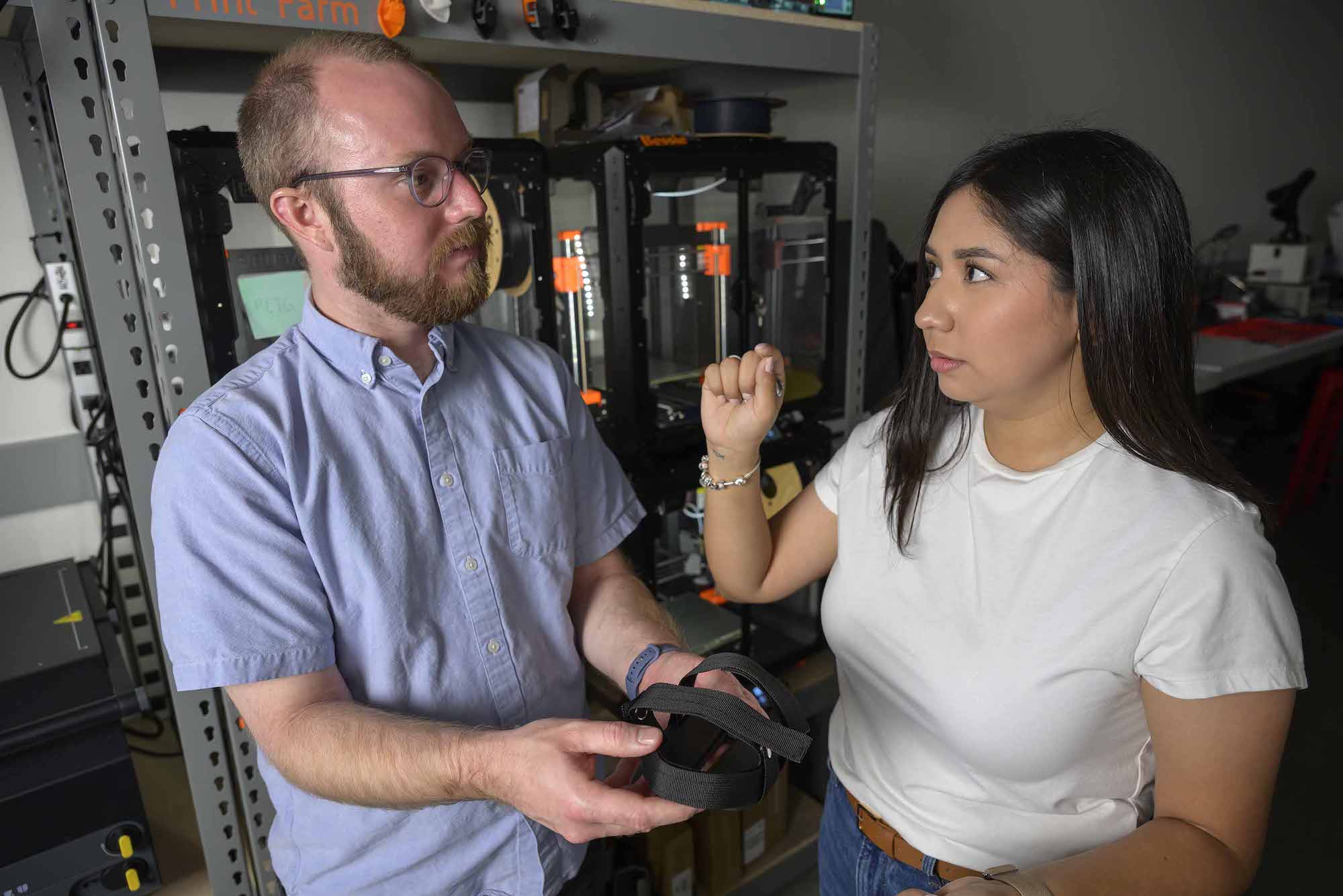
Salazar designed an adaptive foot pedal for children’s bicycles used at the Children’s Clinics for Rehabilitative Services in Tucson.
Kris Hanning/U of A Health Sciences Office of Communications
Briggs, an assistant professor of practice in the Health Sciences Design program and U of A College of Engineering, encouraged Salazar to reach out to local organizations for input. Her contact with the Children’s Clinics for Rehabilitative Services, where she had previously worked, led to a new challenge: developing cost-effective bicycle pedal adapters for children with complex medical needs.
Under Briggs’ mentorship, Salazar shifted gears to design and iterate 3D-printed pedal adapters that met these specific requirements. Her journey exemplifies the dynamic learning environment Briggs nurtures, where students are trained to face real-world health challenges with innovative solutions.
“My teaching philosophy has evolved to focus on building students’ confidence with technology through hands-on experience,” Briggs stated. “I want them to feel ready to run with an idea. My goal is to spark creativity, teach practical skills and build their confidence – not just with the tools, but in themselves, their communities and their careers.”
A Path Defined by Making and Mentorship
Briggs’ journey to his current position began at Arizona State University, where he delved into graphic information technology and digital culture. His fascination with the makerspace concept was sparked by a 3D modeling class, where he encountered a ZCorp 3D printer. This passion led him to become one of the first student employees at ASU’s makerspace, where he honed his skills in digital fabrication and CNC milling.
Briggs enters a virtual reality world created by a student as part of a Health Sciences Design course.
Noelle Haro-Gomez/U of A Health Sciences Office of Communications
Briggs furthered his expertise with a Master of Fine Art in Design for Emerging Technologies from the School of the Art Institute of Chicago. Returning to Arizona during the pandemic, he joined Phoenix Forge, enhancing his skills and preparing for a role at the U of A Health Sciences.
Today, Briggs teaches various courses, including a makerspace class for physical fabrication, an artificial intelligence and extended reality studio, and a digital audiology class where students create 3D-printed hearing aid molds. He emphasizes creativity and applied skills, often using peer-to-peer feedback to enhance learning.
Empowering Students to Innovate
Briggs’ courses guide students through design briefs, focusing on personal and community-oriented projects. These assignments often lead to tangible results, such as Salazar’s successful pedal adapters. Her project, which involved collaboration with therapists, allowed children to use bicycles more effectively.
Students in an artificial intelligence and extended reality studio course listen as Briggs introduces an AI video generator software program.
Kris Hanning/U of A Health Sciences Office of Communications
“We start with something tangible, understanding their own practice,” Briggs explained. “Then we build a community of practice, like partnering with a clinic to solve a specific problem. Finally, discursive projects let them explore what’s possible, creating designs that move their field forward by sparking new ideas.”
Salazar’s success story is a testament to the impact of Briggs’ guidance. Her pedal adapters made a significant difference for children at the Children’s Clinics for Rehabilitative Services, allowing them to enjoy activities previously inaccessible.
Through his dedication, Briggs is cultivating a new generation of designers who are transforming ideas into impactful solutions.
This article originally appeared on the U of A Health Sciences website.
Read More Here