
After years of watching reservoirs shrink and water restrictions tighten, communities across the American Southwest are finally catching a break — and it’s coming from an unlikely source. A burst of intense autumn storms has pushed water into depleted lakes and underground aquifers at a pace that has surprised even veteran scientists, offering a rare moment of relief in a region that has struggled with a prolonged megadrought.
Flooding that swept through parts of the U.S. Southwest in late October and early November forced hundreds of residents to evacuate and cut off road access in some communities. But even as the storms caused damage, scientists say much of that water is now doing exactly what the region desperately needs — soaking into the ground and replenishing lakes that have dropped to historic lows.
Martin Hoerling, a climate scientist and hydrologist at the University of Colorado, Boulder, described the surge as something few had anticipated.
“That’s somewhat of an unexpected boost from Mother Nature,”
Hoerling said.
The timing is significant. Last winter’s lackluster snowfall delivered far less water than usual when it melted in spring and summer — the season when Western reservoirs typically see their biggest annual gains. The storms are now helping fill a gap left by that shortfall, aided by the climate pattern known as El Niño, which has amplified rainfall across the region. Experts say El Niño’s influence will likely persist for several more months, potentially delivering additional water to lakes, aquifers, and snowpack throughout the West.
Lake Powell Sees Dramatic Rise
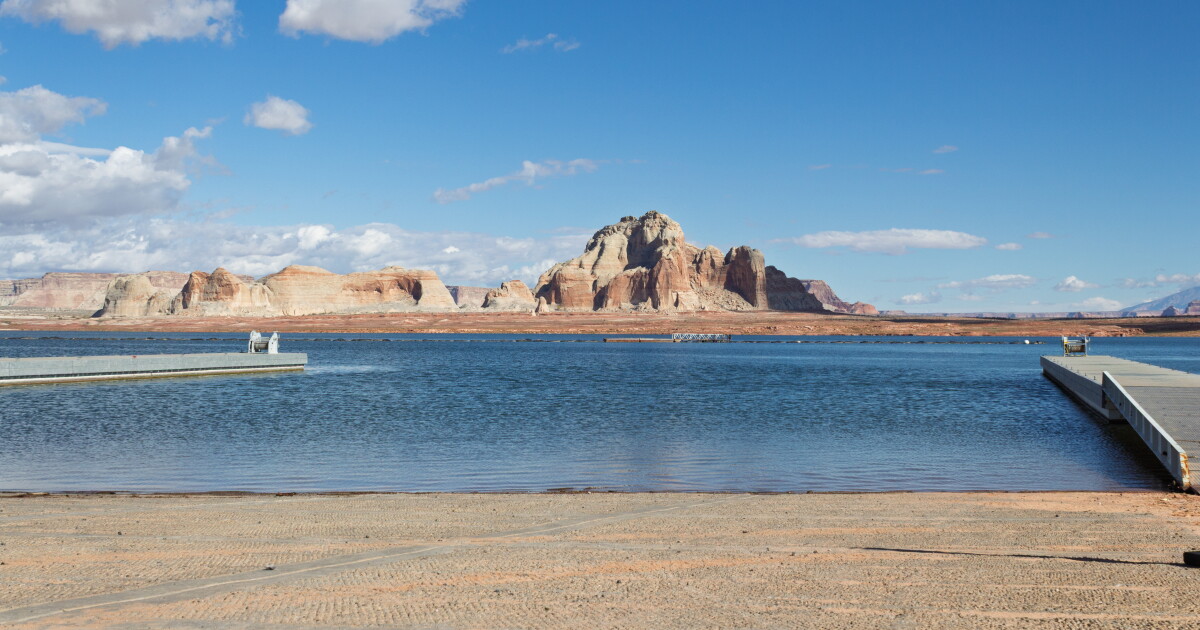
Lake Powell, the second-largest reservoir in the United States, gained more than 20 feet (6.1 meters) from its mid-September low point — a jump that far exceeded what this year’s snowmelt had produced. Despite that progress, the reservoir along the Arizona-Utah border remained just over a quarter full, and 15 of its 17 boat launches were still unusable as of last Friday.
Hoerling estimates that the combination of floodwaters and additional rainfall could add more than 1.2 million acre-feet of water to Lake Powell in total — enough to supply roughly 4 million average American families for an entire year.
Local Water Supplies Get a Needed Boost
The effects have been immediate and tangible for communities that were already rationing water. In Pagosa Springs, Colorado, more than 10,000 residents had been living under mandatory water restrictions before roughly 7 inches (17.78 centimeters) of rain fell on the area in October. Businesses were asked to cut back wherever possible — including a request that restaurants hold off on bringing water to tables unless customers specifically requested it. Town Manager David Harris said those restrictions have since been lifted.
“While the storm was destructive, I think there is a silver lining,”
Harris said.
“You’re getting a good start to the winter snowpack in the higher elevations.”
Farther south, the gains were equally striking. Upper Lake Mary, a reservoir in Northern Arizona that feeds up to 40% of Flagstaff’s municipal water supply by capturing spring snowmelt, received more than 3 billion gallons since early October, according to Flagstaff water production manager Brian Huntzinger. Last weekend’s storms alone poured in the equivalent of more than two years’ worth of the city’s surface water supply, giving the system a critical cushion on top of its underground aquifer reserves.
“It’s just a great, great thing to see,”
Huntzinger said.
“We might be overflowing at this rate before we see any snow fly.”
In central Arizona, floodwaters that left some residents temporarily stranded in their homes channeled into streams feeding the Verde River. The surge pushed two upstream dams to near capacity, prompting water managers to release water into the Verde’s normally bone-dry stretch through the Phoenix metropolitan area, said Bo Svoma, principal meteorologist at the Salt River Project, which oversees reservoirs on the Salt and Verde rivers. Some Arizona cities are already exploring longer-term solutions, with plans to fund preliminary work on expanding a dam along the Verde River to better capture storm runoff for future use.
No Quick Changes for Colorado River Management
Despite the encouraging rainfall, the broader Colorado River basin remains in drought, and water managers are not expected to make immediate adjustments. The U.S. Bureau of Reclamation, which oversees Western reservoirs, typically waits until snowpack reaches its peak — usually around April — before revising water release schedules, according to Jack Schmidt, a professor at Utah State University who studies the Colorado River.
Reclamation spokesperson Mary Carlson acknowledged that conditions have improved but added that
“considerable uncertainty remains.”
Under an existing federal agreement, California, Nevada and Arizona are collectively required to cut water use by 1.25 million acre-feet annually over the next two years — a volume equivalent to filling more than 600,000 Olympic-sized swimming pools, with the possibility of steeper cuts depending on how conditions evolve. Nevada and Arizona are currently challenging that plan in court.
Coverage of the flooding’s impact on voting in the region, including how Navajo voters hopped tractors and made extraordinary efforts to vote after widespread flooding, has been reported by KNAU and Arizona News, with reporting contributed by Wufei Yu of the Associated Press.
Scientists and water managers agree that while the storms are welcome, they are not a solution to the region’s long-running water crisis.
“We need to figure out how to be resilient in a drier future. And we’re not quite there yet,”
Hoerling said.








Comments are closed.