
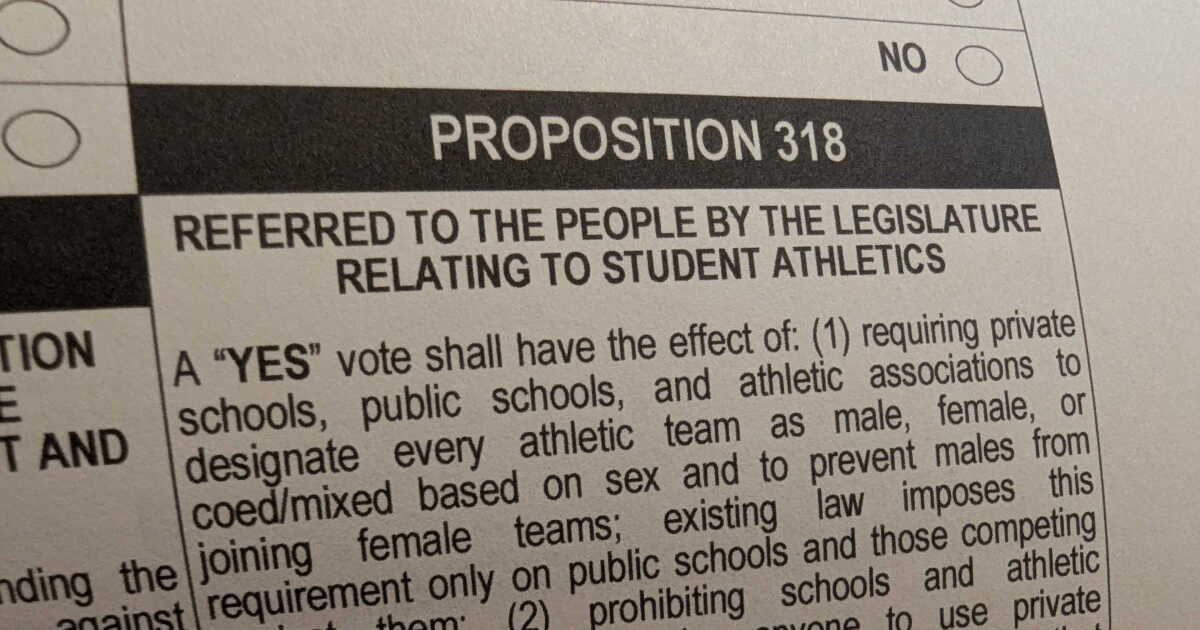
When millions of Arizona voters stepped into the ballot box during last week’s midterm elections, many cast their votes for Democratic candidates — and then, in the same session, approved a measure that restricts the rights of transgender students. The result has exposed a complicated fault line inside the American electorate, one that challenges easy assumptions about how voters think and what they actually understand when they pull the lever on ballot initiatives.
Proposition 318, branded the “Protect Girls’ Sports in Arizona Act,” passed with nearly 59% of the vote. The measure does several things at once: it locks into state law an existing ban on transgender girls competing in girls’ sports, extends that restriction to professional athletic associations, regulates bathroom use inside schools, and formally defines sex as what appears on a person’s birth certificate. While a sports ban was already on the books in Arizona, Prop. 318 significantly expanded the legal framework — and voters, by a wide margin, said yes.
A Democratic Wave That Carried a Conservative Measure
Arizona was not alone. Voters in Colorado and Washington — reliably blue states — also passed bans on transgender women and girls competing in women’s sports. Nebraska went even further, cementing its own ban directly into the state constitution. The pattern raised immediate questions: how does a broadly Democratic electorate approve measures that many Democratic officeholders actively oppose?
Joseph Darius Jaafari, founder and editor-in-chief of LGBTQ+ news outlet Lookout, says the answer partly lies in how ballot measures are written — and how difficult they can be to understand. Speaking with Lauren Gilger of KJZZ, Jaafari explained that his outlet had already begun speaking with voters who identified as supporters of transgender civil rights but still voted yes on the measure.
“We’ve already started interviewing a lot of people who walked in and arguably are for transgender civil rights, and then went into the ballot box and didn’t quite understand the wording and voted yes anyways.”
Ballot language, Jaafari noted, is typically written at a very high reading level — a structural feature of direct democracy that can disadvantage voters trying to parse complex policy questions in the moment. He drew parallels to earlier ballot battles: California’s Proposition 8 in 2008, which eliminated same-sex marriage rights, and Colorado’s Amendment 2 in the 1990s, which blocked anti-discrimination protections for LGBTQ+ people. In each case, confusing or misleading language contributed to outcomes that surprised observers.
Jaafari was direct about his outlet’s expectations going into Election Day:
“Behind closed doors, I think we all were preparing for it, because public polling on this is pretty clear.”
That polling paints a stark picture: more than 70% of Americans report being uncomfortable with transgender athletes competing on sports teams that do not match their sex at birth. For Jaafari, the vote was not a shock — it was a predictable outcome shaped by both genuine public sentiment and the mechanics of how ballot questions reach voters.
Who Gets to Vote on Civil Rights?
Beyond the question of voter confusion, Jaafari raised a deeper concern about the democratic process itself — one that goes to the heart of how ballot initiatives function when civil rights are at stake.
“The big question on our mind, and I think the big ethical question, is whether or not ballot measures, when it comes to civil rights, should go to the … people who vote, right? It’s a population that doesn’t have the opportunity to vote overwhelmingly to quash any kind of vote against them. But on top of it, you’re talking about a youth who doesn’t even have the ability to vote.”
This tension — between direct democracy as a tool of civic participation and direct democracy as a vehicle for majority rule over minority rights — is not new, but Prop. 318 brings it into sharp focus. The students most affected by bathroom and sports policies had no vote at all.
Families in Blue States Feel “Abandoned”
For many LGBTQ+ families, states like Colorado and Washington represented a refuge — places they moved to specifically to escape more restrictive policies in states like Texas and Florida. The passage of similar restrictions in those presumed safe havens has landed hard.
Jaafari said families his outlet spoke with acknowledged that Colorado still feels safer than outright-hostile states, but the emotional impact of the vote was real:
“It feels a bit of an abandonment, because they’ve tried so hard to make a point that, ‘My child is no different from your child. All the stuff that we do for our kid is done through very deep conversations with doctors and medical professionals. It shouldn’t have anything to do with you.'”
On Colorado’s measures specifically — Propositions 134 and 135 — Jaafari noted that one mirrored Arizona’s sports ban while the other addressed surgical procedures for minors. He pointed out that the state had not been able to identify even ten transgender youth participating in youth sports, and that no Colorado hospitals had reported performing the surgeries the measure was designed to restrict.
Enforcement Questions Remain Unanswered
Now that Prop. 318 is law in Arizona, significant practical questions surround implementation. Who enforces bathroom restrictions inside schools — local police, county officials, school administrators? Schools that lack single-sex bathroom facilities would need costly renovations. Who pays for those upgrades?
As Jaafari put it, the answers are still “swirling” — and nobody has them yet. The gap between passing a ballot measure and actually implementing it in schools and public institutions is where the real-world consequences will ultimately be felt.
For voters trying to understand what this election meant, the results offer a complicated picture: a strong Democratic performance at the candidate level alongside majority support for ballot measures that restrict transgender rights. The election results across Arizona and Maricopa County will continue to be analyzed in the weeks ahead, alongside other notable outcomes — including the reelection of Arizona Attorney General Kris Mayes by nearly 300,000 votes, the finding that independent voters broke for Democrats, the historic election of Clara Pratte as the first Native American to hold statewide office in Arizona’s history, and the expectation that a Democrat-led Arizona Legislature will drop lawsuits defending abortion restrictions. Each of these outcomes reflects how ballot choices by everyday voters shape the direction of policy — with consequences that extend far beyond Election Day.







Comments are closed.