
The path to space is paved not just by rockets and satellites but by the collaborative efforts of academia, industry, and government. As the United States strives to maintain its leadership in space exploration, fostering partnerships among these sectors becomes crucial.
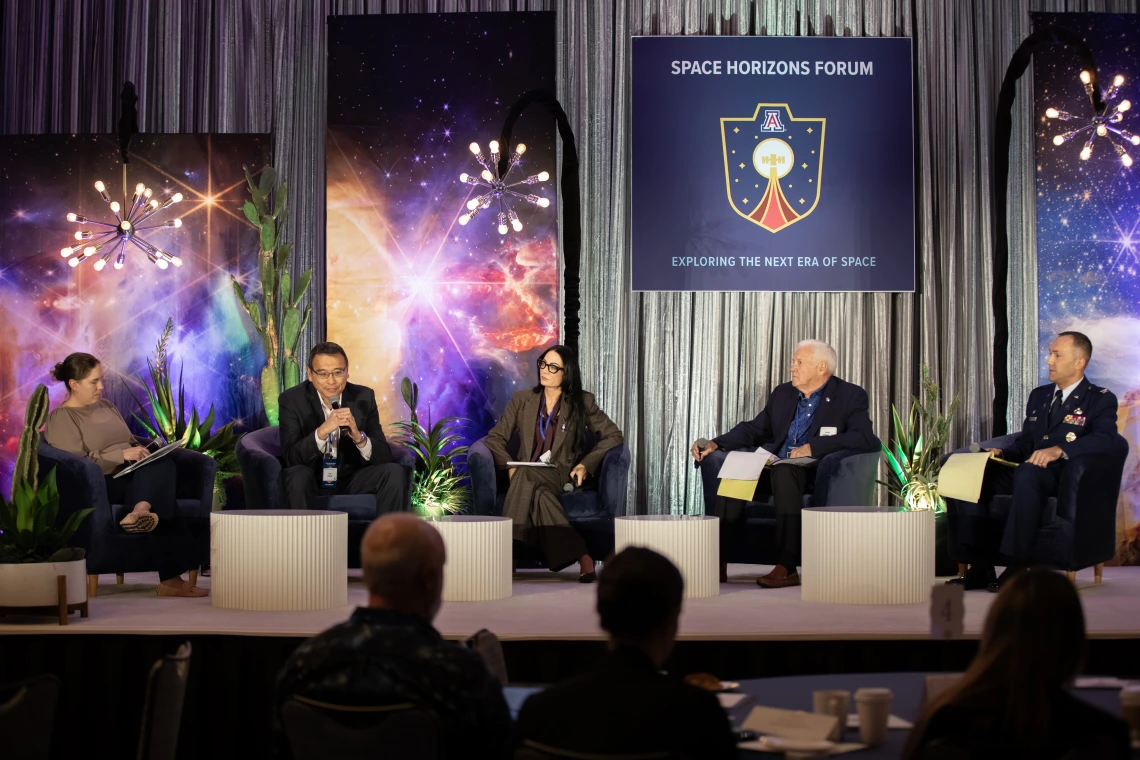
On October 29-30, Tucson hosted the first-ever Space Horizons Forum, bringing together leaders from NASA, the U.S. Space Force, the defense sector, commercial space companies, and universities. The event aimed to explore how these different entities can work together as the lines between them blur.
Former NASA Administrator Jim Bridenstine delivers the opening keynote at the inaugural Space Horizons Forum in Tucson on Oct. 29. Bridenstine, now CEO of Quantum Space, said a secure space environment is what makes human spaceflight and lunar missions possible.
Photo by Leslie Hawthorne-Klingler
Jim Bridenstine, CEO of Quantum Space and former NASA Administrator, joined with other key figures, including U.S. Space Force Chief Science Officer Stacie Williams and U.S. Rep. Juan Ciscomani, at the forum. The discussions, featuring speakers from NASA’s Jet Propulsion Laboratory and the Air Force Research Laboratory, centered on future space exploration and security.
University of Arizona President Suresh Garimella remarked, “The capabilities that once belonged only to governments and nations are now built by companies and increasingly by universities and our students.” He highlighted the University’s history in space excellence and the importance of collaboration across sectors.
Organized by the U of A Office of Research and Partnerships, the forum examined the interplay between government, industry, and academia in space exploration, technology development, and national security.
In his keynote address, Bridenstine emphasized, “The U of A is like another NASA center. When students partner early with government and industry to achieve outcomes on behalf of NASA, it puts us in a position where the incoming space workforce has hands-on experience.”
Tomás Díaz de la Rubia, senior vice president for research and partnerships, stated, “We’re bringing all of this together: the science we do, where the commercial space sector is heading, and what the government needs from us.”
Back to the Moon
Associate Professor Dani DellaGiustina from the Lunar and Planetary Laboratory led a panel on the U.S.’s reliance on international and commercial partners for lunar missions. The panel noted that NASA’s accelerated mission schedule allows for simultaneous missions, offering training opportunities for the workforce.
Panelists discussed robotic missions as a means to lower risks and costs for crewed lunar exploration.
The Future of Space Defense
U.S. Space Force Chief Science Officer Stacie Williams (left) discusses space defense during a fireside chat with retired Air Force Maj. Gen. DeAnna Burt.
Photo by Leslie Hawthorne-Klingler
During a discussion with retired Air Force Maj. Gen. DeAnna Burt, Williams highlighted key growth areas such as data fusion and nuclear propulsion. The Space Force’s use of commercial capabilities “enables us to free up our very precious science and technology dollars,” she noted.
The “Future of Space Defense” panel at the Steward Observatory focused on shared infrastructure training among military, commercial, and academic operators to maintain resilience in space. Panelists underscored the need for strategic passive defenses and AI-driven autonomy in orbit.
Industry and Workforce Development
Retired Maj. Gen. Michele Edmondson, advising the Kyl Institute for National Security, stressed the importance of investing in the people who will lead future space endeavors. The “Private Sector in Space” panel, led by Regents Professor Dante Lauretta, explored the role of commercial companies in a sustainable space economy.
Discussions included in-orbit data processing and spacesuit mobility, emphasizing the need for private investment to drive the space economy while providing value to Earth.
Erika Hamden (left), director of the Arizona Space Institute, and Regents Professor Dante Lauretta, director of the Arizona Astrobiology Center and principal investigator of NASA’s OSIRIS-REx mission, emcee the Space Horizons Forum.
Photo by Laine Kowalski, U of A Office of Research and Partnerships
Panelists urged universities to prepare students for an industry where success requires both innovation and resilience in the face of failure.
Academia as a Connection Point
Moderated by Erika Hamden, Director of the Space Institute, a university-focused panel encouraged academic institutions to prioritize student involvement despite funding delays. They advocated for strategic partnerships and flexible mission funding.
Jonathan Lunine from NASA’s JPL highlighted an ambitious future for planetary exploration but warned of potential funding gaps. He emphasized the need for stronger partnerships and flexible funding.
The forum concluded with a keynote by Lauretta and discussions on quantum sensing and lunar infrastructure. Lauretta noted, “We’re looking at science, defense, industry and higher education, and we see how much the future of space security depends on bringing these different perspectives together.”
A version of this story originally appeared on the Office of Research and Partnerships website.
Read More Here





Comments are closed.