
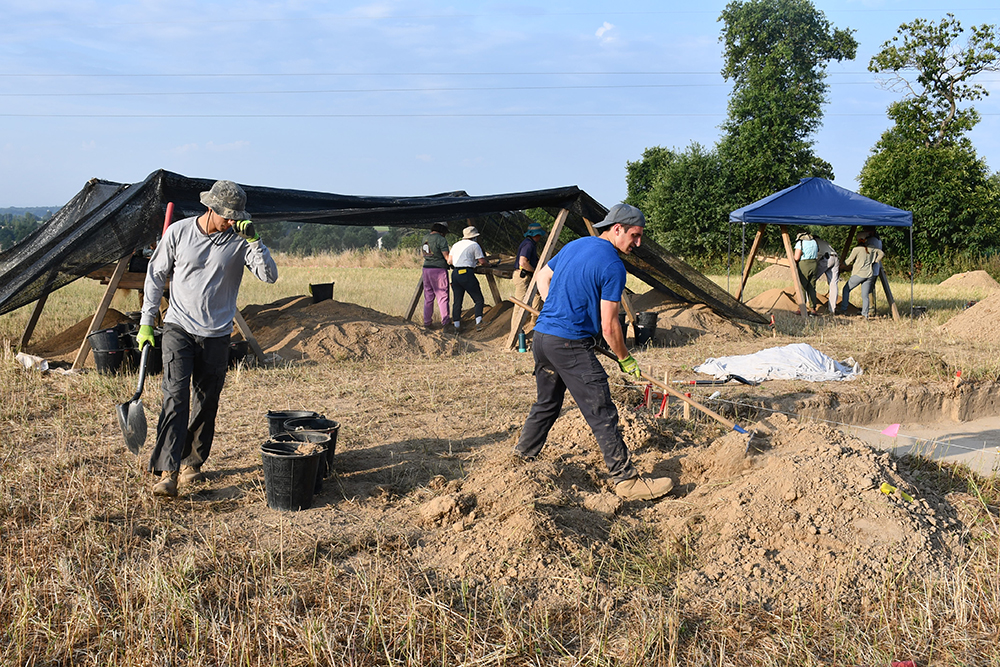
In the historical fields of France, four ROTC students embarked on a mission that was as much about closure as it was about discovery. Amidst a summer heat wave and far from the usual tourist spots, these individuals labored meticulously, not in search of treasure, but to piece together fragments of a past era and provide long-awaited answers to families of World War II soldiers lost and never recovered.
Collaborating with archaeologists and students from Texas State University, their project was part of a broader mission supported by the Defense POW/MIA Accounting Agency (DPAA), involving all three major Arizona universities. Rich Ingleby, the founder of the Arizona Center for the Missing in Action, emphasized the importance of this mission, highlighting the nation’s commitment to bring home every fallen comrade: “There are still families out there across the country today that remember their Second World War or Korean War relatives and are hoping for them to one day finally come home,” he stated.
The mission saw Northern Arizona University’s cadets, including Paul Petersen, Alexandro Alvarez, Talan Lee, and Eric Millis, engage in this poignant task. Petersen, a mechanical engineering major aspiring to be a pilot, reflected on the experience, “It was definitely hard work, but the mission was vital to all of us.”
Mission Origins and Development
Rich Ingleby initiated the Arizona Center for the Missing in Action in 2025 following a revelatory mission to Poland. His efforts, alongside University of Arizona archaeologist Jesse Stephen, caught the attention of the Arizona Board of Regents, who supported expanding the initiative to include all state universities. Regent Jim McCain, inspired by his father’s military service and personal history, expressed pride in the students’ dedication to honoring military commitments.
NAU’s mission involved cadets from various disciplines under the guidance of senior ROTC instructor Nathan Hoepner, who noted the cultural and historical insights gained through such travel experiences.

Petersen’s journey began with a cryptic invitation from his commander, leading to a full immersion in French culture and teamwork with Texas State University students. This experience was not only physically demanding but also a profound exercise in historical empathy.
Arizona State University students recently completed a similar mission in Poland, while University of Arizona students, along with one from Embry-Riddle Aeronautical University, conducted missions in Germany.
The Work on the Ground

The mission involved systematic excavation of a field with an aim to uncover evidence of downed aircraft and missing crew members. Each discovery, from fragments of aluminum to personal items, served as a solemn reminder of the mission’s gravity, as described by Ingleby: “Then, every once in a while, a piece of osseus material—something that would excite you for a half-second because you found what we were really looking for, but then the weight of what you were holding would hit and things become pretty somber.”

Post-discovery, artifacts were sent to DPAA labs for analysis, a process that enriches students’ education beyond traditional classroom settings. According to Ingleby, these missions offer a unique form of education, imparting lessons of personal growth and national service, while also addressing the DPAA’s resource limitations in recovering missing WWII soldiers.
Heidi Toth | NAU Communications
(928) 523-8737 | heidi.toth@nau.edu
Read More Here




Comments are closed.