Imagining life on distant planets often brings to mind images of highly advanced civilizations. However, a recent study challenges this notion by suggesting that planetary evolution may not solely rely on time but also on plant energy.
Led by Chris Doughty, a professor of ecoinformatics at Northern Arizona University, the study explores how life on exoplanets might be less advanced than previously thought. Despite some exoplanets being billions of years older than Earth, their evolutionary progress could be hindered by less favorable conditions for photosynthesis.
Understanding Planetary Evolution
“Physicist Enrico Fermi famously asked, given the high likelihood of intelligent life in the galaxy, ‘Where are they?’” Doughty stated. “This paper suggests that our exoplanet stellar neighborhood may be quiet because most Earth-like planets near us are likely to be evolutionarily behind us and still at the microbial stage.”
Published on Sept. 22 in the International Journal of Astrobiology, the study posits that cumulative plant energy plays a critical role in a planet’s evolutionary timeline. While warm, wet environments on Earth support diverse life, similar conditions may not exist on older, colder exoplanets, potentially stalling their biological development.
The Role of Photosynthesis
Coauthor Michael Gowanlock, an associate informatics professor at NAU, explained, “If photosynthetic life evolved on these planets, that life has been photosynthesizing for potentially billions of years longer than on Earth. However, the total annual photosynthesis is likely lower because there is less light and half the planetary surface area available for photosynthesis.”
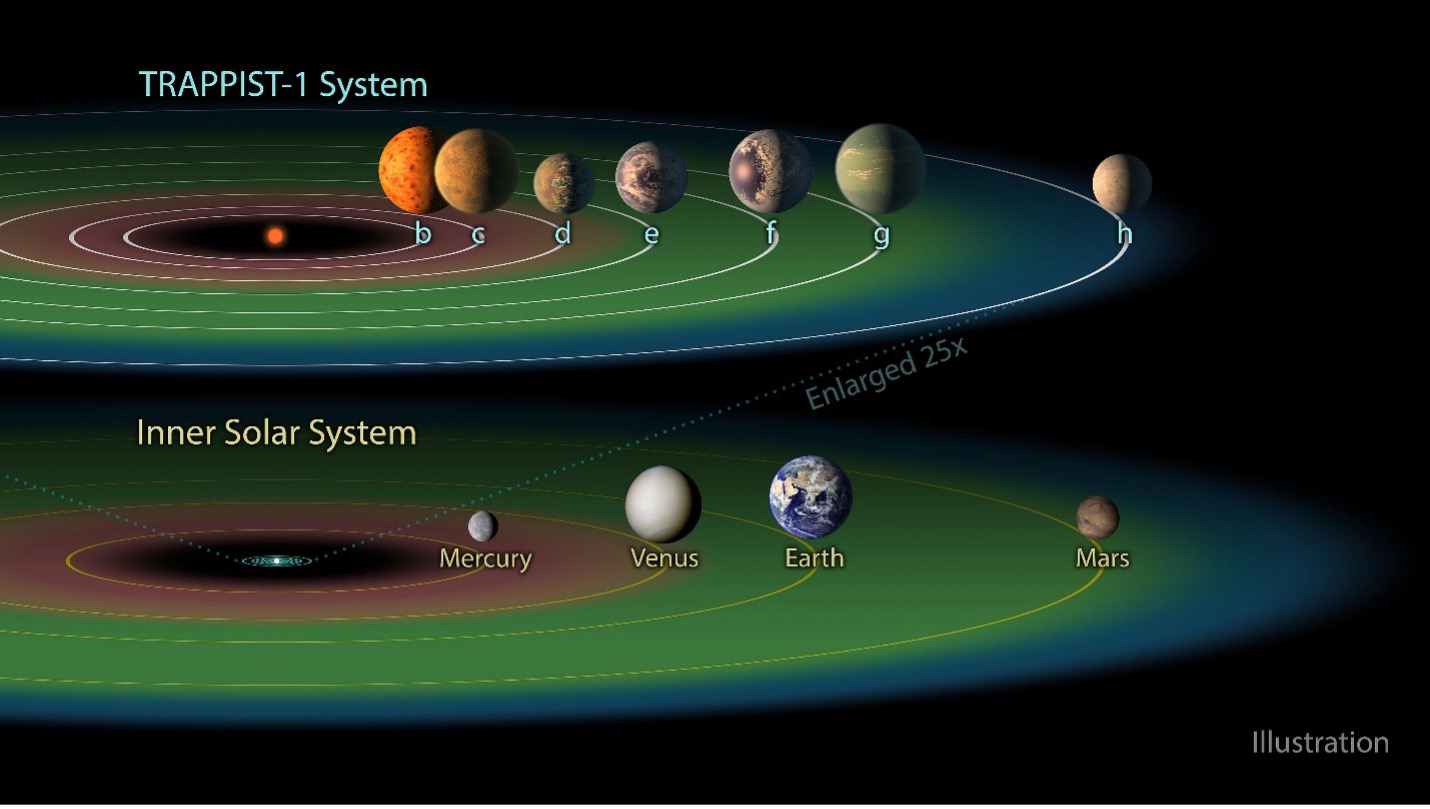
Recent simulations by Denis Sergeev from the University of Bristol modeled climate patterns on exoplanets to predict potential plant growth. Using these models, researchers assessed evolutionary rates for TRAPPIST-1e and 28 other nearby exoplanets, considering factors like temperature, light, and precipitation.
Comparing TRAPPIST-1e and Earth
On Earth, the evolution of efficient vascular plants significantly increased carbon fixation. In contrast, TRAPPIST-1e, despite its age, has fixed only 21% of Earth’s carbon. “Since this is less than the Earth had fixed before the evolution of more efficient vascular plants, we estimated that TRAPPIST-1e may only be at the microbial stage of evolution,” noted coauthor Cameron Hrabak, an NAU alumnus.
Among the 29 exoplanets examined, only two, GJ 1061c and K2-3d, potentially harbor life forms more advanced than those on Earth. Meanwhile, three others might be in a stage similar to Earth’s Mesozoic era.
The team emphasized that these are estimates, not definitive conclusions. Future observations with the James Webb Space Telescope could refine these predictions by providing additional data on exoplanet atmospheres.
Future Prospects and Alien Life
This research methodology could shed light on evolutionary constraints that influence life on exoplanets potentially more advanced than Earth. Similar to Earth, where ecosystems vary from deserts to tropical forests based on environmental factors, exoplanets might also have unique ecological characteristics.
“To use two pop culture references, the ecological characteristics that shape advanced life on those exoplanets might be more ‘Dune’ than ‘Avatar,’” Doughty remarked.
For more information, contact Heidi Toth at NAU Communications: (928) 523-8737 or heidi.toth@nau.edu
Read More Here