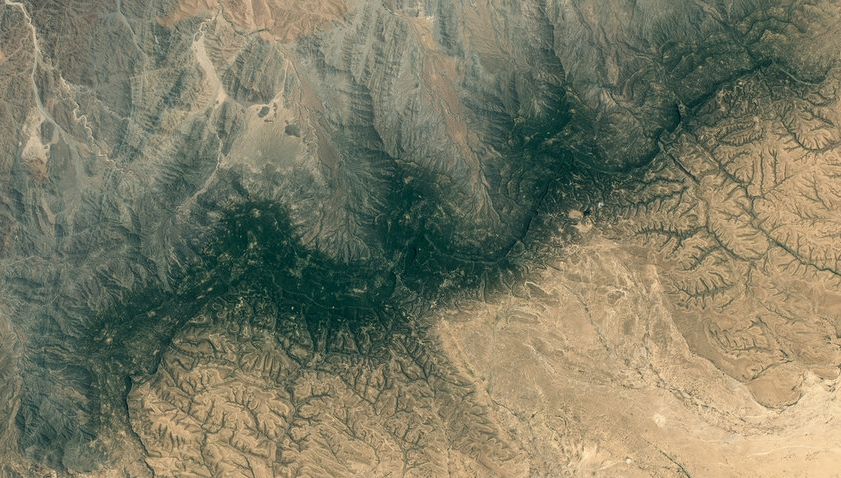
Rising Instability in Dryland Ecosystems Threatens Agricultural Dependence
Drylands, covering 40% of the Earth’s terrestrial surface and supporting over two billion people, are exhibiting increasing instability, according to a recent study published in Nature Climate Change. The research, utilizing satellite data from the past four decades, reveals that although atmospheric carbon dioxide has encouraged plant growth during wet periods, significant instability arises during dry years.
Researchers from the University of Arizona, led by Wen Zhang, a doctoral student in the School of Natural Resources and the Environment, have analyzed satellite data to assess changes in the vegetation leaf area index, a key indicator of plant activity and productivity. Their findings indicate that approximately 80% of global drylands are undergoing increased instability.
“The upper and lower extremes are getting farther and farther apart as time goes by,” Zhang explained. “Vegetation activity is increasing during wet years, but dry years are hitting plants harder. It’s a bit like the nursery rhyme about the little girl with the curl: When it’s good, it’s very good, but when it’s bad, it’s awful.”
The study suggests that this volatility may result from a combination of rising atmospheric carbon dioxide levels and rainfall variability. Zhang pointed out that while high atmospheric CO2 levels might enhance plant water efficiency, enabling more leaf growth, this can lead to larger plants that require more resources, making them more vulnerable during drought conditions.
Challenges for Rain-Fed Agriculture and Ecosystems
The increased year-to-year variability in dryland productivity has significant implications for rain-fed farming, particularly in regions such as the American Southwest. Farmers may need to rely more heavily on artificial irrigation to sustain agricultural output, while unpredictable pasture yields could affect livestock production and rangeland management.
“Higher variability in forage production presents a significant challenge for rangeland managers,” noted Bill Smith, the study’s senior author and an associate professor specializing in geospatial analysis of land, water, and climate change. “Ranchers depend on stable forage production so they can accurately plan out their land needs each growing season. Less predictable forage production can thus disrupt their plans with potential detrimental consequences to livelihoods.”
David Moore, a study co-author and professor in watershed management and ecohydrology, cautioned that these fluctuations might signal broader ecological changes. “If you look at lots of different ecological systems, their productivity tends to flicker on and off right before a big change happened. It’s a sign that they’re under stress and losing their resilience. It’s possible that’s what’s happening with drylands,” he said.
Limitations in Current Vegetation Models
The research also highlights a significant gap in global vegetation models, which have not adequately captured the observed increase in year-to-year variability. An evaluation of 13 leading models showed they failed to account for the dynamic changes in dryland plant responses.
“The models assume drylands are still stable and that plants will respond to changes in atmospheric carbon dioxide and rainfall in predictable ways,” Zhang said. “They fail to account for how plant responses are fundamentally changing over time.”
This oversight in modeling poses challenges for predicting climate change impacts on ecosystems globally. Smith emphasized the importance of addressing this gap, stating, “If Earth system models are not correctly capturing the sensitivity of dryland plants to climate change, then all bets are off when making projections 50 years into the future. We hope this paper inspires new research focused on a better understanding and representation of drylands in the Earth system.”
Read More Here