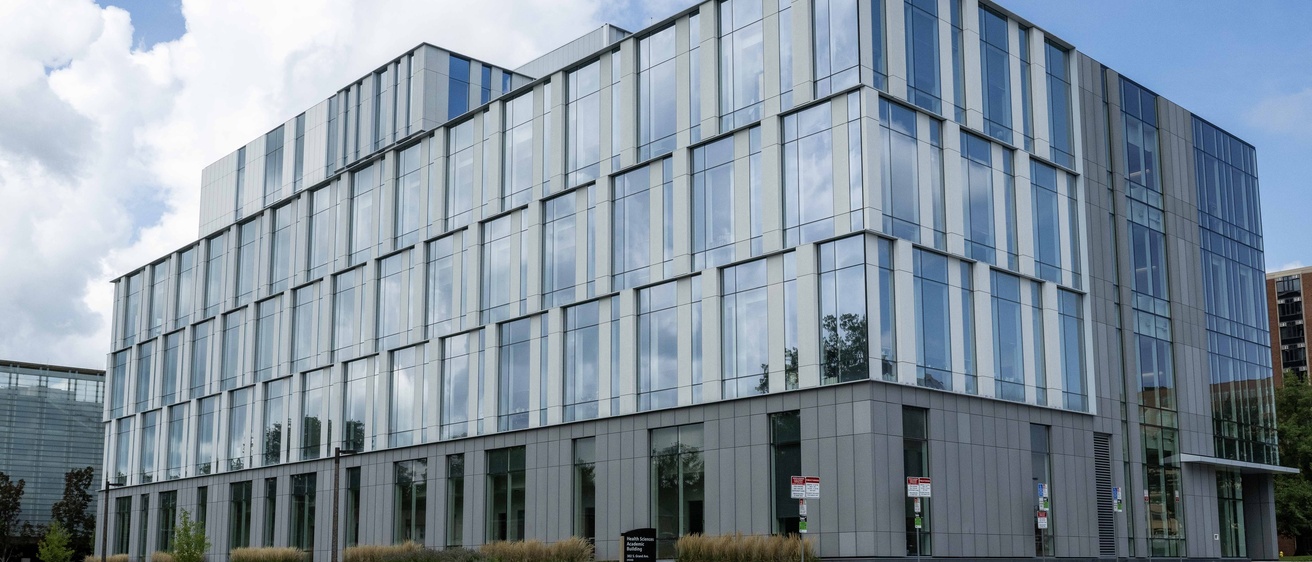
The University of Iowa marks a significant milestone with the opening of its Health Sciences Academic Building, a modern facility poised to enhance learning, research, and community service. This state-of-the-art building is home to three of the university’s most prominent programs, each contributing to the health and well-being of Iowans and beyond.
Health Sciences Academic Building Dedication
The University of Iowa will host a ceremony at 3 p.m. Wednesday, Sept. 2, at the Health Sciences Academic Building, 302 S. Grand Ave., to dedicate the building. All are welcome to attend.
Situated at the intersection of South Grand and Melrose avenues, just south of Slater Residence Hall, the Health Sciences Academic Building provides a unified space for the departments of Communication Sciences and Disorders, Health, Sport, and Human Physiology, and Physical Therapy and Rehabilitation Sciences. The building reached substantial completion in 2025, with final touches done by summer 2026, allowing for phased occupation by the departments.
Enhanced Facilities for Education and Innovation
Eric Hunter, the executive officer for Communication Sciences and Disorders, highlights the immediate benefits of the new environment, noting that the department’s relocation from the Wendell Johnson Speech and Hearing Center—scheduled for demolition—has fostered better collaboration and interaction among faculty, students, and clinicians.
“The Health Sciences Academic Building has transformed the way we teach, conduct research, deliver clinical care, and interact with one another,” Hunter states. The building’s design encourages informal collaboration, with modern clinical spaces and a rooftop adaptive play area enhancing educational and community engagement opportunities.
Rich Shields, head of the Physical Therapy and Rehabilitation Sciences department, comments on the growth the new space supports, with student numbers nearly doubling over two decades. Shields praises the new student lounge for providing a central place for students to connect, study, and collaborate, a feature previously unavailable due to dispersed locations across campus.
The facility also boasts cutting-edge technology, including an AI-based suspension system for research in various areas like amputation and fall prevention. This equipment mirrors that found in top rehabilitation clinics nationwide, offering students hands-on experience with industry-standard tools.
Gary Pierce, leading the Department of Health, Sport, and Human Physiology, notes the department’s expansion since its inception in 2010. Now serving over 2,600 undergraduates and 100 graduate students, the department benefits from new teaching labs equipped with advanced technology, including a dedicated food and nutrition science lab.
A Vision for the Future
Pierce emphasizes that despite past space constraints, the department’s growth demonstrates the demand for high-quality educational experiences and research opportunities. The new facility is expected to enhance recruitment efforts and prepare students for careers in health sciences and sport management.
Hunter is optimistic about the future, expressing hope that the building will support the department’s legacy in speech-language pathology and audiology. “Prospective students and faculty immediately see a department investing in its future while honoring its remarkable history,” Hunter remarks.
Shields adds that the building’s operational efficiencies will enable deeper investments in research and collaboration, furthering the mission to advance rehabilitation science. “Our success reflects strong leadership and support around us, including the vision that made this new space possible,” Shields asserts.
Collaboration and Shared Goals
Shields appreciates the proximity to other departments, which facilitates collaborative research and shared learning opportunities. “Being in close proximity creates new opportunities to formalize research collaborations,” he says, highlighting the potential for interdisciplinary initiatives.
Pierce echoes this sentiment, anticipating productive discussions among faculty and students across departments. He envisions joint research seminars and professional development activities that leverage the shared space.
Hunter concludes that the building’s design fosters spontaneous interactions that can lead to significant collaborations, emphasizing the value of relationships built within the Health Sciences Academic Building. “The building’s greatest contributions won’t simply come from the technology inside it but from the relationships it helps foster among people passionate about improving health and quality of life,” he states.
Read More Here