Trump Administration Boosts Mining Education with $180 Million Grant
In a significant move to bolster the U.S. mining sector, President Donald Trump announced $180 million in grants during an August 7 roundtable at the Department of State. This initiative includes a $100 million Department of Energy program designed to enhance the critical minerals workforce and domestic supply chain.
“Today we are taking another historic action toward the future of American mining,” President Trump stated, highlighting the decline of mining schools crucial for the industry’s future leaders.
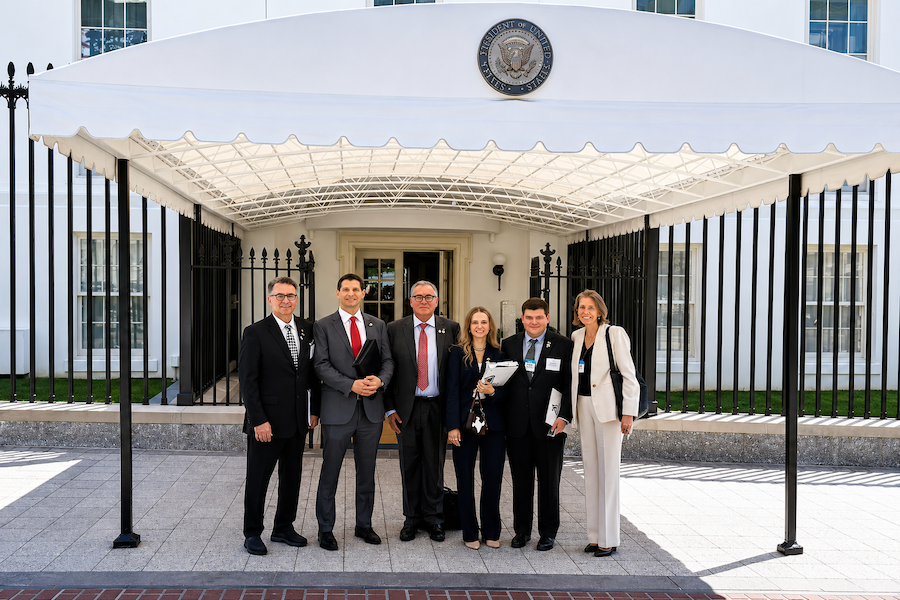
University of Arizona representatives, including Tomás Díaz de la Rubia, Kray Luxbacher, Moe Momayez, and students Alexandra Zadro and Esteban Garza, participated in the roundtable. Luxbacher emphasized the role of American mining schools in achieving mineral dominance, stating, “In order to achieve American mineral dominance, we really need technology and talent, and your American mining schools are ready to get to work.”
The Department of Energy is launching PROSPECT – Providing Opportunities for Specialized Education in Critical Technologies – intending to double the number of graduates from the 14 accredited mining schools in the U.S. Furthermore, an additional $80 million has been allocated to the Colorado School of Mines, South Dakota School of Mines, and Johns Hopkins University by the Department of War.
A previous roundtable at the Old Eisenhower Executive Office Building included senior administration leaders and industry representatives discussing mining education and workforce development. University of Arizona attendees included Díaz de la Rubia, Garza, Luxbacher, Momayez, and Zadro.
Luxbacher organized the inaugural U.S. Mining Summit in April 2025 to address the industry’s workforce needs amid rising mineral demand.
The Society for Mining, Metallurgy and Exploration projects that over half of the mining workforce, approximately 221,000 workers, will hit retirement by 2029.
“PROSPECT gives us a once-in-a-generation opportunity to reinvent how we discover, extract and process critical minerals,” Díaz de la Rubia remarked. He noted that technologies such as AI and robotics are transforming the industry, and the University of Arizona is preparing students to lead this change.
The University of Arizona has appointed Robert J. Bodnar to lead its new mining institute, which aims to support and accelerate mining-related innovation and workforce development.
Critical minerals, including copper, silicon, nickel, and zinc, are vital to industries like aerospace and clean energy. The Department of Energy reports that more than 80% of the U.S. supply of these minerals is imported.
U.S. Secretary of Energy Chris Wright highlighted the importance of a domestic mining workforce, stating, “A strong domestic mining and minerals workforce is essential to powering America’s future, strengthening our national security, and ending our dependence on foreign adversaries for the materials that underpin modern energy, manufacturing, and defense.”
University of Arizona’s Initiatives in Mining Education
Since joining the University of Arizona in 2022, Luxbacher has worked with partners to expedite mining training. Her latest project, MiningWerx, serves as a national hub for mining education, featuring a hands-on training facility at the San Xavier Underground Mining Laboratory.
Momayez commented on the importance of supporting academic institutions, “If the national agenda is long-term critical mineral security, we have to support the academic institutions training the workforce that makes it happen.”
The Arizona State Legislature awarded $850,000 in October 2025 for a mineral-processing plant at San Xavier Mine, with an additional $3 million from the federal government in February 2026. This plant serves as a training ground for students and industry partners.
“It’s really exciting that mining is getting so much federal attention,” Luxbacher expressed. “It is the first building block in our supply chain.”
Students at San Xavier Mine gain practical experience with industry-standard equipment and processes, integrating classroom learning with real-world applications. Zadro noted the value of this hands-on approach, highlighting the opportunity to work with industry professionals.
With strong industry ties, University of Arizona mining engineering graduates enjoy a 100% job placement rate. Garza, a student involved in the program, emphasized the industry’s dynamic nature and the vast technological opportunities available.
“Being involved with the mining engineering program has its perks,” Garza shared, attributing his success to the program’s encouragement of industry connections. “It has opened doors for me.”
Read More Here