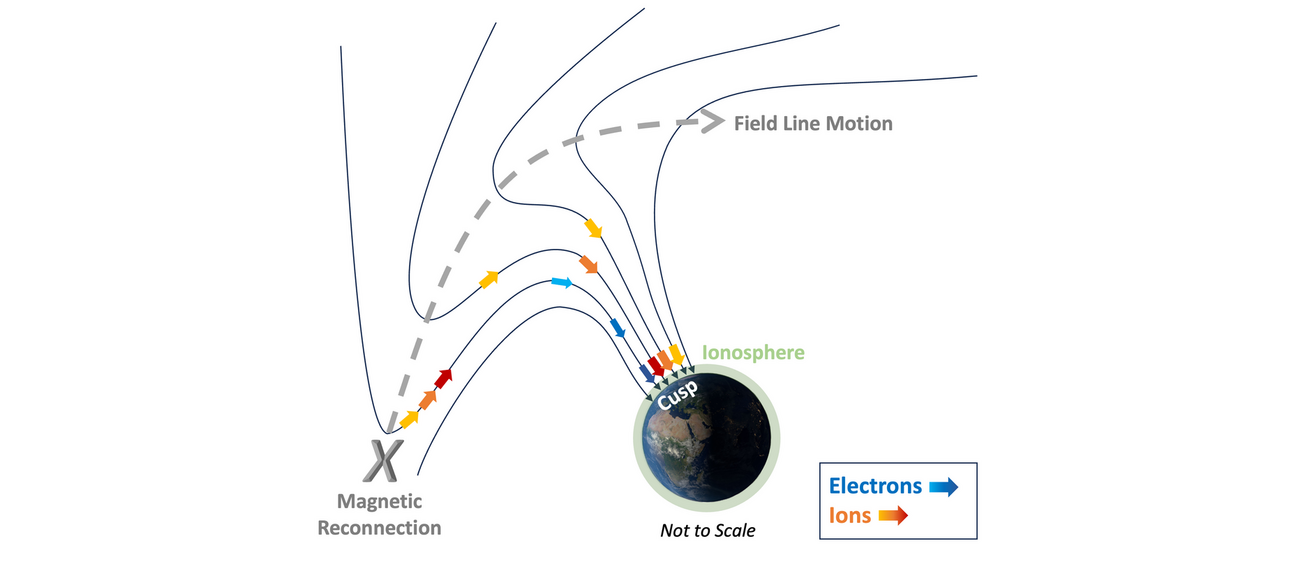
Understanding how solar energy interacts with Earth’s magnetic field is crucial for predicting space weather, which can affect everything from satellite communications to power grids on Earth. In a groundbreaking study, physicists from the University of Iowa have detailed this intricate relationship, shedding light on how the sun’s energy travels and impacts our planet.
Recent research led by the University of Iowa has achieved the most detailed documentation to date of how the sun’s energy affects Earth’s magnetic field. The study focused on the interaction points known as cusps, which are openings allowing solar particles to enter Earth’s ionosphere, acting as conduits for this energy exchange.
Professor Jasper Halekas, a key figure in the study, emphasizes the significance of these findings: “With magnetic reconnection, we don’t really know how it varies at a fine scale. We have a hunch that it’s either varying in time or varying spatially.” The team’s electron measurements have unveiled variations in these processes on small scales, providing insights into the efficiency of solar energy coupling with Earth.
The study is part of TRACERS, a NASA-funded mission worth approximately $170 million, marking the largest external research grant in the University of Iowa’s history. Launched in July 2025, the mission utilizes twin satellites to collect data from low-Earth orbit, focusing on the interactions between the sun and Earth.
Halekas notes the importance of understanding magnetic reconnection: “This is important because magnetic reconnection is how the energy from the sun gets into Earth’s system. It’s important to know the duty cycle of that reconnection — is it happening continuously, or is it sort of turning on and off?”
Electrons play a critical role in this process due to their high speeds and minimal mass. They serve as rapid messengers, signaling magnetic reconnection events occurring about 30,000 miles from Earth and foretelling the subsequent impact near the cusps in Earth’s ionosphere.
“The electrons are saying, magnetic reconnection is taking place way out here, and we’re letting you know that there’s going to be this wave of mass and energy coming to us,” Halekas explains.
The research team utilized data from the Analyzer for Cusp Electrons (ACE) instrument, developed at Iowa, to document 149 cusp encounters by one of the TRACERS spacecraft. Of these, 57 encounters revealed typical electron dispersion signatures at the equatorward edge, the primary point where solar wind energy first contacts the ionosphere.
“The equatorward edge is the leading edge of the cusp, where the solar wind energy and plasma can first reach the ionosphere,” Halekas states. “The electron and ion signatures we see there are the proof we’re seeing the effects of magnetic reconnection.”
The study, titled “Electron dispersion at the electron edge of the Earth’s magnetospheric cusp,” was published on May 19 in the journal Geophysical Research Letters.
Contributing authors from Iowa include Sarah Henderson, Scott Bounds, Aidan Moore, Ivar Christopher, David Miles, Connor Feltman, George Hospodarsky, Allison Jaynes, Brendan Powers, and Shirsh Soni. Additional authors are affiliated with institutions such as the University of Colorado-Boulder, the University of California-Berkeley, the University of Maryland-Baltimore County, NASA Goddard Space Flight Center, and several others.
Read More Here