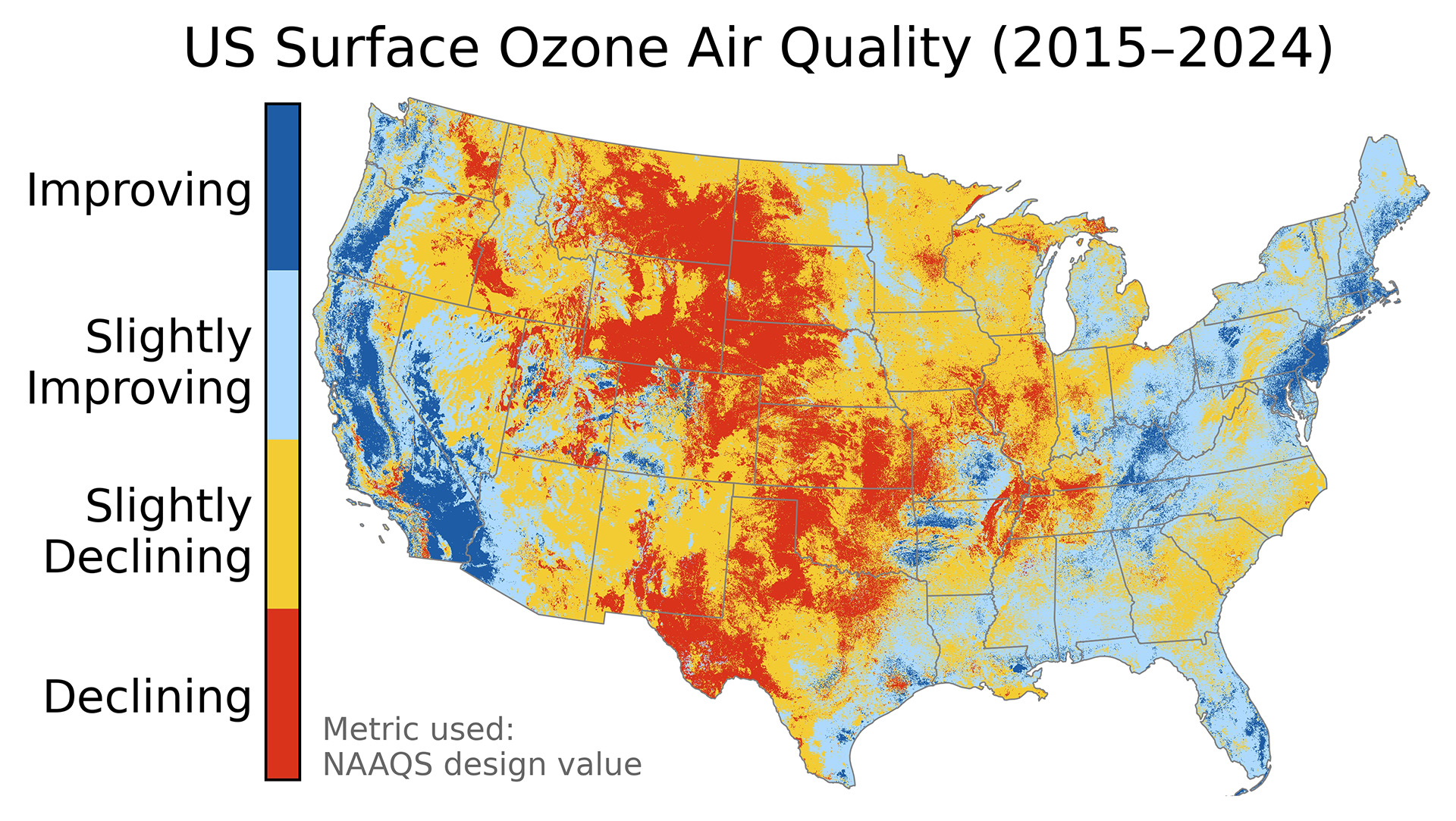
As climate change drives an increase in wildfires, air quality across the continental United States is deteriorating, a new study by researchers from the University of Iowa reveals. Published in the journal Science, the study highlights that the smoke from these fires is significantly impacting regions far removed from the actual blaze sites, leading to hazardous air conditions and posing a risk to public health.
Researchers have identified that exposure to ozone pollution, exacerbated by wildfire smoke, has led to over 300 additional premature deaths annually in the U.S. since 2013. The study notes particularly high figures for premature deaths in the years 2020, 2021, and 2023.
The team utilized a detailed grid analysis to track surface ozone pollution across the U.S. from 2003 to 2024, finding notable deterioration in air quality from 2015 onwards, especially in the Midwest and large areas of the Western U.S. This trend runs counter to previous improvements achieved through reduced automobile emissions, indicating that the rise in wildfire-driven pollution has reversed earlier air quality gains.
The spring of 2026 saw wildfire activity reaching historic levels, with fires blazing across millions of acres from California to Georgia. The formation of surface ozone, a type of smog, is linked to chemical reactions involving carbon monoxide and nitrogen oxide, often originating from wildfires. These pollutants can travel great distances, impacting areas far from the original source.
Jun Wang, a leading author of the study and Lichtenberg Family Chair in Chemical and Biochemical Engineering at the University of Iowa, commented, “The bottom line is the air is getting worse in these regions, and the reason is pollutants are being transported long distances from wildfires in the western U.S. and Canada.”
The study indicates that surface ozone levels in the U.S. have been increasing by 0.13 parts per billion (ppb) annually since 2015, reversing the downward trend observed since 2003. This reversal is attributed mainly to the impact of wildfires.
Weizhi Deng, a key contributor to the study, emphasized, “While U.S. air quality regulations have reduced surface ozone, a pollutant linked to respiratory and cardiovascular diseases, this progress has reversed since around 2015. Wildfire smoke has become a major driver of increasing ozone pollution, especially in the western and midwestern United States.”
The 2023 Canadian wildfires had a significant effect, with surface ozone levels surpassing federal air quality standards for 148 million Americans, or 44% of the population in the continental U.S. This pollution was felt as far as New York, Texas, and Georgia, with the Midwest experiencing unsafe ozone levels for over a week.
In 2023 alone, the study calculated nearly 8,000 premature deaths in the U.S. due to smog. The researchers underscore the growing public health burden of wildfire-driven ozone pollution, which poses a challenge for local authorities.
Wang points out that while the Environmental Protection Agency sets national air quality standards, local and state governments are often tasked with managing air quality issues, even when the pollution originates from distant wildfires. “When air quality is poor — even when the pollution is from elsewhere — the responsibility is on the local or state authority to collect the evidence and then file an ‘exceptional event claim’ to the EPA,” Wang explained.
Utilizing satellite data and around 1,000 ground-based stations, the researchers employed deep learning techniques to analyze and predict surface ozone concentrations, correlating these with premature death estimates. This research echoes findings from a 2023 study, also led by Wang, which documented the impact of wildfires on air quality through black carbon levels.
The study, entitled “Fires reverse progress toward ozone air quality standards in the USA,” was made available online on June 4. Along with co-corresponding author Meng Zhou from NASA Goddard Space Flight Center, the research team included experts from various institutions in the U.S., France, and Germany. Funding for the study was provided by NASA.
Read More Here