
University Students Innovate with Affordable Prosthetic Arm Project
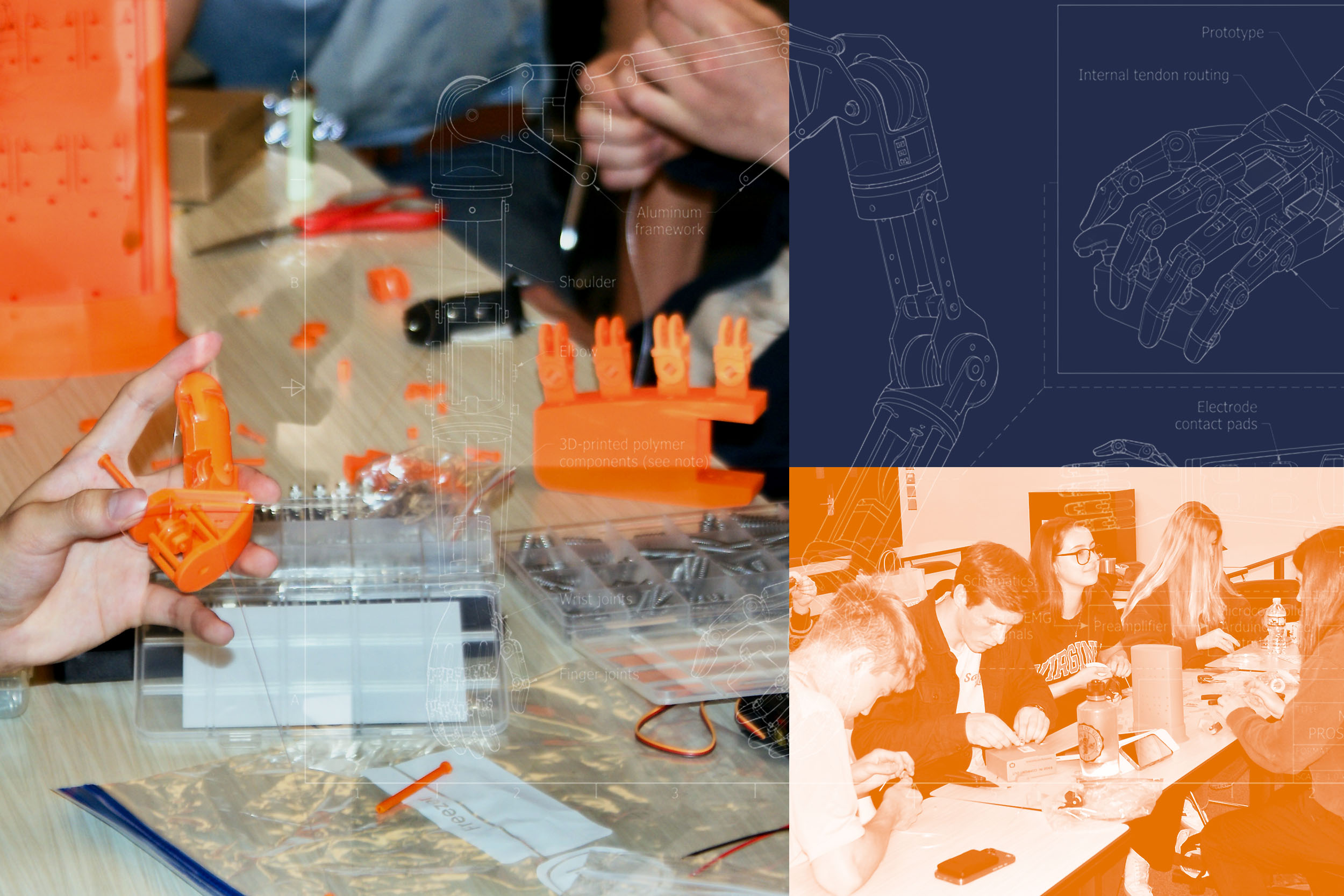
In the heart of the University of Virginia, a group of engineering students is pioneering an ambitious project aimed at creating an affordable prosthetic arm. This initiative, led by the organization Cavalimbs, is in its nascent stages but holds promising potential for those in need of cost-effective prosthetic solutions.
“We’re going through a couple of phases of building a robotic arm that we hope to turn into a prosthetic arm to be able to help people in need – and possibly, in the future, to create something that’s more affordable,” explained Maya Golubkova, a second-year mechanical engineering student and the founder and president of Cavalimbs. “This is a way to have engineers be able to work together, actually applying their skills from the classroom.”
Golubkova, driven by a keen interest in biomedical engineering, found the high cost of prosthetics to be a barrier for many. Together with Emma Camiolo, a second-year civil engineering major, she laid the foundation for Cavalimbs. The initial funding came from Golubkova’s own resources, but a recent grant of $3,335 from the Jefferson Trust has provided a significant boost.
Andrea Seese, associate director of promotions and events for the Jefferson Trust, commented, “The Jefferson trustees liked that this project is student-led, involves students from across the University and has a social entrepreneurship mindset. It was a well-written proposal.”
About 50 students are part of this initiative, with a committed core team of roughly 15. “We all work together,” said Camiolo. “We sit together and talk, and two meetings ago, we were putting together a prototype with all of our 3D-printed pieces. And it’s a lot of fun because you can tell everyone’s really interested, especially the ones who come every time.”
Golubkova highlighted that although they found some designs online, the team preferred to innovate from scratch. “We made all of our own joints, and everything was 3D-printed from scratch,” she stated. “We could look online, and there are a lot of different designs, but we didn’t like any of the ones that we found.”
Each team member contributes to different aspects of the design and construction. Golubkova emphasized, “It’s all our own. I think the whole point of engineering and being an engineering student is to create things from scratch and learn how things work. And I think it was a cheat and a cop-out if we were to just copy something.”
Read More Here


![Robert Harmon Celebrates 99th Birthday at UVA’s Homecomings Weekend[embed]https://www.youtube.com/watch?v=c_VPFnE8x-w[/embed]](https://realnewsfast.com/wp-content/uploads/2026/10/Robert-Harmon-Celebrates-99th-Birthday-at-UVAs-Homecomings-Weekendembedhttpswwwyoutubecomwatchvc_VPFnE8x-wembed-300x200.jpg "Robert Harmon Celebrates 99th Birthday at UVA’s Homecomings Weekend[embed]https://www.youtube.com/watch?v=c_VPFnE8x-w[/embed]")
![Environmental Opera “Auksalaq” Opens UVA’s Arts on the Hill Series[embed]https://www.youtube.com/watch?v=PjYuP9wh3Hw[/embed]](https://realnewsfast.com/wp-content/uploads/2026/10/Environmental-Opera-Auksalaq-Opens-UVAs-Arts-on-the-Hill-SeriesembedhttpswwwyoutubecomwatchvPjYuP9wh3Hwembed-300x200.jpg "Environmental Opera “Auksalaq” Opens UVA’s Arts on the Hill Series[embed]https://www.youtube.com/watch?v=PjYuP9wh3Hw[/embed]")
![New documentary explores Elizabeth Holmes’ final days before prison[embed]https://www.youtube.com/watch?v=GGJSRFWALTI[/embed]](https://realnewsfast.com/wp-content/uploads/2026/10/New-documentary-explores-Elizabeth-Holmes-final-days-before-prisonembedhttpswwwyoutubecomwatchvGGJSRFWALTIembed-300x200.jpg "New documentary explores Elizabeth Holmes’ final days before prison[embed]https://www.youtube.com/watch?v=GGJSRFWALTI[/embed]")