The quest for cleaner energy is driving an increase in solar power installations worldwide, but maintaining these systems presents a new set of challenges. At Carnegie Mellon University, researchers are exploring innovative solutions to keep solar panels operating at peak efficiency.
A common issue faced by solar farms is ‘soiling,’ where dust and other airborne particles settle on solar panels, significantly reducing their ability to absorb sunlight. This problem is particularly acute in arid regions like the American Southwest, India, and Northern Africa’s Sahel, where solar farms are often located.
Space technology meets Earth’s solar needs
Traditional methods of cleaning solar panels involve manual or robotic water-based cleaning, which can be resource-intensive. However, Michael Provenzano, a Carnegie Mellon University alumnus, offers a more cost-effective alternative.
“Soiling is a really big problem, and companies spend lots of money to clean their solar panels,” said Michael Provenzano, a graduate of the Tepper School of Business. Provenzano’s company, Clear Solar, has acquired technology from NASA designed for lunar and Martian missions to remove dust using an electrodynamic dust shield.
This technology proved essential in space missions where dust accumulation can halt spacecraft functionality, as seen with NASA’s Opportunity rover in 2024. Provenzano aims to apply this technology to Earth-based solar panels.
Innovative cleaning methods: Zapping dust away
The cleaning mechanism involves placing thin conductive lines on the glass surface of solar panels, covered by a transparent protective film. When an electrical current runs through these lines, it charges particles on the panel’s surface. Flipping the current’s polarity repels the dust particles.
“It’s cool, you can actually see the dust particles bouncing off of the panel,” Provenzano noted. The system is designed to clean panels daily, utilizing gravity and wind to assist in keeping panels dust-free.
Despite a 1% reduction in energy transmittance, Provenzano argues that the dust shield’s benefits outweigh its costs, estimating a cleaning cost of $0.14 per megawatt of capacity. Clear Solar is conducting pilot projects globally, with field tests starting in July.
Enhancing solar panel reliability

Meanwhile, CMU assistant research professor Stewart Isaacs is exploring the role of wind in cleaning solar panels as part of his work at Carnegie Mellon University in Africa. Isaacs’ research focuses on off-grid solar installations, where reliable performance is crucial.
“In some of the dirtiest locations, dust can actually reduce power output by more than half,” Isaacs said. His work involves computational modeling to predict how soiling affects solar panel efficiency, aiming to optimize cleaning schedules and explore alternative cleaning methods.
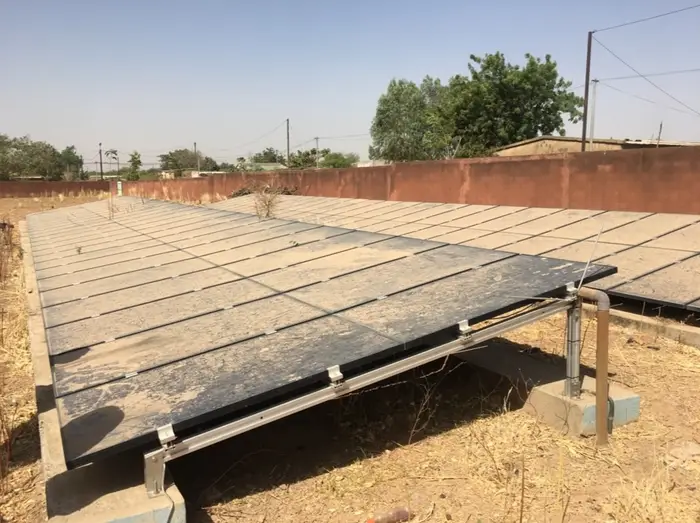
Isaacs is also examining how changes to solar panel design could enhance their ability to shed dust naturally, leveraging wind dynamics for better cleanliness.
Investing in solar’s longevity

Alan Scheller-Wolf, a professor at the Tepper School of Business, emphasizes the importance of maintenance for maximizing the value of solar investments. “These are very expensive machines that you want to have very high utilization on, so you can derive value from them,” he remarked.
Scheller-Wolf advises investors to consider maintenance as part of their investment strategy, as it can extend the lifespan of solar panels and enhance sustainability. “The most efficient thing you can do to make something more sustainable is just use it longer,” he stated, highlighting the broader environmental benefits of prolonged equipment use.
Read More Here